[vc_row][vc_column][vc_column_text]
The Turkish strongman’s offer to mediate in the Kashmir issue is a reflection of his strong ties with Pakistan.
By Abu Turab
The recent visit of Turkish President Recep Tayyip Erdogan to New Delhi, with an appeal to India and Pakistan to start multilateral dialogue for resolving the Kashmir issue was overwhelmingly welcomed by the Pakistani media.
Erdogan, in his pre-visit interview to India’s WION TV channel, asked the two countries to “build bridges, strengthen dialogue between stakeholders” to resolve Kashmir dispute. It was welcomed by Pakistani press as “pleasant surprise” since, it believes, “the international community has tended to stay away from the problem”.
Erdogan reportedly said that both India and Pakistan are Turkey’s friends and they must keep the channels for dialogue open and engage different stakeholders. He said, “India is our friend in the region. Pakistan is our friend in the region. And there are certain aspects that contribute tremendously to our ancient relations. In terms of faith, in India, we have followers of the Muslim faith. And, in Pakistan, there are Muslims and this brings us even closer.
India, however, dismissed the proposal of multilateral dialogue. Gopal Baglay, the spokesperson of the Ministry of External Affairs, said in a veiled reference to Pakistan, that the Kashmir issue has a “prominent dimension of cross-border terrorism” that needs to be stopped by “those who are perpetuating it”. He further elaborated that “our case essentially was that Kashmir is an issue of terrorism that has dogged us for 40 years”.
Describing the reason of its opposition to multilateral dialogue, the spokesperson said, “We are ready to address any issue between India and Pakistan bilaterally through peaceful means as has been stipulated in the Simla Agreement and Lahore Declaration.” India was always ready to talk about Kashmir and all other issues with Pakistan so that “peaceful solutions can be found bilaterally,” Bagley added.
The Karachi-based newspaper Dawn, in its editorial published on May 3, said “President Erdogan showed the statesman’s way forward by broaching the subject of Kashmir with the Indian media ahead of his trip to India.” It advised that “other international leaders should take their cue from the Turkish leader and demonstrate a courageous and principled stand by speaking directly to India about the need for it to move forward on the Kashmir dispute”.
The News International, another Pakistani newspaper published from Islamabad, Lahore and Karachi, in its editorial, said that India’s economic and political clout has made Kashmir a diplomatic minefield and for Erdogan to try to step in, and that too he was about to embark on an important visit to India, took moral courage. It further says that Erdogan’s offer to lead international talks on Kashmir is in keeping with what he said about the disputed region while visiting Islamabad last year, where he took the position that the movement there (in Kashmir) was one of genuine liberation.
Meanwhile, Hindustan Times, in its editorial, while commenting on Erdogan’s adventurist statement on Kashmir, said that Erdogan, a friend of Pakistani Prime Minister Nawaz Sharif, has repeatedly expressed support for Islamabad’s positions over Delhi’s, and this has come in the way of deeper ties between India and Turkey. He has also supported position of Organization of Islamic Countries (OIC) in Kashmir.
It would be interesting to note that Sana Ahmed Sani, a regular author for Pakistan ka Khuda Hafiz (www.pakistankakhudahifiz.com), in her article, Historical overview of Pakistan-Turkey relations, described the issue on November 27, 2016. “Pakistan’s stance on Kashmir conflict is openly supported by Turkey. It also recognises Jammu and Kashmir as part of Pakistan and the Turkish Ambassador spent a week in the capital of Azad Kashmir (what India know as Pakistan-occupied Kashmir (PoK)), Muzaffarabad, to show Turkish solidarity with Pakistan.” She also reminded President Recep Erdogan’s recent address in Parliament when he reportedly said, “We know well the pain and problems of Kashmiris and we condemn the brutality of India in Kashmir.”
Sana further writes, “Turkey also maintained military and political support during the wars with India. …Large number of Turks volunteered to fight for Pakistan against India and a number of nurses to serve Pakistan flew in from there. In December 1965, the then President Ayub Khan visited Turkey and expressed his profound gratitude to the Turkish President Gural for the moral and material support during Indo-Pak war in 1965.”
Turkish Foreign Ministry website says, “positive reflection of the excellent bilateral relations can also be seen in the international fora.” Turkey and Pakistan are supporting each other in all international platforms. Pakistan also adopts a highly supportive approach on international matters, which are of special interest to Turkey.
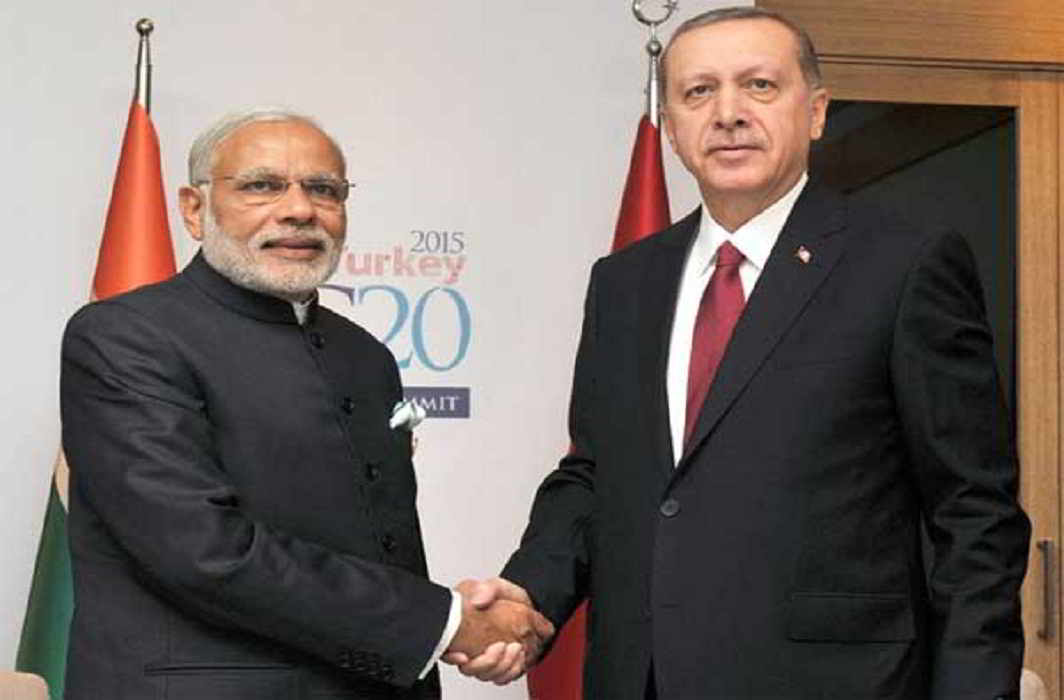
Meanwhile, after his meeting with Prime Minister Narendra Modi, President Erdogan condemned all forms of terrorism. “Turkey will always be by the side of India in full solidarity while battling terrorism,” he said. He condemned the recent terrorist attack on April 24 on CRPF personnel by Maoists in Sukma, Chhattisgarh.
President Erdogan said India was a strategic partner to Turkey because of its location, resources and its economy. The present trade volume between two countries is at around $6.5 billion which should be increased to at least $10 billion as soon as possible, he added. The Turkish President said the two countries will look at ways to expand cooperation in the energy and infrastructure sectors, in particular.
Similarly, Prime Minister Narendra Modi said during their bilateral talks, two leaders took stock of all political, economic and cultural engagements. He talked of encouraging stronger partnership of Turkish companies with Indian government’s flagship programmes.
Analysts believe that President Erdogan’s India visit at a time when Kashmir was experiencing turmoil was of utmost importance. He proposed multilateral dialogue for “resolving” Kashmir issue, which was completely against India’s longstanding policy of Kashmir being a bilateral issue. Even Pakistani media expressed pleasant surprise on Erdogan’s statement proposing multilateral dialogue on Kashmir.
It would be interesting to an eye on the progress in the bilateral economic and trade ties between the two countries. If the intention was just to rake the Kashmir issue on the international arena, then implementation of the memorandums of understanding signed during the visit will experience slow progress. Some analysts believe that Erdogan, in a desire to rise as a towering leader of the region, has thrown his hat into the most vexed issue in the region. He probably wished to project his image as a strong leader among Muslim nations.[/vc_column_text][/vc_column][/vc_row]