
Latest world news
Indonesia: Earthquake-Tsunami Kills 400, Injures Over 500


Electricity supply and mobile network heavily affected
Nearly 400 people have been killed and over five hundred have injured by the earthquake and tsunami that hit Indonesian city of Palu, Central Sulawesi on Friday, the government agency claimed on Saturday.
According to country’s National Disaster and Mitigation Agency (BNPB) spokesman Sutopo Purvo who briefed the media persons on Saturday, at least 384 people are dead, 29 missing and 540 injured.
Jakarta Post quoted Sutopo saying, “Updated numbers of the victims show that 384 people died, 29 are missing and 540 are injured. Donggala is still unreachable because communications are still cut off. A team has been dispatched to the regency.”
He indicated that the number of victims was likely to increase because the rescue teams have yet to reach all affected areas.

“Friday’s earthquake that hit Central Sulawesi was bigger than Lombok’s. It was shallow, only at a depth of 10 kilometers. Moreover, it was followed by a tsunami that damaged areas close to the shore. We believe that the numbers of casualties will increase,” he said.
A string of earthquakes hit the Central Sulawesi regency of Donggala on Friday afternoon, one of which reached 7.4-magnitude on Friday at 6:02 p.m. local time. The earthquake was followed by waves up-to 3 meters high, on parts of Donggala’s coast and Talise Beach in Palu.
Read More: Indonesia quake toll touches 131, hundreds injured, 1.5 Lac homeless
Sutopo said the earthquake had knocked out seven power stations in Palu and Donggala. Two of them were managed to power up Saturday.
The electricity blackout affected mobile phone network across the area making it difficult for people and agencies to gather information from the affected areas.
Sutopo told the media, “Communication networks in Donggala and Palu as well as the areas around it is not working because the electricity is cut off. There are 276 base [network] stations that cannot be used.”

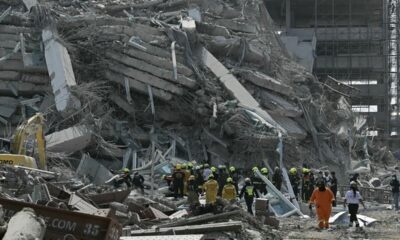
The earthquake also destroyed the biggest shopping mall in Palu along with the iconic Ponulele bridge that connected West and East Donggala.
Read More: Indonesia Earthquake: 91 Killed, Hundreds Injured, Thousands Building Collapsed
The tsunami that followed inundated buildings near the shore and the Pesona Palu Nomoni Festival arena, which was held on Friday evening. “Hundreds of people attended the event, and we still don’t have any news about their fate,” Sutopo said.











Latest world news
S Jaishankar says India is a natural option for Russia amid Europe tensions
External Affairs Minister S Jaishankar said India remained a natural option for Russia as Moscow increasingly turned towards Asia amid strained relations with Europe. He highlighted the continuity of India-Russia ties and their significance for the balance of power in Asia.


Latest world news
Putin praises PM Modi, says he has very good ideas on Ukraine war
Russian President Vladimir Putin has praised Prime Minister Narendra Modi for repeatedly raising the need to end the Ukraine war, describing his ideas for a settlement as “very good”.

Latest world news
S Jaishankar calls Pakistan a “serial practitioner of terrorism” at UN
S Jaishankar criticised Pakistan at the UN General Assembly, referring to a “serial practitioner of terrorism” and warning against attempts to normalise terrorism.


Rahul Gandhi hosts high tea for INDIA bloc after Gyanesh Kumar protests

L Murugan quits Union ministry to strengthen BJP in Tamil Nadu

Amit Shah attacks Rahul Gandhi over Congress poll losses, questions SIR row

BJP focuses on religion as opposition pushes BDM strategy in UP

CJP leaders Saurav Das, Ashutosh Ranka, Ajinkya Shinde sent to 5-day judicial custody

PM Modi speaks to Mark Carney as India and Canada push to strengthen ties

S Jaishankar says India is a natural option for Russia amid Europe tensions
CJP leaders Saurav Das, Ashutosh Ranka, Ajinkya Shinde sent to 5-day judicial custody
BJP focuses on religion as opposition pushes BDM strategy in UP
L Murugan quits Union ministry to strengthen BJP in Tamil Nadu

Afghan Men Try To Hang With The Jet Engine Of The Aircraft in Kabul- Afghanistan News – Kabul News
Trending Top 10 News: 10000 Crore Fine on Flipkart, Apple to Launch Unique Feature, Hdfc Bank Job Ad

Trending Top 10 News: Nokia 6310, Apple sales, Bachpan ka Pyar Video Kid, Dainik Bhaskar IT Raid

Trending Top 10 News: Canada bans Indian flights, Rain in Delhi NCR, AIMIM Twitter hacked, Raj Kundra case

Trending Top 10 News: Shein India, Apple New Service, Pocket Oxygen, Oppo Launched New Phone
-
 India News16 hours ago
Rahul Gandhi hosts high tea for INDIA bloc after Gyanesh Kumar protests
-
 India News16 hours ago
L Murugan quits Union ministry to strengthen BJP in Tamil Nadu
-
 India News16 hours ago
Amit Shah attacks Rahul Gandhi over Congress poll losses, questions SIR row
-
 India News15 hours ago
BJP focuses on religion as opposition pushes BDM strategy in UP
-
 India News4 hours ago
CJP leaders Saurav Das, Ashutosh Ranka, Ajinkya Shinde sent to 5-day judicial custody
-
 Latest world news4 hours ago
S Jaishankar says India is a natural option for Russia amid Europe tensions
-
 India News3 hours ago
PM Modi speaks to Mark Carney as India and Canada push to strengthen ties
