English हिन्दी
Connect with us

Latest world news

Modi’s Israel Visit: Memories of a Journalist’s Visits To Jewish State

Published

on

Modi In Israel

[vc_row][vc_column][vc_column_text]By: Saeed Naqvi

Israel has been in the news in the context of the Prime Minister’s visit and I may be forgiven for a touch of nostalgia. I was the first Indian journalist to visit Israel after an Australian fanatic had set fire to the pulpit of the Al- Aqsa mosque in Jerusalem in August 1969. The Arab World was ablaze.

Indian passports in those days were not valid for South Africa, Israel and Southern Rhodesia. Under a special dispensation you could obtain a separate passport for travel to countries with which India did not have diplomatic ties. Israelis were more practical: they pinned a piece of paper for entry and exit which could be pulled out when travelling to other countries.

The reception I received at Ben Gurion airport was the stuff of fairytales for a reporter in his 20s. Never will Jerusalem Municipality have a public relations officer more beautiful than Bathsheba Herman.

Something that had not touched the Israelis then was arrogance. They came across as clever, wise, modest people, working diligently on their Kibbutz, the typically Jewish cooperatives, where inequalities were not discernable. It was possible to contemplate Fa Giladi, the exquisite Kibbutz in the shadow of Mt. Hermon, as the dream location for research on the Palestinian issue.

The simplicity of the people helped tone down shades of Zionism instilled in us and which was the bane of the Palestinian people. Ambassadors like John Kenneth Galbraith held Pandit Nehru in their thrall with their intellect. But during the Indira Gandhi years, changes were creeping across the diplomatic corps. There were various ways to gauge how well informed an Ambassador was. A simple test could be this: was the ambassador a regular fixture at the New Year eve party hosted by Indira Gandhi’s leftist adviser, editor of Seminar, Romesh Thapar. By this and several other criteria the trophy belonged to Clovis Maksoud, Arab League’s first ambassador, articulate, even bombastic, with an unerring eye for New Delhi’s well groomed ladies. His role in sensitizing the New Delhi elite to the intricacies of the Palestinian case must never be underestimated.

Nehru as leader of the Non-Aligned and Afro-Asian bloc obviously had a large constituency among left liberals and Muslims. His charm offensive even on the Arabs worked such magic that Raees Amrohvi, an Urdu poet from Pakistan, was moved to write a quatrain:

“Jup raha hai aaj mala ek Hindu ki Arab

Barhaman zaade mein shaane dilbari aisi to ho!

Hikmat e Pandit Jawaharlal Nehru ki qasam

Mar mitey Islam jispar, kafiri aisi to ho!”

(What a spell this Brahmin has cast on the Arabs

Who now chant his name on their beads.

Look at the magic of this kafir (non-believer);

Believers of the Arab world lie at his feet)

Until 1990s, it was anti intellectual to cast positive light on the Israeli case. When Rajiv Gandhi became Prime Minister in 1984, he was advised by Muslim Congressmen in his vicinity (but totally out touch with the community) not to upgrade relations with Israel because that would adversely affect the party’s Muslim support.

When I argued against this line in the Indian Express, Rajiv had it expanded into an official note. Muslim leaders, such as they were, and the Mullah had shackled the community with issues like Shah Bano, Salman Rushdie, Babri Masjid, Muslim character of Aligarh Muslim University and now relations with Israel. What any backward community needed was employment, education, entrepreneurial help, I wrote.

After Rajiv was assassinated, half way through the 1991 General Elections. P.V. Narasimha Rao upgraded relations with Israel in 1992. There was not a whimper from the community.

Initially, relations were more or less mechanically upgraded. Absence of any real content in the relationship invited Shimon Peres to quip in an interview with me:

“Indo-Israeli relations are like French perfume – to be smelt not drunk.”

The Israel Bathsheba Harman introduced me to soon after the 1967 war, had hardened by the 1993 Oslo accords. But even so one could salve one’s conscience with the thought that Oslo would atleast lead to a two-state solution.

 An episode firmed up my appraisal of the Israeli-Palestinian two-state process.

It was a Shabath lunch, at a friend’s house in Herzilia. Among this very small group happened to a person at one end of the lawn, wreathed in cigarette smoke, a glass of red wine in one hand, rapidly replenished, obviously reveling in the company of three well groomed ladies who had formed an admiring circle around him. It was Prime Minister Yitzhak Rabin, lighting one Kent after another, like Belmondo in a Godard film.

He came across at first a shy man but once he opened up, he was transparent and obviously trustworthy. His approach to Oslo was not at a variance from another loveable Israeli, Yossi Beilin, very much the author of the Oslo accords.

Obsession with survival and security had injected some iron in the Israeli soul, but the Jewish state became hard as nails after the 9/11 wars, Islamophobia, and Ariel Sharon, the Israeli Prime Minister who visited India on the first anniversary of 9/11, just when the war-on-terror rhetoric was being amplified here too.

Sensitive defence deals with Israel begun under Atal Behari Vajpayee were boosted by Manmohan Singh. The Palestinian issue, which was highest priority upto Indira Gandhi, dipped in saliency.

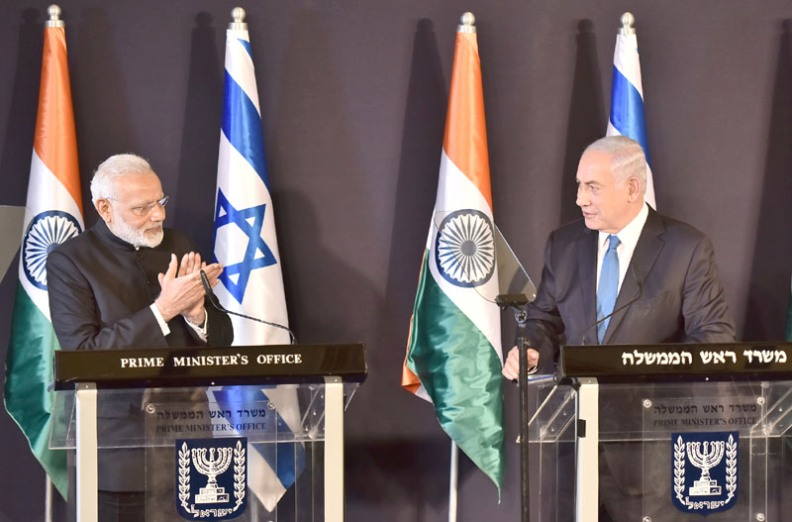
Prime Minister Narendra Modi’s visit, however, is fired by an atavistic Hindutva adoration for a small country on top of its mischievous Muslim neighbors. Ramallah has been bypassed, of course. But it should not be lost on the insiders that during the September non aligned summit in Venezuela the Indian delegation received instructions from South Block, to drop the routine reference to the Palestinian issue altogether. It was a tradition from the earliest days of NAM.

No, Ramallah was not just bypassed; Palestine has been downgraded to the level of irrelevance.[/vc_column_text][/vc_column][/vc_row]

Latest world news

Israel-Lebanon ceasefire to begin within hours as Trump announces 10-day truce

Israel and Lebanon may begin a 10-day ceasefire within hours after a proposal announced by Donald Trump amid ongoing tensions.

Published

on

Donald Trump

A temporary halt in hostilities between Israel and Lebanon is expected to begin within hours after US President Donald Trump announced a proposed 10-day ceasefire between the two sides, amid ongoing tensions in the region.

According to his statement, the ceasefire is likely to take effect around 5 p.m. Eastern Time, although independent confirmation from both sides is still awaited.

The development follows discussions involving Israeli Prime Minister Benjamin Netanyahu and Lebanese President Joseph Aoun, with mediation efforts led by the United States.

Officials indicated that the proposed truce is aimed at creating a limited window to reduce violence and potentially pave the way for broader diplomatic engagement. The situation along the Israel-Lebanon border has remained tense in recent weeks, with escalation linked to the activities of Hezbollah.

Diplomatic efforts have intensified in recent days, with discussions facilitated by the United States, including the involvement of US Secretary of State Marco Rubio. However, details of the agreement and the extent of coordination between the parties remain unclear.

The situation remains fluid, and the success of the ceasefire will depend on adherence by all sides involved. The conflict has already led to significant humanitarian and geopolitical consequences, including displacement and disruption in affected areas.

While the proposed ceasefire is being seen as an important step toward de-escalation, broader negotiations involving regional stakeholders are expected to be necessary for any lasting resolution.

Continue Reading

Latest world news

US ends oil sanctions waiver for Iran and Russia, impact likely on India’s energy imports

The US decision to end the Iran and Russia oil waiver may impact India’s oil imports, fuel prices and global energy markets.

Published

on

US oil tanker

The United States has decided not to extend a temporary sanctions waiver that allowed limited trade in Iranian and Russian oil, marking a shift towards stricter enforcement of economic restrictions.

The waiver, introduced in March 2026, had permitted the sale of oil already loaded on ships to stabilise global supply during heightened geopolitical tensions. However, it is now set to expire around mid-April without renewal.

US officials have indicated that the move is part of a broader strategy to increase pressure on both Iran and Russia amid ongoing conflicts and geopolitical tensions.

What the waiver did and why it mattered

The short-term waiver allowed millions of barrels of oil—estimated at around 140 million barrels—to enter global markets, helping ease supply shortages and prevent sharp price spikes.

It also enabled countries like India to purchase discounted crude oil from Russia and resume limited imports from Iran after years of restrictions.

Impact on India

India, one of the world’s largest oil importers, is expected to feel the impact of the decision in several ways:

  • Reduced access to discounted oil
    India had been buying cheaper Russian crude and recently resumed Iranian imports under the waiver. Its end may limit these options.
  • Potential rise in fuel costs
    With fewer discounted supplies available, India may need to rely more on costlier sources, which could increase domestic fuel prices.
  • Supply diversification pressure
    India may need to explore alternative suppliers in the Middle East, Africa, or the US to maintain energy security.
  • Geopolitical balancing challenge
    The move adds pressure on India to align with US sanctions while managing its own economic interests.

Global energy market concerns

The end of the waiver comes at a time when global oil markets are already under stress due to conflict in West Asia and disruptions in key routes like the Strait of Hormuz.

Analysts warn that tightening sanctions could:

  • Reduce global oil supply
  • Increase price volatility
  • Intensify competition among major buyers like India and China

Bigger picture

The US decision reflects a broader shift from temporary relief measures to stricter enforcement of sanctions, even if it risks tightening global energy markets.

For India, the development highlights a recurring challenge—balancing affordable energy access with geopolitical realities.

Continue Reading

Latest world news

Sanctioned tanker fails to breach US blockade, turns back near Strait of Hormuz

A US-sanctioned tanker failed to cross the Hormuz blockade and turned back, underscoring rising tensions and disruption in global shipping routes.

Published

on

A US-sanctioned oil tanker failed to break through a newly imposed American naval blockade and was forced to turn back near the Strait of Hormuz, highlighting growing tensions in the region.

The vessel, identified as the Rich Starry, reversed its course after attempting to exit the Gulf, according to shipping data. The development comes just days after the United States enforced restrictions on ships linked to Iranian ports.

The blockade was announced by Donald Trump following the collapse of recent diplomatic talks with Iran. The move aims to restrict maritime traffic associated with Iranian trade.

Officials said that during the first 24 hours of enforcement, no vessel successfully crossed the blockade. Several ships, including the sanctioned tanker, complied with instructions from US forces and turned back toward regional waters.

The tanker is reported to be linked to a Chinese company previously sanctioned for dealing with Iran. It was carrying a cargo of methanol loaded from the United Arab Emirates at the time of the incident.

The situation underscores the rising risks in one of the world’s most critical oil transit routes. The Strait of Hormuz typically handles a significant share of global energy shipments, but traffic has sharply declined due to ongoing geopolitical tensions.

The blockade, which applies specifically to vessels travelling to or from Iranian ports, has added further uncertainty for shipping companies, insurers and global energy markets.

Continue Reading

Trending

© Copyright 2022 APNLIVE.com