
Latest world news
Saudi shoots down ‘toy drone’ near Royal Palace in Riyadh


Amidst Yemen’s Houthi Ansarullah’s frequent missile attacks on Saudi Arabia including capital Riyadh, Saudi forces have, on Saturday evening, shot down a toy drone near the royal palace in Riyadh, as videos posted online purported to show the area ringing with heavy gunfire.
Al-Arabia, the official news network, reports that the spokesman of Riyadh police has said that at 19:50 pm on Saturday, one of the security screening points in Al-Khuzama district in Riyadh observed the flight of “a small radio remote control aircraft,” in violation of the regulations in the area.
Read More: Saudi Arabia claims intercepting Yemen’s Houthi missiles
“The personnel at the security point dealt with it according to the instructions in this regard, the official spokesman said. The authorities have also initiated investigation procedures into the incident,” he said. There was no immediate information about any injuries or damage.
 Footage shared on social media appeared to show heavy shooting that lasted for at least 30 seconds, sparking speculation of political unrest.
The UAE based Gulf News reports from Riyadh says that Saudi Arabian security forces said they shot down a “recreational drone” in the capital after online videos showing gunfire in a neighbourhood where royal palaces were located.
The authenticity of the videos could not be verified.
Read More: Saudi Arabia attacks Yemeni capital airport, target drones
Some observers say that due to ongoing tension among Saudi people due to frequent missile attacks by Yemen’s Houthi Ansarullah and the ongoing socio-political transformation led by Crown Prince Mohammed Bin Salman made some people speculating of a possible coup attempt.
The 32-year old prince has also overseen a major military shake-up and royal purge as he consolidates power much beyond wielded by previous rulers.
An unnamed senior Saudi official told a foreign news agency that Saudi Arabia’s King Salman was not in his palace at the time of the incident. “The king was at his farm in Diriya,” the other Riyadh area, the official said.
In October 2017, two security guards were killed by Mansour al-amri, a young Saudi national armed with Kalashinkov rifle who drove up to a gate of the king’s palace in Jeddah. Three others were also wounded in the attack. The royal guards killed the attacker on the spot.
Saudi Arabian authorities have not yet alleged Yemen’s Houthi’s or its internal opponents for flying drone in one of the most sensitive areas of the capital.








Latest world news
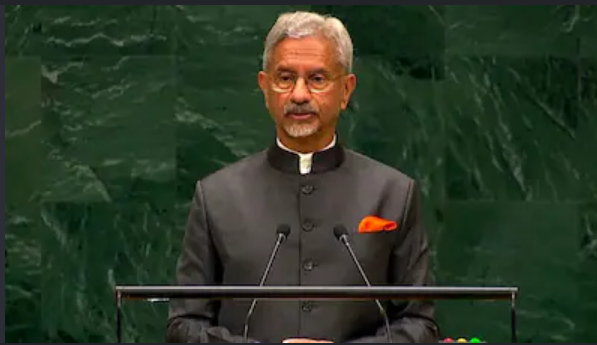
S Jaishankar says India is a natural option for Russia amid Europe tensions
External Affairs Minister S Jaishankar said India remained a natural option for Russia as Moscow increasingly turned towards Asia amid strained relations with Europe. He highlighted the continuity of India-Russia ties and their significance for the balance of power in Asia.


Latest world news
Putin praises PM Modi, says he has very good ideas on Ukraine war
Russian President Vladimir Putin has praised Prime Minister Narendra Modi for repeatedly raising the need to end the Ukraine war, describing his ideas for a settlement as “very good”.

Latest world news
S Jaishankar calls Pakistan a “serial practitioner of terrorism” at UN
S Jaishankar criticised Pakistan at the UN General Assembly, referring to a “serial practitioner of terrorism” and warning against attempts to normalise terrorism.

CJP leaders Saurav Das, Ashutosh Ranka, Ajinkya Shinde sent to 5-day judicial custody

S Jaishankar says India is a natural option for Russia amid Europe tensions

PM Modi speaks to Mark Carney as India and Canada push to strengthen ties

Meerut murder: Muskaan Rastogi and Sahil Shukla get death sentence

Rahul Gandhi joins India Gate protest by Ankita Bhandari’s parents

Supreme Court questions EC over missing records in Sringeri election dispute
Rahul Gandhi joins India Gate protest by Ankita Bhandari’s parents
Meerut murder: Muskaan Rastogi and Sahil Shukla get death sentence
PM Modi speaks to Mark Carney as India and Canada push to strengthen ties
S Jaishankar says India is a natural option for Russia amid Europe tensions

Afghan Men Try To Hang With The Jet Engine Of The Aircraft in Kabul- Afghanistan News – Kabul News
Trending Top 10 News: 10000 Crore Fine on Flipkart, Apple to Launch Unique Feature, Hdfc Bank Job Ad

Trending Top 10 News: Nokia 6310, Apple sales, Bachpan ka Pyar Video Kid, Dainik Bhaskar IT Raid

Trending Top 10 News: Canada bans Indian flights, Rain in Delhi NCR, AIMIM Twitter hacked, Raj Kundra case

Trending Top 10 News: Shein India, Apple New Service, Pocket Oxygen, Oppo Launched New Phone
-
 India News22 hours ago
CJP leaders Saurav Das, Ashutosh Ranka, Ajinkya Shinde sent to 5-day judicial custody
-
 Latest world news22 hours ago
S Jaishankar says India is a natural option for Russia amid Europe tensions
-
 India News21 hours ago
PM Modi speaks to Mark Carney as India and Canada push to strengthen ties
-
 India News11 hours ago
Meerut murder: Muskaan Rastogi and Sahil Shukla get death sentence
-
 India News10 hours ago
Rahul Gandhi joins India Gate protest by Ankita Bhandari’s parents
-
 India News10 hours ago
Supreme Court questions EC over missing records in Sringeri election dispute
