English हिन्दी
Connect with us

Latest world news

Turkey and Syria witnesses another earthquake of 6.4 magnitude weeks after fatal quake

As per the reports, the epicenter of the recent earthquake of 6.4 magnitudes was near the southern Turkish city of Antakya and was also felt in various regions of Syria, Egypt, and Lebanon.

Published

on

Turkey earthquake

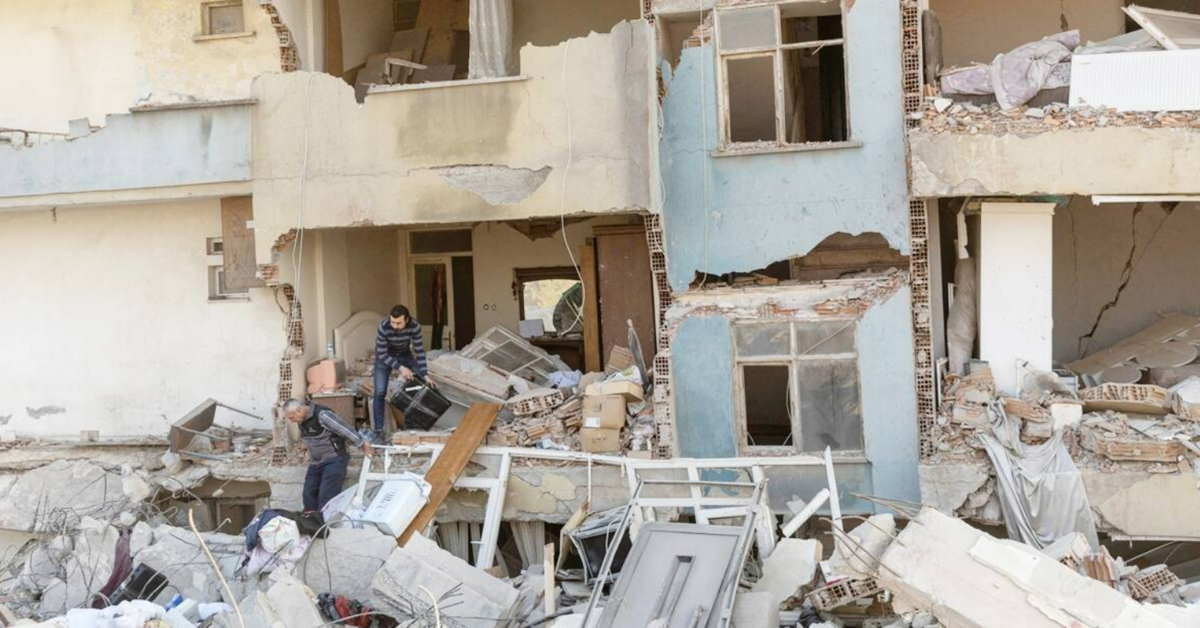
Weeks after Turkey and Syria witnessed the fatal earthquake which claimed the lives of more than 40 thousand people, another earthquake of 6.4 magnitudes shook up the nation.
The tremors were felt in the southern region of Turkey’s Hatay on Monday evening and led to several deaths and various injuries.

The earthquake comes after the fatal earthquake of 7.8 magnitudes that struck Turkey’s southeastern Kahrmanmaras region on February 6. The February 6 earthquake was subsequently followed by up by 40 aftershocks which led to building falling and collapsing as people get stuck or even die stuck in the debris.

As per the reports, the epicenter of the recent earthquake of 6.4 magnitudes was near the southern Turkish city of Antakya and was also felt in various regions of Syria, Egypt, and Lebanon. Reports by the European Mediterranean Seismological Centre suggest that the quake registered at a depth of 10 km.

Read Also: Police arrest Samajwadi Party leader for helping gangster’s son Abbas Ansari, wife in jail

The recent incident of the earthquake reportedly resulted in the deaths of 6 whereas 300 others were injured due to the earthquake. It was also reported that the rescue team had to carry out several operations to pull out people who were trapped in a building as a result of the latest tremors.

Recently, the National Disaster Response Force personnel made their way back to India after being deployed in disaster-hit Turkey. The Indian rescue and medical teams were deployed to various regions of turkey as assistance aid. The operation was called project dost and it was also reported that the prompt and timely response by the rescue and first responders of the Indian envoy helped save many lives in Turkey.

Following the NDRF team’s return, Prime Minister Narendra Modi talked to the Indian NDRF team and hailed them for their heroic efforts and work in the disaster-struck nation. As per the reports, a total of three teams were sent to the disaster-struck nation where the NDRF personnel delivered heroically and saved many lives.

Uddhav Thackeray faction camped outside Shiv Sena’s BMC office to foil takeover by Eknath Shinde group

Policeman hacked to death by Naxals in Chhattisgarh’s Bijapur

Latest world news

India eyes Rs 8,000 crore mid-air refuelling aircraft deal as PM Modi begins Israel visit

India and Israel are in talks for a Rs 8,000 crore deal to convert six Boeing 767 jets into mid-air refuelling aircraft for the Indian Air Force.

Published

on

PM Modi

Prime Minister Narendra Modi began his two-day visit to Israel on Wednesday, with a key defence agreement expected to be among the major outcomes of the trip.

According to sources, India and Israel are in advanced negotiations for a deal involving six mid-air refuelling aircraft for the Indian Air Force (IAF). The proposed agreement, estimated at around Rs 8,000 crore, would significantly strengthen India’s aerial refuelling capability.

Under the plan, an Israeli government-owned corporation is expected to collaborate with Hindustan Aeronautics Limited (HAL) to convert six pre-owned Boeing 767 passenger aircraft into military tanker jets for the IAF.

IAF’s long-pending tanker requirement

The Indian Air Force currently operates six ageing Russian-origin IL-78 mid-air refuelling aircraft. Efforts to procure additional tanker aircraft have remained unsuccessful for nearly two decades, leaving the force dependent on its limited fleet and, at times, leased aircraft to meet operational requirements.

If finalised, the new agreement would mark a significant upgrade in India’s aerial refuelling capacity, which plays a crucial role in extending the operational range and endurance of fighter jets and other aircraft.

Sources indicated that negotiations are ongoing, and the agreement is likely to be formalised in 2026.

High-level engagements in Israel

During his visit, Prime Minister Modi is scheduled to hold talks with his Israeli counterpart Benjamin Netanyahu. He will also address the Knesset and interact with members of the Indian diaspora.

In his departure statement, the Prime Minister described India and Israel’s relationship as a robust and multifaceted strategic partnership that has seen remarkable growth. He said he looks forward to discussions aimed at strengthening cooperation in areas such as science and technology, innovation, agriculture, water management, defence and security, trade and investment, and people-to-people ties.

The Prime Minister noted that his address to the Knesset would mark the first time an Indian Prime Minister addresses the Israeli Parliament.

Continue Reading

Latest world news

PM Modi to begin two-day Israel visit, defence and trade in focus

PM Narendra Modi begins a two-day Israel visit aimed at strengthening defence cooperation, trade ties and upgrading bilateral relations to a special strategic partnership.

Published

on

pm modi

Prime Minister Narendra Modi will begin a two-day visit to Israel on Wednesday, with defence and trade cooperation high on the agenda. The visit is expected to further deepen the growing strategic engagement between the two countries.

During the trip, India and Israel are set to upgrade their relationship to a “special strategic partnership”, marking a significant step beyond the strategic partnership established in July 2017 during the Prime Minister’s first visit to the country.

Sources indicated that the new framework would enable expanded collaboration, including joint development of advanced defence systems and a strengthened understanding to support each other during times of need.

High-level engagements in Jerusalem

Mr Modi will be received at the airport by Israeli Prime Minister Benjamin Netanyahu and his wife Sara. The two leaders are scheduled to hold a one-on-one meeting shortly after his arrival.

In Jerusalem, the Prime Minister will interact with members of the Indian community before addressing lawmakers at the Knesset, a distinction reserved for select global leaders.

On Wednesday evening, he will attend a technology exhibition showcasing Israel’s advancements, with leading Israeli industry executives expected to be present. Mr Netanyahu will also host a private dinner in his honour.

Tribute at Yad Vashem and presidential meeting

On Thursday morning, Mr Modi will pay tribute to Holocaust victims at Yad Vashem. He is also scheduled to meet Israeli President Isaac Herzog during the visit.

Defence cooperation and technology partnerships

Several memorandums of understanding are expected to be signed, including a widely discussed agreement in the defence sector. As part of the proposed arrangement, a secrecy mechanism will reportedly be created to facilitate expanded cooperation in previously restricted areas.

Local media reports have indicated discussions around air defence systems and possible integration of India into Israel’s laser-based air defence system, Or Eitan.

Beyond defence, the two nations are expected to formalise cooperation in emerging and disruptive technologies such as artificial intelligence, quantum research and cybersecurity.

In New Delhi, the Ministry of External Affairs said the visit would reaffirm the deep-rooted strategic partnership and provide an opportunity to align efforts in addressing shared challenges while strengthening collaboration between the two democracies.

Defence cooperation has been a cornerstone of India-Israel relations, with Israel supplying a range of military platforms and weapon systems to India in recent years. Bilateral ties have also expanded in fields including scientific research, innovation and cybersecurity.

Continue Reading

Latest world news

Trump says tariffs will replace income tax, criticises Supreme Court setback in key address

Donald Trump has said tariffs collected from foreign nations could eventually replace income tax in the US, while criticising a Supreme Court ruling against his earlier import duties.

Published

on

trump

US President Donald Trump has said that tariffs collected from foreign countries could eventually replace the modern system of income tax in the United States, arguing that such a shift would ease the financial burden on American citizens.

Speaking during his annual State of the Union address, Trump defended his sweeping tariff measures, asserting that countries which had “ripped off” the US for years were now paying billions of dollars in duties.

“As time goes by, I believe that tariffs, paid for by foreign countries, will, like in the past, substantially replace the modern-day system of income tax, taking a great financial burden off the people that I love,” he said.

The Republican leader credited tariffs as a key driver behind what he described as an economic turnaround. According to him, the US collected “hundreds of billions of dollars” through import duties, which he said helped secure favourable economic and national security deals.

“Countries that were ripping us off for decades are now paying us hundreds of billions of dollars,” Trump said, adding that the arrangements had resulted in growth and no inflation during that period.

Supreme Court ruling draws sharp reaction

Trump also criticised a recent 6-3 ruling by the Supreme Court of the United States that struck down his earlier sweeping import duties. He termed the verdict “very unfortunate” but maintained that most countries and corporations would continue to honour agreements already negotiated.

He said alternative legal provisions would allow his administration to retain similar tariff measures without requiring new congressional approval. “They’re a little more complex, but they’re actually probably better,” he said, referring to the legal statutes under which the revised duties would be imposed.

Hours after the ruling, Trump signed a fresh order imposing a 15 per cent tariff on imports from around the world. The new measure falls under a law that limits such duties to 150 days and is expected to take effect almost immediately.

Reciprocal tariffs and global backlash

On April 2, Trump announced “reciprocal” tariffs of up to 50 per cent on imports from countries with which the US runs trade deficits, along with a 10 per cent baseline tariff on most other nations. He invoked a 1977 law to declare the trade deficit a national emergency, which he said justified the sweeping import taxes.

Following global backlash, the administration suspended the reciprocal tariffs for 90 days to allow negotiations. According to Trump, several countries agreed to new trade terms during that period, while others faced steeper duties for not complying.

Reiterating his stance, Trump also linked tariffs to what he described as conflict resolution efforts abroad, saying the “threat of tariffs” had helped him settle disputes.

Continue Reading

Trending

© Copyright 2022 APNLIVE.com