
Latest world news
US fireworks

[vc_row][vc_column][vc_column_text]Awaiting details from Afghanistan, a look at the Syrian outrage
By Saeed Naqvi
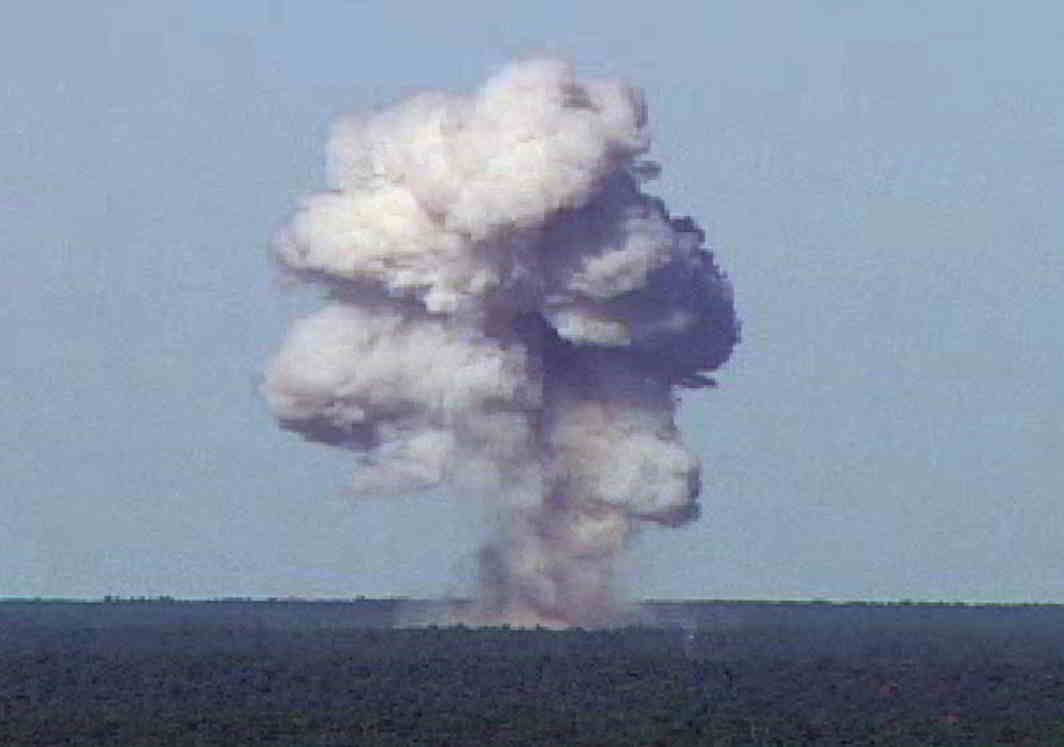
President Trump has furnished proof that the leader of the Free World, which dropped the first nuclear bomb on Hiroshima, remains true to form: it has dropped an even bigger Mother Of All Bombs (non-nuclear, we are being persistently reminded) on Nangahar province in east Afghanistan on what are being described as IS tunnels. Since details are not known, let us first sort out the Syrian outrage.
The alleged sarin gas attack on Khan Shaykhun, a small town in Idlib province where the Jabhat al-Nusra’s militant offshoots are now fighting with their backs to the wall, invited a massive US retaliation: 59 cruise missiles were fired on the nearby Shurayat air strip to teach Bashar al-Assad a lesson.
Analysts under pressure to meet deadlines, hurriedly suggested the strikes made Trump look virile in his meeting with Xi Jinping in Florida, that Rex Tillerson looked strong in his meeting with Sergei Lavrov and that the North Koreans will think twice before their next menacing launch. All of this is fanciful because the big players know the truth. Yes, the opposition to the Syrian army, mostly Al-Nusra and IS wearing other labels, and their regional sponsors, now know that the Trump, browbeaten at home, can be dragged into the Syrian fight. The civil war can be prolonged.
To make sense of the air strikes, it would be useful to visit a similar incident in August 2013. Then, too, a sarin gas attack was allegedly mounted on an even bigger scale on Ghouta township, on the outskirts of Damascus. Two US missiles took off from a US base in Spain—in retaliation, of course. On this occasion, the Russian anti-missile paraphernalia at their base in Tartus, brought down the missiles in Mediterranean Sea. Apparently, a sizeable number of missiles fell in the sea this time, too. So the Russian S400 and S300 are indeed operational.
President Obama would have met President Vladimir Putin at the September 2013 G20 summit in St Petersburg from what the US “Deep State” had designed to be a position of strength once the two missiles have been launched. Instead his face was in the lower mould during his bilateral aside with the Russian leader. If the Russian intercepts had caused a loss of face, subsequent face saving for the Obama administration in 2013 was also provided by the Russians. They suggested that Syria sign the Chemical Weapons Convention and surrender its chemical weapons.
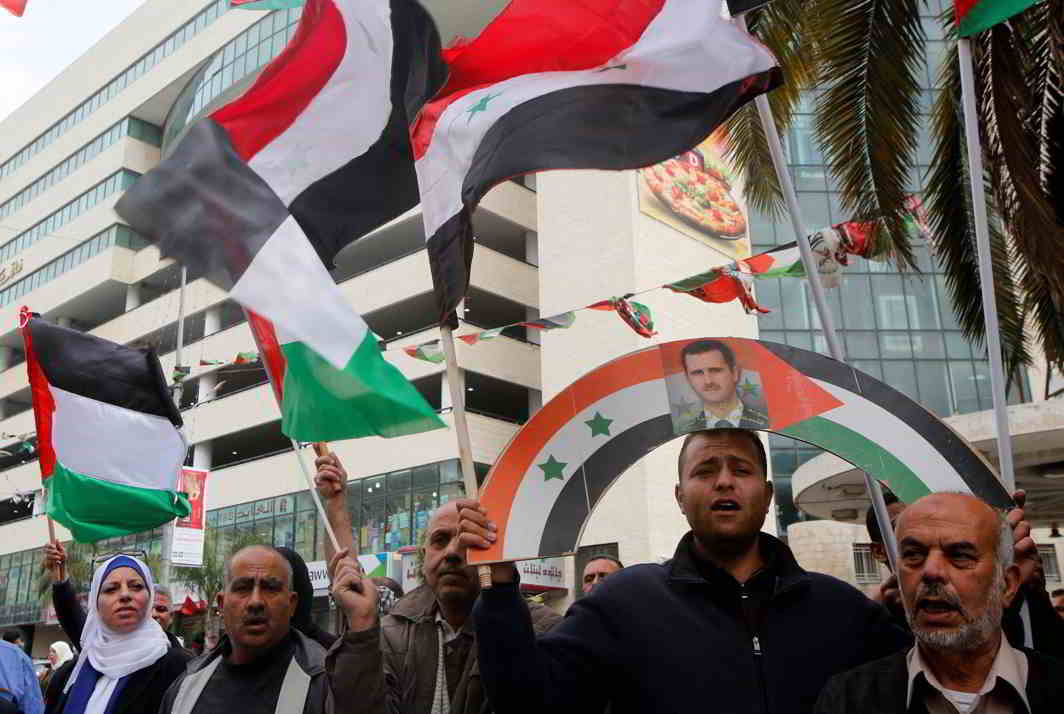
A Palestinian demonstrator holds a placard with a poster depicting Syria’s President Bashar al-Assad during a protest against American airstrikes in Syria, in the West Bank city of Nablus, Reuters/UNI
On September 11, 2013, Putin wrote in The New York Times: “No one doubts that poison gas was used in Syria. But there is every reason to believe it was used not by the Syrian army, but by opposition forces, to provoke intervention by their powerful foreign patrons, who would be siding with fundamentalists.”
Putin then points to something even more sinister. “Reports that militants are preparing another attack, this time against Israel, cannot be ignored.”
In other words, the opposition was checked in their tracks by timely Russian intervention. Air attacks in retaliation for the false flag at Ghouta were prevented. The desperate opposition was now about to play its trump card: launch a poison gas attack on Israel.
In his weekly address to the nation, Obama said: “Until recently, the Assad regime would not admit that it possessed chemical weapons. Today Syria has signaled a willingness to join with 189 other nations, representing 98 percent of humanity, in abiding by an international agreement that prohibits the use of chemical weapons.” There was fulsome praise for Russia. “Russia has staked its own credibility in supporting this outcome,” Obama said.
It was clear even then that this Washington-Moscow entente over Syria would set the cat among the pigeons in Tel Aviv and Riyadh. All their huge investments in arms, money, mercenaries and years of planning was liable to be wasted in Obama’s second term when John Kerry because his Secretary of State.
On the issue of Russia and Syria, the Deep State, with the media as amplifier, was not going to give up. No wonder it pitched its tent behind Hillary Clinton’s platform for the 2016 Presidential elections. The spider in the Deep State web, weaving the Syrian yarn is one Robert Stephen Ford, US ambassador to Damascus in 2011 when the “insurgency” was first initiated.
The most accurate narrative of Ford, in cahoots with this French counterpart, Eric Chevallier, and how they stoked the fires in Syria should be available with New Delhi’s ministry of external affairs. Of the entire diplomatic corps in the Syrian capital that this reporter met, the sharpest eye was that of Ambassador V.P. Haran.
The grinding of the US, Israeli, Saudi propaganda machine in Syria never stopped.
Every now and then the White Helmets in Syria would produce a heartwrenching story of “Assad’s brutality”. The photograph of a four-year-old Syrian boy, his face burnt by “Assad’s” attack on civilians in Aleppo, found its way to the final Trump-Clinton debate in Las Vegas on October 19, 2016. Clinton simulated a lump in her throat describing the child with burns as evidence of indiscriminate Russian (not just Syrian) bombing of civilians.
Exactly on cue, Christiane Amanpour of the CNN, in her high profile interview with Russian Foreign Minister, Sergei Lavrov, produced the very same picture for Lavrov to see. “This is a crime against humanity,” Amanpour thundered. Lavrov looked at the photograph. “Very tragic,” he said. He then made a bold assertion: the US was probably supporting the Jabhat al-Nusra.
Meanwhile, NGOs in the field furnished video recordings of the “burnt boy” being diligently filmed to be presented to the world media—propaganda of the macabre genre.
If the Pulitzer Prize winning investigative journalist Seymour Hersh is to be believed, the West is itself implicated in the sarin gas scandal. His outstanding piece in the London Review of Books after Ghouta, quite incontrovertibly establishes that “the sarin that was used didn’t come from Assad’s stockpiles”. He quotes British Intelligence for this detail. He adds:
“A secret agreement in 2012 was reached between the Obama administration and the leaders of Turkey, Saudi Arabia and Qatar, to set up a sarin gas attack and blame it on Assad so that the US could invade and overthrow Assad.”
Sarin gas has been in the news earlier when Bill Clinton’s Defence Secretary William Cohen caused journalists as senior at Peter Arnett and Bernard Shaw to be sacked for having pointed to US stockpiles or nerve gas which was used on a village in Laos to hunt down US army defectors. It became notorious as Operation Tailwind. The official version then was that the gas was not dropped on Americans. That which was dropped, on whoever, was not sarin but “but garden variety CS tear gas.” The reporters stuck to their guns.[/vc_column_text][/vc_column][/vc_row]





Latest world news
S Jaishankar says India is a natural option for Russia amid Europe tensions
External Affairs Minister S Jaishankar said India remained a natural option for Russia as Moscow increasingly turned towards Asia amid strained relations with Europe. He highlighted the continuity of India-Russia ties and their significance for the balance of power in Asia.


Latest world news
Putin praises PM Modi, says he has very good ideas on Ukraine war
Russian President Vladimir Putin has praised Prime Minister Narendra Modi for repeatedly raising the need to end the Ukraine war, describing his ideas for a settlement as “very good”.

Latest world news
S Jaishankar calls Pakistan a “serial practitioner of terrorism” at UN
S Jaishankar criticised Pakistan at the UN General Assembly, referring to a “serial practitioner of terrorism” and warning against attempts to normalise terrorism.


Dhruv Rathee gets fresh summons in 2018 BJP IT cell video case

Nobody can browbeat judiciary, Chief Justice warns over Rahul Gandhi’s march

India-US trade deal first phase finalised, drafting underway

Election Commission orders voter roll revision in 17 states, UTs

Actor Imran Khan asked to leave India after CJP protest

Delhi Police offers 11-person limit for CJP’s Connaught Place protest
Actor Imran Khan asked to leave India after CJP protest
Election Commission orders voter roll revision in 17 states, UTs
India-US trade deal first phase finalised, drafting underway
Nobody can browbeat judiciary, Chief Justice warns over Rahul Gandhi’s march

Afghan Men Try To Hang With The Jet Engine Of The Aircraft in Kabul- Afghanistan News – Kabul News
Trending Top 10 News: 10000 Crore Fine on Flipkart, Apple to Launch Unique Feature, Hdfc Bank Job Ad

Trending Top 10 News: Nokia 6310, Apple sales, Bachpan ka Pyar Video Kid, Dainik Bhaskar IT Raid

Trending Top 10 News: Canada bans Indian flights, Rain in Delhi NCR, AIMIM Twitter hacked, Raj Kundra case

Trending Top 10 News: Shein India, Apple New Service, Pocket Oxygen, Oppo Launched New Phone
-
 India News16 hours ago
Dhruv Rathee gets fresh summons in 2018 BJP IT cell video case
-
 India News13 hours ago
Nobody can browbeat judiciary, Chief Justice warns over Rahul Gandhi’s march
-
 India News8 hours ago
India-US trade deal first phase finalised, drafting underway
-
 India News6 hours ago
Election Commission orders voter roll revision in 17 states, UTs
-
 India News6 hours ago
Actor Imran Khan asked to leave India after CJP protest
-
 India News5 hours ago
Delhi Police offers 11-person limit for CJP’s Connaught Place protest
