[vc_row][vc_column][vc_column_text]By Rajesh Sinha
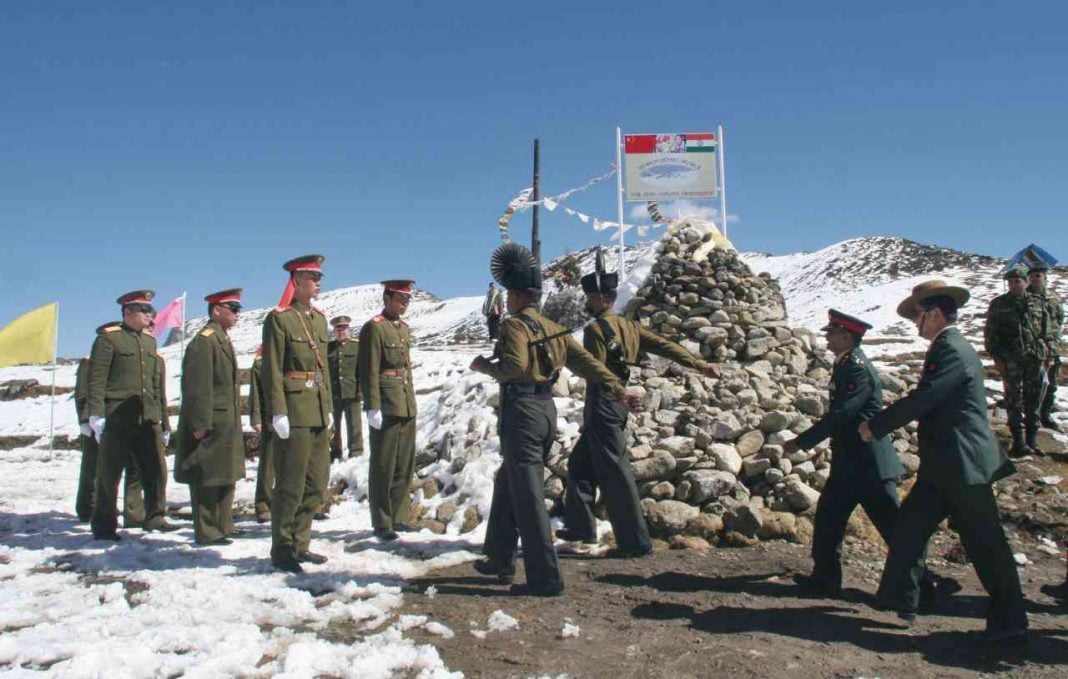
A war of words has erupted between India and China over the standoff between their armies in Sikkim sector with a hardening of Chinese stance and its commentators not ruling out an armed conflict unless the situation is handled properly.
As the standoff at the Doklam area entered the third week, Chinese official media and think-tanks said that “war is possible if the conflict between India and China is not handled properly”. Calling India’s action in Sikkim a “betrayal”, China on Monday said it will take every action to safeguard its borders and countered Defence Minister Arun Jaitley’s remarks saying that China of 2017, like India, is also different from 1962. It warned, “China will take all necessary measures to safeguard its territorial sovereignty” and repeated that India pull back the soldiers who Beijing accuses of entering its territory on the other side of the Sikkim border.
India had rushed additional troops to the area that is witnessing a standoff between the two countries, to engage the Chinese army in a non-combative mode. Jaitley, responding to China’s oblique reference to the war the two countries had fought 55 years ago and asking India to learn from “historic lessons”, had said, “If they are trying to remind us, the situation in 1962 was different and India of 2017 is different.”
He had also held China responsible for the current standoff between Indian and Chinese troops in the Sikkim sector.
Responding to Jaitley’s remarks, Chinese foreign ministry spokesman Geng Shuang said, “He is right in saying that India in 2017 is different from 1962; just like India, China is also different.”
He said China’s border with India in Sikkim is well-demarcated and the Indian Army’s action there over the last month is a “betrayal” of the position taken by successive Indian governments. “Former Indian Prime Minister Jawaharlal Nehru endorsed the 1890 Sino-British Treaty on Sikkim in a letter to the then Chinese counterpart Zhou Enlai in 1959. Successive Indian governments have also endorsed this,” Shuang said at a media briefing.
He said India needs to observe the Treaty and pull back troops immediately from Doklam. “I would like the Indian side to respect the 1890 treaty immediately and pull back the border troops which have crossed into Chinese territory back to the Indian side of the boundary. China will take all necessary measures to safeguard its territorial sovereignty,” he warned.
Geng accused India of using Bhutan as a cover up for its “illegal entry” into the Doklam area over which Bhutan has lodged a protest with the Chinese government.
“In order to cover up the illegal entry of the Indian border troops, to distort the fact and even at the expense of Bhutan’s independence and sovereignty, they try to confuse right from wrong, that is futile,” Geng said. He said China has “no objection to normal bilateral relations between India and Bhutan but firmly opposed to the Indian side infringing on Chinese territory using Bhutan as an excuse”.
Beijing made a formal protest last week, accusing Indian border guards of crossing from the north eastern state of Sikkim into its Tibetan territory to stop the road building. The new hotspot has emerged in a remote scrap of territory where the frontiers of China, India and Bhutan meet.
India said on Friday that China’s People’s Liberation Army (PLA) troops entered the area to unilaterally construct the road. “India is deeply concerned at the recent Chinese actions and has conveyed to the Chinese government that such construction would represent a significant change of status quo with serious security implications for India,” the Ministry of External Affairs (MEA) said in a statement. “India cherishes peace and tranquillity in the India-China border areas. It has not come easily,” it said, urging Beijing to resolve the skirmish through dialogue.
Bhutan also lodged a formal protest to China, saying the road violated a bilateral agreement. China insists that it has every right to build the road and that it controls the territory under an 1890 accord made with Britain when it was colonial power in the region.
Playing Chinese checkers with borders
A report in The Times of India quoted strategic affairs expert Brahma Chellaney, to say China is deliberately conflating two separate issues – the delineation of the tri-junction points and PLA’s forcible attempt to change status quo by building a strategic highway through the Doklam plateau.
To mount pressure on India and stake a maximalist position, Beijing has released, as Chellaney said, dubious maps laying claim to areas that are south of the tri-junction points as determined and perceived by India. It is through such constructions that Beijing alleges that Indian troops crossed over to the Chinese side. The attempt is to forcefully alter the ground positions to China’s advantage.
If India relents, it will keep losing control of areas and will also be seen to be letting down Bhutan, said the ToI report quoting a former official conversant with the dispute.
Moreover, as New Delhi pointed out last week, India and China reached an understanding on the Sikkim sector in 2012 to discuss and finalise the boundary’s demarcation under the Special Representatives framework. “In this context, for Beijing to cite an 1890 colonial-era agreement on Sikkim makes little sense other than to confound the real issue at stake. That colonial-era accord is of no direct relevance to China’s road building through Doklam,” Chellaney said.
The citing of the 1890 Sikkim-Tibet agreement is interesting as it coincides with the disdain expressed by Beijing for the 1984 Sino-British accord, which paved the way for Hong Kong’s handover in 1997, saying that it no longer had binding power.
A small State, Sikkim is of crucial strategic importance to India. Located between Nepal, Bhutan and China, it is at the head of a narrow stretch of land known as the “chicken’s neck” that links the north-eastern States to the rest of India. Of the 3,488-km-long India-China border from Jammu and Kashmir to Arunachal Pradesh, a 220-km section falls in Sikkim.
In retaliation for the Indian army’s action, Beijing has blocked the entry of Indian pilgrims hoping to cross the Sikkim border to visit Mount Kailash in Tibet, which violates a two-year-old accord.
The Possible Context
The military stand-off at Sikkim comes amid emergence of other points of conflict.
China is blocking India’s efforts to become a member of the Nuclear Suppliers Group, the international club that controls the global nuclear trade.
Delhi has also objected to the China Pakistan Economic Corridor that passes through Pakistan-occupied Kashmir (PoK). India wants to keep Kashmir as a bilateral issue, but with the introduction of China and CPEC, it could become an international issue.
China also sees growing India-US ties with suspicion. A state-run daily said on Monday India’s objection to China building a road in the Sikkim sector ahead of Prime Minister Narendra Modi’s visit to the US was aimed at demonstrating to Washington its “firm determination” to “constrain” China’s rise. The article in the Global Times said: Modi took two measures to brace for his meeting with Trump. The first one was to seal a weapons deal with the US. For America, the weapons deal will not only reap enormous monetary gains from India but also strengthen India’s advantage in the Indo-Pacific region to check China.
“The other measure aimed to demonstrate to the US India’s firm determination to constrain China’s rise,” said the article written by Liu Zongyi, senior fellow of the state-run thinktank, the Shanghai Institutes for International Studies.
“For example, Indian troops crossed the undisputed Sikkim section of the China-India border and impeded Chinese workers from building roads a few days before Modi’s visit to the US,” it said on the ongoing standoff in Doklam.
In addition, the Indian government has started an anti-dumping probe into Chinese products, the article said, adding that the Modi administration sought US support at the cost of China-India ties and has taken a lead in containing China’s rise.[/vc_column_text][/vc_column][/vc_row]