English हिन्दी
Connect with us

Latest world news

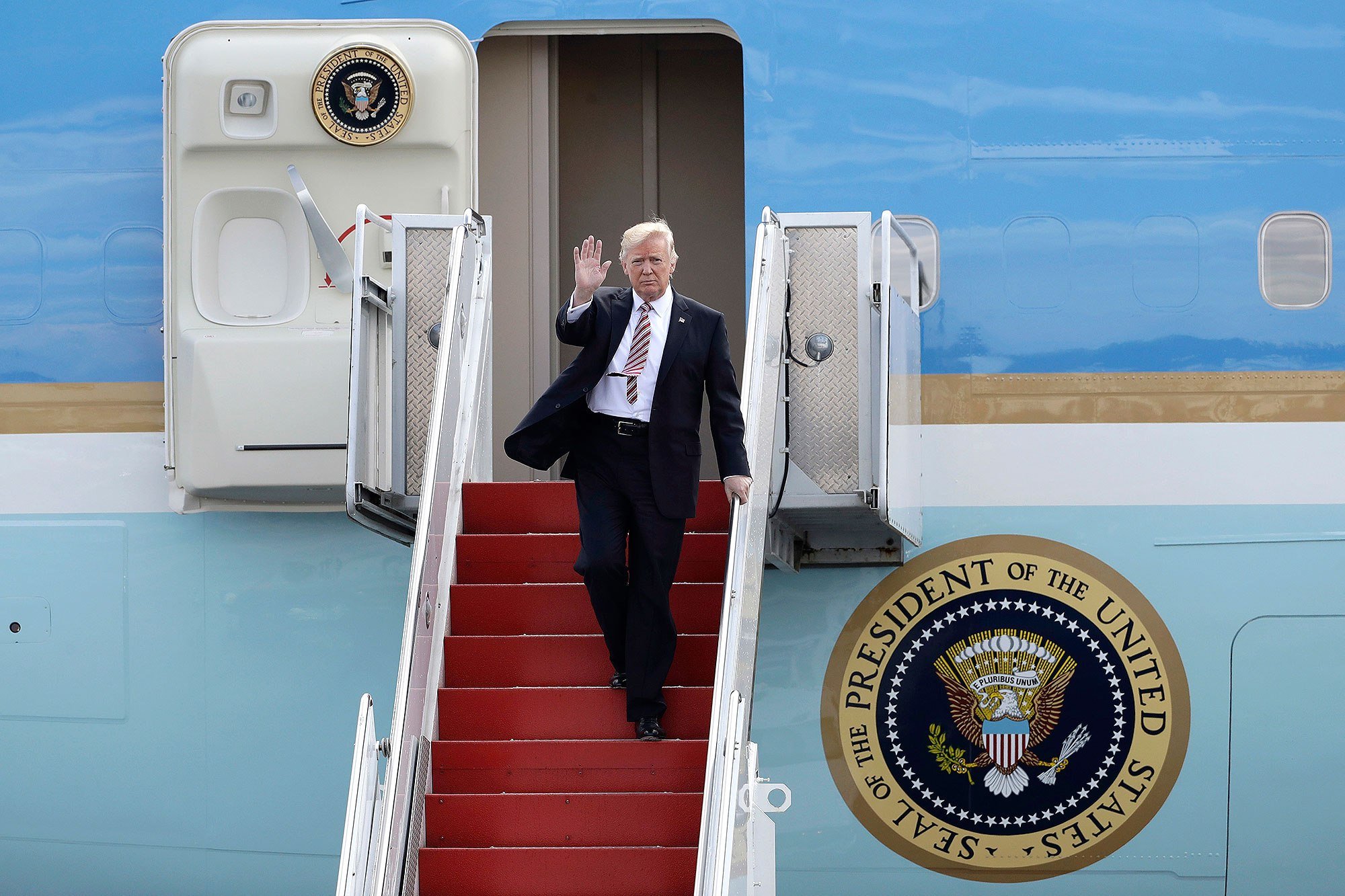
To save US taxpayer’s money, Donald Trump to expand Air Force One with jets from bankrupt Russian firm

Published

on

Donald Trump to expand Air Force One to save US taxpayer’s money

[vc_row][vc_column][vc_column_text]After his surprise win in the 2016 US Presidential election, Trump had said that he thought the cost of a new Air Force One fleet was too much for the taxpayer to bear and had pledged to negotiate a better, low-cost deal

Displaying his self-acclaimed fiscal prudence, it seems President Donald Trump is backing the US Air Force for finalising a deal with bankrupt Russian airline Transaero and aviation major Boeing to buy 747-8 jetliners for expansion of the Air Force One fleet in a bid to save money paid by American taxpayers from being spent on the otherwise massive expense of buying new aircraft.

According to a report in The Independent, the two jets are currently parked in the dry Mojave desert since Transaero, which had originally placed a purchase order with Boeing for these aircraft, went bankrupt before making good on the deal.

“The two jets that may become the next iconic Air Force One fleet have been sitting in the (Mojave) desert since earlier this year, after a deal between the jet’s manufacturer Boeing and a Russian airline fell through. The dry air in Mojave makes the area ideal for storing planes, as the air won’t be corrosive. The area, in general, is a storage place for older planes and planes that may one day be flown again,” the report in The Independent said.

The deal is reportedly in its final stages now and the American media quoted Ann Stefanek, the spokesperson of US Air Force, as saying: “We’re working through the final stages of coordination to purchase two commercial 747-8 aircraft and expect to award a contract soon.”

There are reports suggesting that the deal may actually be finalised within days and a formal announcement on the same may come within this week itself.

Although Boeing did not confirm the specifics of the sale, it has reportedly said that the negotiations were centred on delivering a “great value” for the Air Force and American people, indicating that the negotiations were at an advanced, perhaps ultimate, stage.

The Independent report however also added that “the planes are going to cost quite a bit more than your average Boeing 747-8  — which has a sticker price of $386.8 million — since the US military will need to outfit it with specific protections and capabilities for the President’s use and protection.”

Pentagon budget requests have laid out $3.2 billion to pay for those modifications. Those changes include adding private conference rooms in the cabin, private living quarters for the President, an operating room for emergency procedures in-flight, flares in the wings for deterring missiles, a probe for mid-air refuelling, and reinforcement so that the fuselage can withstand a ground-level nuclear blast.[/vc_column_text][/vc_column][/vc_row]

Latest world news

US ends oil sanctions waiver for Iran and Russia, impact likely on India’s energy imports

The US decision to end the Iran and Russia oil waiver may impact India’s oil imports, fuel prices and global energy markets.

Published

on

US oil tanker

The United States has decided not to extend a temporary sanctions waiver that allowed limited trade in Iranian and Russian oil, marking a shift towards stricter enforcement of economic restrictions.

The waiver, introduced in March 2026, had permitted the sale of oil already loaded on ships to stabilise global supply during heightened geopolitical tensions. However, it is now set to expire around mid-April without renewal.

US officials have indicated that the move is part of a broader strategy to increase pressure on both Iran and Russia amid ongoing conflicts and geopolitical tensions.

What the waiver did and why it mattered

The short-term waiver allowed millions of barrels of oil—estimated at around 140 million barrels—to enter global markets, helping ease supply shortages and prevent sharp price spikes.

It also enabled countries like India to purchase discounted crude oil from Russia and resume limited imports from Iran after years of restrictions.

Impact on India

India, one of the world’s largest oil importers, is expected to feel the impact of the decision in several ways:

  • Reduced access to discounted oil
    India had been buying cheaper Russian crude and recently resumed Iranian imports under the waiver. Its end may limit these options.
  • Potential rise in fuel costs
    With fewer discounted supplies available, India may need to rely more on costlier sources, which could increase domestic fuel prices.
  • Supply diversification pressure
    India may need to explore alternative suppliers in the Middle East, Africa, or the US to maintain energy security.
  • Geopolitical balancing challenge
    The move adds pressure on India to align with US sanctions while managing its own economic interests.

Global energy market concerns

The end of the waiver comes at a time when global oil markets are already under stress due to conflict in West Asia and disruptions in key routes like the Strait of Hormuz.

Analysts warn that tightening sanctions could:

  • Reduce global oil supply
  • Increase price volatility
  • Intensify competition among major buyers like India and China

Bigger picture

The US decision reflects a broader shift from temporary relief measures to stricter enforcement of sanctions, even if it risks tightening global energy markets.

For India, the development highlights a recurring challenge—balancing affordable energy access with geopolitical realities.

Continue Reading

Latest world news

Sanctioned tanker fails to breach US blockade, turns back near Strait of Hormuz

A US-sanctioned tanker failed to cross the Hormuz blockade and turned back, underscoring rising tensions and disruption in global shipping routes.

Published

on

A US-sanctioned oil tanker failed to break through a newly imposed American naval blockade and was forced to turn back near the Strait of Hormuz, highlighting growing tensions in the region.

The vessel, identified as the Rich Starry, reversed its course after attempting to exit the Gulf, according to shipping data. The development comes just days after the United States enforced restrictions on ships linked to Iranian ports.

The blockade was announced by Donald Trump following the collapse of recent diplomatic talks with Iran. The move aims to restrict maritime traffic associated with Iranian trade.

Officials said that during the first 24 hours of enforcement, no vessel successfully crossed the blockade. Several ships, including the sanctioned tanker, complied with instructions from US forces and turned back toward regional waters.

The tanker is reported to be linked to a Chinese company previously sanctioned for dealing with Iran. It was carrying a cargo of methanol loaded from the United Arab Emirates at the time of the incident.

The situation underscores the rising risks in one of the world’s most critical oil transit routes. The Strait of Hormuz typically handles a significant share of global energy shipments, but traffic has sharply declined due to ongoing geopolitical tensions.

The blockade, which applies specifically to vessels travelling to or from Iranian ports, has added further uncertainty for shipping companies, insurers and global energy markets.

Continue Reading

Latest world news

Jaishanakar discusses Middle East crisis with Kuwait and Singapore counterparts, focus on Indian community

Jaishankar holds talks with Kuwait and Singapore counterparts on West Asia tensions, highlights Indian community safety.

Published

on

India’s External Affairs Minister S. Jaishankar held discussions with his counterparts from Kuwait and Singapore amid the ongoing crisis in West Asia, focusing on regional developments and the safety of Indian nationals.

In separate telephonic conversations, Jaishankar exchanged views with Kuwait’s Foreign Minister Sheikh Jarrah Jaber Al-Ahmad Al-Sabah and Singapore’s Foreign Minister Vivian Balakrishnan. The discussions come at a time of heightened tensions in the Middle East region.

According to details shared by the minister, his conversation with the Kuwaiti counterpart primarily revolved around the evolving regional situation and the well-being of the Indian community residing in Kuwait.

He described the interaction as a constructive exchange, highlighting India’s continued attention to the safety and interests of its citizens abroad during the crisis.

In a separate interaction with Singapore’s foreign minister, Jaishankar said the two sides discussed the ongoing conflict in West Asia and its broader implications.

The talks reflect India’s ongoing diplomatic engagement with key global partners as tensions in the Middle East continue to escalate, impacting regional stability and international concerns.

The latest outreach is part of a series of high-level communications by India aimed at closely monitoring developments in the region while safeguarding its strategic and humanitarian interests.

Continue Reading

Trending

© Copyright 2022 APNLIVE.com