English हिन्दी
Connect with us

Latest Politics News

Mission 2019 of BJP: Get stronger, demolish opposition

Published

on

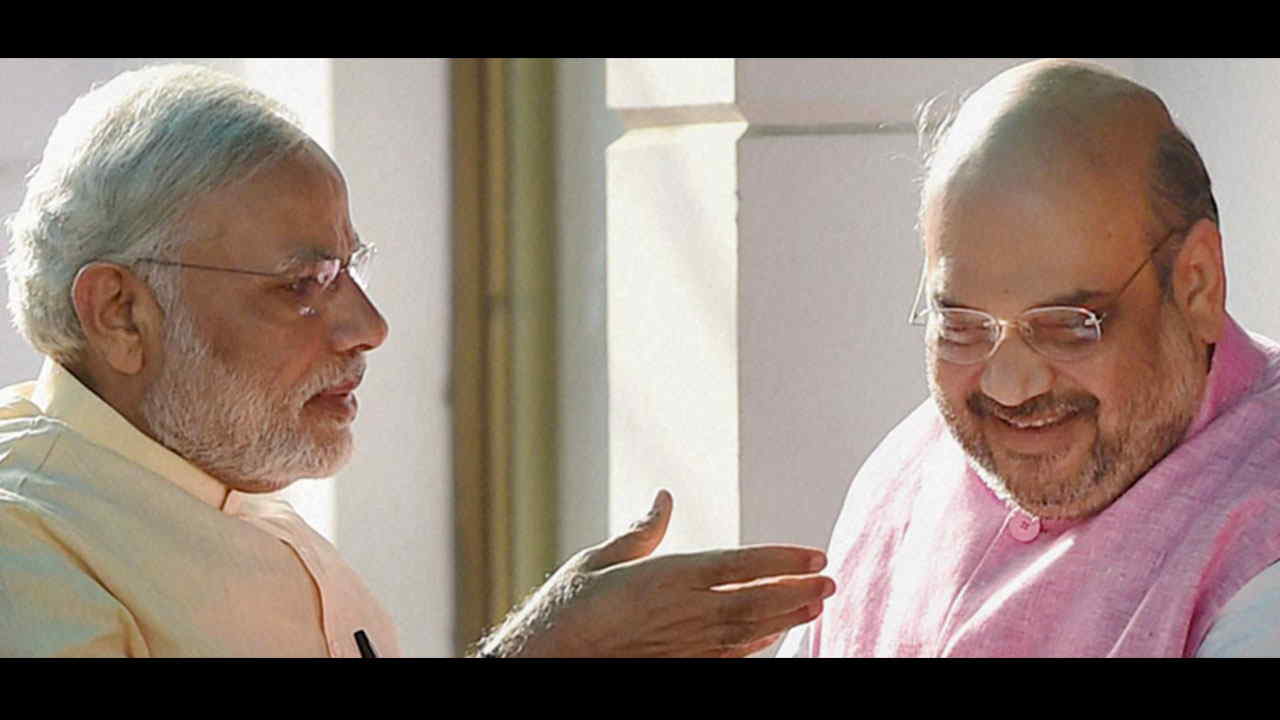
Narendra modi and Amit Shah

[vc_row][vc_column][vc_column_text]Already the dominant national political party, BJP is vigorously pursuing an action plan to consolidate and expand its base and reach in the country while decimating its rivals. While the opposition is in a disarray with Congress and other smaller parties clueless and without any idea of how to redeem their fortunes, BJP president Amit Shah is already busy gearing up the party for future elections.

The BJP is no mood to give any quarter to its rivals: this is the stamp of Narendra Modi and Amit Shah style of politics. Every election matters and the party has to constantly acquire more power, expand its strength and win, as Shah memorably put it, everything ‘from the Parliament to the Panchayat’.

Shah is on a 110-day countrywide tour which began from Jammu in April this year to mobilise and prime the party for ‘Mission 2019’ – the next Lok Sabha election, two years away. His tour of Uttar Pradesh, where the BJP already has a government firmly in place, dealt a blow to the opposition rival camp by setting off defections from other parties.

He is now in Haryana on a 3-day visit since Wednesday to review the working of the State government, which completed 1,000 days last month, and also assess the political situation in Haryana. Shah will be attending 27 programmes, including 17 meetings with BJP MLAs and others. He would take stock of the political situation in Haryana and decide on a future course of action to help the State government perform better. “The Cabinet ministers will give presentations on the performance of their departments while Shah will take feedback from the chairmen of various boards,” said a BJP leader.

His first meeting was with district presidents, district general secretaries and office-bearers of the BJP, chairmen of boards and corporations, and state cabinet led by chief minister Manohar Lal Khattar. He asked party workers to strengthen what he called the “world’s largest democratic party” at the grassroots level and work for ‘Mission 2019’ with fresh zeal. Addressing the office-bearers, Shah stressed on launching intensive door-to-door campaigns to inform all sections of the society about schemes and policies initiated by the government in Centre and state.

He said the BJP government led by Prime Minister Narendra Modi has introduced 106 schemes in the country for youths, farmers, women and labourers. “We introduced a new scheme in every 15 days of our government for the welfare of the people. It is utmost important that these schemes reach their beneficiaries as well,” Shah said.

Party workers were told to reach out to the public and redress people’s grievances through ‘CM Window’ and monitoring committees. He took feedback from workers and sought suggestions on how the BJP could do better, how to strengthen the BJP at every single booth in the state, so that it wins all the 10 Lok Sabha seats in the 2019 general elections.

Lauding the performance of his party’s governments, he supplemented it with a scathing attack on Congress and its leadership. Addressing a rally, Shah said “Gandhi ji ne kaha tha azadi ke turant baad Congress ko bikher dena chahiye… khair wo Gandhi ne nhi kiya ab koi Gandhi kar rha hai (Mahatma Gandhi had asked to dissolve Congress immediately after independence… that Gandhi did not do it, now some other Gandhi is doing it).”

Praising the BJP-ruled government at Centre, Shah also said, “Jab Congress ki sarkar aati hai desh ka growth rate neeche jaata hai, BJP ki sarkar aati hai growth rate upar jaata hai.” (The country’s progress and development goes down when the Congress party comes to power, while when BJP is in power, the growth rate increases.)

Shah added that the BJP is trying to make the country free of caste based politics. “Desh ko parivarvaad, jaativaad aur tushtikaran ki rajniti se mukt karaane ka kaam BJP ne kiya hai.” (BJP has worked in the direction of making Indian free of dynasty and cast based politics), said Shah.

On the concluding day of his visit, Shah will address some meetings where the focus will be to work hard on ‘vistarak yojna’ (expansion plan) which was initiated across the country to strengthen BJP in view of the 2019 Lok Sabha polls.

Not one to miss out even on smaller token gestures, Shah is also scheduled to have lunch at the house of one of the party’s Dalit workers before he returns to Delhi on Friday evening.

Shah chose Rohtak for his Haryana leg of the tour, a politically significant move as Rohtak has been the traditional stronghold of former Haryana Chief Minister and Congress leader Bhupinder Singh Hooda. Besides the lone Congress MP Deepender Hooda, majority of the 15 Congress MLAs in the current Haryana Assembly are also from the Rohtak-Sonipat belt.

Every effort was made to keep his programme in public eye. The BJP president was received with much fanfare, right from Delhi-Haryana border upto Tilyar Convention Centre in Rohtak, where he chaired his meetings for Wednesday. Thousands came on road to welcome Shah with flowers. CM Khattar and BJP state president Subhash Barala welcomed him with turban (pagdi). Agriculture minister OP Dhankar then welcomed him with a mace (gada).

All Haryana ministers, including Chief Minister Manohar Lal Khattar are in town to welcome Amit Shah. Private schools in Rohtak district in Haryana declared holiday on Wednesday as their buses were deployed for the rally organised to welcome BJP national president Amit Shah, in contravention of a recent ban imposed by the state on using school buses for political rallies. But such minor aberrations from norms or law are par for the course in the march of the BJP juggernaut.

Shah will be visiting Tamil Nadu from August 22. The party has been making concerted efforts to fill the political space created by Jayalalithaa’s death and Karunanidhi’s retirement from active politics.[/vc_column_text][/vc_column][/vc_row]

India News

Rahul Gandhi attacks Centre ahead of Vladimir Putin’s India visit

Rahul Gandhi alleged that the government discourages visiting foreign dignitaries from meeting Opposition leaders, calling it a sign of “insecurity,” hours before Russian President Vladimir Putin arrives in Delhi.

Published

on

Rahul Gandhi

As Russian President Vladimir Putin arrives in Delhi today for the India-Russia Annual Summit, Leader of the Opposition Rahul Gandhi has renewed his charge that the Centre discourages visiting foreign leaders from meeting Opposition representatives. He called it a sign of “insecurity” within the government.

Rahul Gandhi alleges break in long-followed tradition

Speaking outside Parliament, Rahul Gandhi said that it has traditionally been the norm for visiting foreign leaders to meet the Leader of the Opposition, a practice he claims continued during the tenures of Atal Bihari Vajpayee and Manmohan Singh.

He alleged that the present government advises foreign dignitaries against such meetings. “When foreign leaders come, the government suggests they should not meet the Leader of the Opposition. This is their policy,” Gandhi said. He added that a meeting with the Opposition offers visiting leaders a broader perspective, as “we too represent India.”

Gandhi further stated that this approach reflects the government’s reluctance to allow engagement between the Opposition and foreign guests.

Former Foreign Secretary counters Gandhi’s remarks

Responding to Gandhi’s allegations, former Foreign Secretary and Rajya Sabha MP Harsh Vardhan Shringla said visiting leaders operate on very tight schedules and there is no protocol mandating a meeting with the Leader of the Opposition. He stressed that such interactions depend entirely on the guest’s time and preference, noting that the required meetings are those with the President and the Prime Minister.

Putin’s schedule packed with bilateral engagements

Russian President Vladimir Putin is set to land in Delhi this evening on Prime Minister Narendra Modi’s invitation. His itinerary includes:

  • A private dinner with PM Modi
  • Visit to Mahatma Gandhi’s memorial at Raj Ghat
  • Engagements at Bharat Mandapam and Hyderabad House
  • A banquet hosted by President Droupadi Murmu

The visit forms part of the 23rd India-Russia Annual Summit.

Continue Reading

India News

TMC MLA Humayun Kabir suspended after Babri Mosque replica proposal sparks row

TMC suspended MLA Humayun Kabir after he proposed building a Babri mosque replica in Murshidabad, a move that drew criticism from the party and sparked political tension.

Published

on

Trinamool Congress on Thursday suspended MLA Humayun Kabir after he publicly announced plans to construct a replica of the Babri Masjid in West Bengal’s Murshidabad district. Party leaders said Kabir had earlier been cautioned for making such statements but continued to push ahead with the controversial proposal.

Kolkata Mayor Firhad Hakim said the MLA’s remarks were unacceptable, stressing that the party stood firmly by its secular stance. “We noticed that one of our MLAs suddenly declared he would build the Babri masjid. We had warned him before. As per the party’s decision, we are suspending him,” he said.

Kabir vows to continue project, may form new party

Kabir had planned to lay the foundation stone for the mosque replica in Beldanga on December 6. Sources indicated he is likely to resign from Trinamool on Friday and float a new party while continuing with the project.

The choice of date and nature of the project drew sharp criticism from the Trinamool leadership. Hakim alleged the move reflected a “divisional politics” strategy aligned with the BJP. “Why December 6? He could build a school or college. This is divisional politics,” he said.

Sources also said Chief Minister Mamata Banerjee was “hugely annoyed” by Kabir’s remarks and informed him that the party would not support or associate with such activities.

Governor raises concerns, administration on alert

West Bengal Governor Ananda Bose questioned why action was not being taken if the MLA’s statements risked creating a law-and-order issue. He said intelligence inputs suggested attempts to turn Murshidabad into a “hub of scandal,” adding that authorities would not remain silent if communal tensions were provoked.

Officials confirmed that while Kabir has permission to hold the December 6 event, the administration is maintaining a high-level alert in Murshidabad.

Minutes after his suspension, Kabir withdrew from Mamata Banerjee’s rally in the India–Bangladesh border district, where she was protesting against the Special Intensive Revision (SIR) of voter lists.

BJP attacks Kabir over remarks

BJP spokesperson Pratul Shah Deo condemned Kabir’s comments, claiming they were intended to “create communal tensions.” He said any attempt to raise structures linked to historical rulers would trigger disputes similar to the Babri Masjid conflict.

Continue Reading

India News

Karnataka Power Shift: What Siddaramaiah–DK Shivakumar compromise formula means

A closer look at the emerging ‘compromise formula’ between Karnataka’s top leaders Siddaramaiah and DK Shivakumar, and how it may shape the state’s political future.

Published

on

A possible settlement between Karnataka Chief Minister Siddaramaiah and Deputy Chief Minister DK Shivakumar has emerged, signalling a calmer phase in the leadership tussle within the state Congress. While the final decision rests with the party leadership in Delhi, details of the so-called “compromise formula” are gradually becoming clearer.

Breakfast diplomacy calms tensions

After weeks of speculation over friction between the two top leaders, Siddaramaiah and Shivakumar met over breakfast today. The meeting, aimed at projecting unity, served as a symbolic reset after their strained ties over the chief ministership question.

Analysts believe the optics were crucial — the Congress successfully avoided a public showdown by diffusing tensions before they escalated further.

A transition of power likely, say analysts

According to political observers, the compromise indicates a strong possibility of Shivakumar taking over as Chief Minister in a smooth transition, potentially as early as March–April 2026.
For now, sources say the arrangement requires Shivakumar to continue as Deputy Chief Minister without pushing for immediate change.

In return, the formula reportedly includes more cabinet positions for leaders loyal to Shivakumar and continuation of his role as the state Congress chief. Siddaramaiah is also expected to back Shivakumar as the party’s face for the 2028 Assembly election.

Why the Congress prefers this route

Replacing Siddaramaiah abruptly would not only upset internal balance but could also weaken the party, given his stature and mass appeal. Shivakumar, despite his influence, does not have the numbers within the legislature to force a takeover, making compromise the most viable path.

Siddaramaiah has already stated that this will be his final term as Chief Minister. With his legacy secure and his position as one of Karnataka’s tallest leaders intact, he appears willing to enable a dignified transition when the time comes.

Variables that could shape the final outcome

The success of the formula depends on three key factors:

1. Trust between the two leaders

Whether Shivakumar believes Siddaramaiah will keep his word remains uncertain. Karnataka’s political history is full of last-minute shifts, giving rise to the phrase “natak in Karnataka”.

2. Decision-making by the Congress high command

Delhi’s leadership must ensure the transition happens on time and without internal resistance, especially in the run-up to the 2028 Assembly polls.

3. Caste equations and political alignment

Siddaramaiah is the strongest face of the AHINDA bloc, while Shivakumar represents the OBC Vokkaliga community. The Congress cannot afford to alienate either group, making the timing and execution of any transition extremely delicate.

Continue Reading

Trending

© Copyright 2022 APNLIVE.com