English हिन्दी
Connect with us

Latest world news

Donald Trump Facing Isolation on Iran Nuclear Compliance

Published

on

iran deal

[vc_row][vc_column][vc_column_text]IAEA and world leaders support n-deal continuation

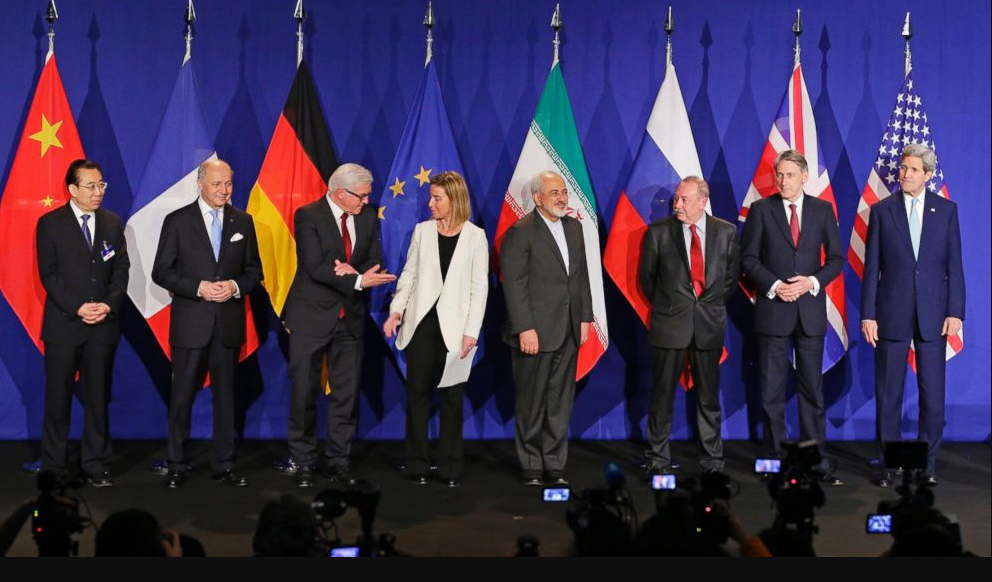
US President Donald Trump has been facing tremendous pressure from permanent members of the Security Council plus Germany and International Atomic Energy Agency (IAEA) on the question of Iran complying the nuclear deal, signed in 2015. Most countries have been advising Washington not to withdraw from the nuclear deal known as Joint Comprehensive Plan of Action (JCPOA).

The International Atomic Energy Agency (IAEA) and many world leaders have unanimously thrown their weight behind the 2015 nuclear agreement between Iran and the P5+1 group of countries, rejecting US President Donald Trump’s claims that Tehran has violated the “spirit” of the deal.

IAEA Director General Yukiya Amano in a statement on Monday has confirmed that Iran was in compliance with its commitments under the nuclear agreement.

“I can state that the nuclear-related commitments undertaken by Iran under the (nuclear agreement) are being implemented,” Amano said at 20th Edoardo Amaldi Conference in Rome.

Donald Trump has once again, on Thursday, accused Iran of failing to act in keeping with the international nuclear deal. He was meeting with US military leaders in the white House Cabinet Room on. He said, “They have not lived up to the spirit of the agreement.”

Iran and the five permanent members of the Security Council: the United States, France, Britain, Russia and China – plus Germany had signed the nuclear deal on July 14, 2015. Its implementation began in January last year.

Under the much discussed deal, Iran undertook to put limitations on its nuclear program in exchange for the removal of nuclear-related sanctions imposed on that country.

Since January 2016, IAEA has repeatedly verified Iran’s compliance with its nuclear-related commitments.

European Union’s foreign policy chief, Federica Mogherini, has  said on Monday that Iran’s compliance had been verified on at least eight occasions, and called for efforts to honour international cooperation instead of dismantling them.

She has asserted that it was time to “invest in international cooperation” and “open new channels and not destroy the ones we already have.”  She suggested to the US administration saying it was “certainly not the time to dismantle them.”

Meanwhile, German Foreign Minister Sigmar Gabriel expressed concern while talking to reporters in Berlin on Monday. “We do not want to see this [nuclear] agreement [with Iran] damaged,” Gabriel emphasized.

On Sunday, Iranian Foreign Minister Mohammad Javad Zarif said that his country would give a “response fitting” any stance adopted by Trump on the historic nuclear accord. “The Islamic Republic of Iran pursues its policies in the region irrespective of the blabber of others,” Zarif told.

Reports from Moscow  says that Kremlin spokesman, Dmitry Peskov has also warned against the negative consequences of a possible US withdrawal from the nuclear deal, saying that Moscow was trying to analyze it.

Peskov added that Russian President Vladimir Putin had repeatedly highlighted the importance of the agreement.

“Of course, the withdrawal of one of the countries, especially a key country like the United States, from this agreement will only have negative consequences,” the spokesman added.

Meanwhile, spokeswoman of China’s Foreign Ministry, Hua Chunying, expressed hope that the nuclear deal would stay intact, which has played an important role in maintaining global peace. She described Iran nuclear deal as a “good example” of how to solve something peacefully through dialogue.

“We have previously responded and explained that the Iran nuclear deal was an expression of multilateralism in the international community and a good example of how to solve something peacefully through talks,” the spokeswoman said.

Meanwhile, British Prime Minister Theresa May told Israeli Prime Minister Benjamin Netanyahu on Monday that London remained “firmly committed” to the Iran nuclear deal.

US President Donald Trump is reportedly planning to “decertify” the nuclear agreement with Iran by October 15. According to reports, Trump plans to declare that the nuclear deal is not in the national interest of the United States and kick the issue to a reluctant Congress. US Congress requires the president to certify Iran’s compliance with the JCPOA every 90 days.[/vc_column_text][/vc_column][/vc_row]

Latest world news

PM Modi to begin two-day Israel visit, defence and trade in focus

PM Narendra Modi begins a two-day Israel visit aimed at strengthening defence cooperation, trade ties and upgrading bilateral relations to a special strategic partnership.

Published

on

pm modi

Prime Minister Narendra Modi will begin a two-day visit to Israel on Wednesday, with defence and trade cooperation high on the agenda. The visit is expected to further deepen the growing strategic engagement between the two countries.

During the trip, India and Israel are set to upgrade their relationship to a “special strategic partnership”, marking a significant step beyond the strategic partnership established in July 2017 during the Prime Minister’s first visit to the country.

Sources indicated that the new framework would enable expanded collaboration, including joint development of advanced defence systems and a strengthened understanding to support each other during times of need.

High-level engagements in Jerusalem

Mr Modi will be received at the airport by Israeli Prime Minister Benjamin Netanyahu and his wife Sara. The two leaders are scheduled to hold a one-on-one meeting shortly after his arrival.

In Jerusalem, the Prime Minister will interact with members of the Indian community before addressing lawmakers at the Knesset, a distinction reserved for select global leaders.

On Wednesday evening, he will attend a technology exhibition showcasing Israel’s advancements, with leading Israeli industry executives expected to be present. Mr Netanyahu will also host a private dinner in his honour.

Tribute at Yad Vashem and presidential meeting

On Thursday morning, Mr Modi will pay tribute to Holocaust victims at Yad Vashem. He is also scheduled to meet Israeli President Isaac Herzog during the visit.

Defence cooperation and technology partnerships

Several memorandums of understanding are expected to be signed, including a widely discussed agreement in the defence sector. As part of the proposed arrangement, a secrecy mechanism will reportedly be created to facilitate expanded cooperation in previously restricted areas.

Local media reports have indicated discussions around air defence systems and possible integration of India into Israel’s laser-based air defence system, Or Eitan.

Beyond defence, the two nations are expected to formalise cooperation in emerging and disruptive technologies such as artificial intelligence, quantum research and cybersecurity.

In New Delhi, the Ministry of External Affairs said the visit would reaffirm the deep-rooted strategic partnership and provide an opportunity to align efforts in addressing shared challenges while strengthening collaboration between the two democracies.

Defence cooperation has been a cornerstone of India-Israel relations, with Israel supplying a range of military platforms and weapon systems to India in recent years. Bilateral ties have also expanded in fields including scientific research, innovation and cybersecurity.

Continue Reading

Latest world news

Trump says tariffs will replace income tax, criticises Supreme Court setback in key address

Donald Trump has said tariffs collected from foreign nations could eventually replace income tax in the US, while criticising a Supreme Court ruling against his earlier import duties.

Published

on

trump

US President Donald Trump has said that tariffs collected from foreign countries could eventually replace the modern system of income tax in the United States, arguing that such a shift would ease the financial burden on American citizens.

Speaking during his annual State of the Union address, Trump defended his sweeping tariff measures, asserting that countries which had “ripped off” the US for years were now paying billions of dollars in duties.

“As time goes by, I believe that tariffs, paid for by foreign countries, will, like in the past, substantially replace the modern-day system of income tax, taking a great financial burden off the people that I love,” he said.

The Republican leader credited tariffs as a key driver behind what he described as an economic turnaround. According to him, the US collected “hundreds of billions of dollars” through import duties, which he said helped secure favourable economic and national security deals.

“Countries that were ripping us off for decades are now paying us hundreds of billions of dollars,” Trump said, adding that the arrangements had resulted in growth and no inflation during that period.

Supreme Court ruling draws sharp reaction

Trump also criticised a recent 6-3 ruling by the Supreme Court of the United States that struck down his earlier sweeping import duties. He termed the verdict “very unfortunate” but maintained that most countries and corporations would continue to honour agreements already negotiated.

He said alternative legal provisions would allow his administration to retain similar tariff measures without requiring new congressional approval. “They’re a little more complex, but they’re actually probably better,” he said, referring to the legal statutes under which the revised duties would be imposed.

Hours after the ruling, Trump signed a fresh order imposing a 15 per cent tariff on imports from around the world. The new measure falls under a law that limits such duties to 150 days and is expected to take effect almost immediately.

Reciprocal tariffs and global backlash

On April 2, Trump announced “reciprocal” tariffs of up to 50 per cent on imports from countries with which the US runs trade deficits, along with a 10 per cent baseline tariff on most other nations. He invoked a 1977 law to declare the trade deficit a national emergency, which he said justified the sweeping import taxes.

Following global backlash, the administration suspended the reciprocal tariffs for 90 days to allow negotiations. According to Trump, several countries agreed to new trade terms during that period, while others faced steeper duties for not complying.

Reiterating his stance, Trump also linked tariffs to what he described as conflict resolution efforts abroad, saying the “threat of tariffs” had helped him settle disputes.

Continue Reading

Latest world news

Trump repeats claim of averting India-Pakistan nuclear war during Operation Sindoor

Donald Trump has claimed that Pakistan’s Prime Minister told him 35 million people could have died during Operation Sindoor if the US had not intervened. India denies any third-party mediation.

Published

on

US President Donald Trump has once again asserted that his administration prevented a potential nuclear conflict between India and Pakistan during last year’s military tensions, claiming that Pakistan’s Prime Minister told him that millions of lives were at stake.

Trump cites Pakistan PM in fresh remarks

Addressing a joint session of the US Congress during his State of the Union speech, Trump said he had ended eight wars within the first ten months of his second term, including tensions between India and Pakistan.

“Pakistan and India would have had a nuclear war,” Trump said. “Thirty-five million people, said the Prime Minister of Pakistan, would have died if it were not for my involvement.”

He attributed the remark to Pakistan Prime Minister Shehbaz Sharif, claiming Sharif told him that US intervention helped prevent catastrophic casualties during the crisis.

Repeated claims of mediation

Trump has repeatedly stated that his administration brokered peace between the two South Asian neighbours. Since May 10 last year, he has claimed on multiple occasions — including through social media posts — that Washington facilitated a “full and immediate” ceasefire between India and Pakistan following talks.

The tensions followed India’s launch of Operation Sindoor on May 7. The operation targeted what India described as terror infrastructure in Pakistan and Pakistan-occupied Kashmir. New Delhi said the strikes were carried out in response to the April 22 Pahalgam attack that left 26 civilians dead.

India rejects third-party role

India has consistently denied any external mediation in the cessation of hostilities. According to New Delhi, the understanding to stop military action was reached through direct communication between the Directors General of Military Operations (DGMOs) of both countries.

Indian officials have maintained that no third-party intervention played a role in the talks that led to the halt in hostilities.

Trump’s renewed remarks are likely to draw attention again, given India’s firm stance that the de-escalation was the result of bilateral military-level engagement rather than US-led diplomacy.

Continue Reading

Trending

© Copyright 2022 APNLIVE.com