
India News
Rousing Welcome To Israeli PM Netanyahu in Gujarat, Praises Modi As Revolutionary


[vc_row][vc_column][vc_column_text]Prime Minister Narendra Modi and his Israeli counterpart Benjamin Netanyahu, who arrived in Ahmedabad on Wednesday, held an eight-kilometer-long roadshow which ended at the Sabarmati Ashram, also known as Gandhi Ashram, where Mahatma Gandhi lived for over a decade.
The Israeli Prime Minister Benjamin Netanyahu and his wife Sara were received at the airport by Narendra Modi. Security was tightened along the route from the Ahmedabad airport to Sabarmati Ashram. They were greeted with song and dance at the airport.
Around 50 stages were set up along the route that Modi and Netanyahu took to Sabarmati Ashram. The stages on the roadshow depicted Gujarat’s cultural and heritage values by various artistes. There were artistes from 22 States showcasing their traditional art and dances.
Pleased with the rousing welcome at his arrival, Netanyahu thanked the people: “Thank you to the thousands of Indians who welcomed us to Ahmedabad today with Israeli flags and tremendous support!”[/vc_column_text][vc_raw_html]JTNDYmxvY2txdW90ZSUyMGNsYXNzJTNEJTIydHdpdHRlci10d2VldCUyMiUyMGRhdGEtbGFuZyUzRCUyMmVuJTIyJTNFJTNDcCUyMGxhbmclM0QlMjJlbiUyMiUyMGRpciUzRCUyMmx0ciUyMiUzRVRoYW5rJTIweW91JTIwdG8lMjB0aGUlMjB0aG91c2FuZHMlMjBvZiUyMEluZGlhbnMlMjB3aG8lMjB3ZWxjb21lZCUyMHVzJTIwdG8lMjBBaG1lZGFiYWQlMjB0b2RheSUyMHdpdGglMjBJc3JhZWxpJTIwZmxhZ3MlMjBhbmQlMjB0cmVtZW5kb3VzJTIwc3VwcG9ydCUyMSUyMCUzQ2ElMjBocmVmJTNEJTIyaHR0cHMlM0ElMkYlMkZ0LmNvJTJGOFBBclZycFVQbyUyMiUzRXBpYy50d2l0dGVyLmNvbSUyRjhQQXJWcnBVUG8lM0MlMkZhJTNFJTNDJTJGcCUzRSUyNm1kYXNoJTNCJTIwQmVuamFtaW4lMjBOZXRhbnlhaHUlMjAlMjglNDBuZXRhbnlhaHUlMjklMjAlM0NhJTIwaHJlZiUzRCUyMmh0dHBzJTNBJTJGJTJGdHdpdHRlci5jb20lMkZuZXRhbnlhaHUlMkZzdGF0dXMlMkY5NTM1NzU0MzQzODk3NzAyNDAlM0ZyZWZfc3JjJTNEdHdzcmMlMjU1RXRmdyUyMiUzRUphbnVhcnklMjAxNyUyQyUyMDIwMTglM0MlMkZhJTNFJTNDJTJGYmxvY2txdW90ZSUzRSUwQSUzQ3NjcmlwdCUyMGFzeW5jJTIwc3JjJTNEJTIyaHR0cHMlM0ElMkYlMkZwbGF0Zm9ybS50d2l0dGVyLmNvbSUyRndpZGdldHMuanMlMjIlMjBjaGFyc2V0JTNEJTIydXRmLTglMjIlM0UlM0MlMkZzY3JpcHQlM0UlMEE=[/vc_raw_html][vc_column_text]The Israeli PM and his wife spent around 20 minutes in the Sabarmati ashram premises, where they visited ‘Hriday Kunj’, the home of Mahatma Gandhi.
Netanyahu and his wife described Mahatma Gandhi as one of the great prophets of humanity. In a four-line message jointly signed by him and his wife Sara in the visitors’ book at the ashram, the dignitaries said their “visit was inspiring.”
“An inspiring visit to the hearth of one of humanity’s great prophets of inspiration — Mahatma Gandhi,” they wrote.
They tried their hands at the ‘charkha’, the hand-spinning wheel that was emblematic of India’s quest for self-reliance during the freedom struggle.[/vc_column_text][vc_raw_html]JTNDYmxvY2txdW90ZSUyMGNsYXNzJTNEJTIydHdpdHRlci10d2VldCUyMiUyMGRhdGEtbGFuZyUzRCUyMmVuJTIyJTNFJTNDcCUyMGxhbmclM0QlMjJldCUyMiUyMGRpciUzRCUyMmx0ciUyMiUzRUFobWVkYWJhZCUzQSUyMFBNJTIwTW9kaSUyMGFuZCUyMElzcmFlbCUyMFBNJTIwTmV0YW55YWh1JTIwYW5kJTIwaGlzJTIwd2lmZSUyMFNhcmElMjBOZXRhbnlhaHUlMjBhdCUyMFNhYmFybWF0aSUyMEFzaHJhbSUyMCUzQ2ElMjBocmVmJTNEJTIyaHR0cHMlM0ElMkYlMkZ0d2l0dGVyLmNvbSUyRmhhc2h0YWclMkZOZXRhbnlhaHVJbkluZGlhJTNGc3JjJTNEaGFzaCUyNmFtcCUzQnJlZl9zcmMlM0R0d3NyYyUyNTVFdGZ3JTIyJTNFJTIzTmV0YW55YWh1SW5JbmRpYSUzQyUyRmElM0UlMjAlM0NhJTIwaHJlZiUzRCUyMmh0dHBzJTNBJTJGJTJGdC5jbyUyRldCZkp6aFFNeXYlMjIlM0VwaWMudHdpdHRlci5jb20lMkZXQmZKemhRTXl2JTNDJTJGYSUzRSUzQyUyRnAlM0UlMjZtZGFzaCUzQiUyMEFOSSUyMCUyOCU0MEFOSSUyOSUyMCUzQ2ElMjBocmVmJTNEJTIyaHR0cHMlM0ElMkYlMkZ0d2l0dGVyLmNvbSUyRkFOSSUyRnN0YXR1cyUyRjk1MzUxNDUxOTk3OTk5OTIzMiUzRnJlZl9zcmMlM0R0d3NyYyUyNTVFdGZ3JTIyJTNFSmFudWFyeSUyMDE3JTJDJTIwMjAxOCUzQyUyRmElM0UlM0MlMkZibG9ja3F1b3RlJTNFJTBBJTNDc2NyaXB0JTIwYXN5bmMlMjBzcmMlM0QlMjJodHRwcyUzQSUyRiUyRnBsYXRmb3JtLnR3aXR0ZXIuY29tJTJGd2lkZ2V0cy5qcyUyMiUyMGNoYXJzZXQlM0QlMjJ1dGYtOCUyMiUzRSUzQyUyRnNjcmlwdCUzRSUwQQ==[/vc_raw_html][vc_column_text]The Indian PM and his Israeli counterpart also flew kites for a couple of minutes, as their visit comes just a few days after ‘Uttarayana’ (or Makar Sankranti), Gujarat’s popular kite festival.
Later, PM Modi and Netanyahu inaugurated a start-up hub called iCreate in Gujarat’s Bavla town. iCreate or the International Centre for Entrepreneurship and Technology, formed in 2011 as an autonomous institution to nurture aspiring entrepreneurs, has tie-ups with leading Israeli firms.
Modi said: “When I went to Israel last year, I made up my mind that this foundation should have more strong relations with Israel. From that time, I was waiting for my friend Benjamin Netanyahu to come to India. He is here & now we are inaugurating this foundation.
“When a farmer sows a small plant, coming generations receives fruits of that huge tree. The farmer’s soul feels elated with this. We are feeling the same happiness on the inauguration of iCreate.
“My motive was that this institution and our youth is benefited by Israel’s experience and their start-up environment. Israel has proved it to the world that commitment of the people, not size of the nation takes the country forward.”
The prime minister said he hoped that iCreate would help youngsters fulfil their dreams and implement their innovative ideas, said media reports. “We are working towards making entire system in our country innovation-friendly, so that ideas are formed from intent, innovations are formed from ideas and a new India is formed from innovations,” said media reports quoting Modi.
Quoting the former President of Israel, Shimon Peres, Modi said innovation had the bigger role in taking people of India and Israel together. “The greater the dream, the more spectacular will be the results,” he said.
Netyanahu praised Modi for doing revolutionary work, and recalled the historic links between the two countries, the Hindustan Times reported. Many Indian soldiers who lost their lives during the liberation of the Israeli city of Haifa were Gujaratis, the Israeli prime minister said.
The youth and technology of the two countries are the future, and the two are coming together and opening new ways, Netanyahu added, before concluding his speech by saying: “Jai Hind! Jai Bharat! Jai Israel!”
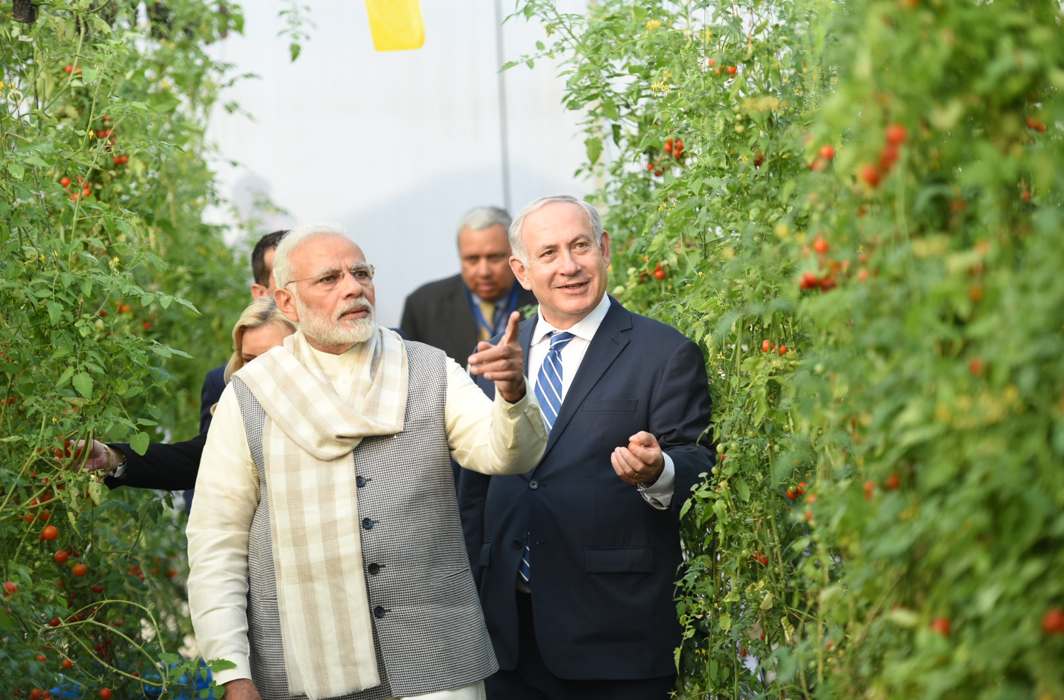
The prime ministers then visited the Centre of Excellence for Vegetables at Vadrad in Sabarkantha district where they spoke with farmers. “We are all aware of the strides Israel has made in agriculture, including when it comes to managing water resources and irrigation,” Modi said. “Israel shows the way on how to transform a nation with the agriculture sector at the core.”
Prime Minister Narendra Modi said that the government was attempting to help farmers double their incomes by 2022, and thanked Netanyahu for taking time out to talk to farmers.
The two leaders and Sara Netanyahu returned to Mumbai in the evening.
On Thursday, the Israeli prime minister will launch a magazine at the Magen David Synagogue at Byculla in South Mumbai, PTI reported. The magazine, called Namaste Shalom, will focus on the relations between the two countries and will be published every month.
Netanyahu and his wife are on a six-day trip to India. Netanyahu’s visit to Gujarat will focus on agriculture, irrigation, innovation and enterprise, the Indian Prime Minister’s Officer said on Twitter.[/vc_column_text][/vc_column][/vc_row]








India News
Two election commissioners complained against senior poll officer, RTI reveals
An RTI response has shed light on complaints by two Election Commissioners against a senior poll panel officer and the Cabinet Secretariat’s decision not to intervene directly.

India News
Punjab strike hits public services as 3 lakh employees and roadways workers protest
Punjab is facing disruption to government work and public transport as over three lakh government employees participate in a mass leave protest and roadways workers continue their strike over pending demands.
India News
Amit Shah says congress won’t return to power for 30 years
Union Home Minister Amit Shah took a swipe at Rahul Gandhi over the Opposition’s vote theft allegations, asserting that the Congress would not return to power for the next 30 years.


Magnitude 7 earthquake strikes Tibet after floods

Yogi Government cites Rs.15,233 crore seizures in UP gangster crackdown

PM Modi attacks Rahul Gandhi with failed product jibe

Amit Shah says congress won’t return to power for 30 years

Punjab strike hits public services as 3 lakh employees and roadways workers protest

Two election commissioners complained against senior poll officer, RTI reveals
Punjab strike hits public services as 3 lakh employees and roadways workers protest
Amit Shah says congress won’t return to power for 30 years
Magnitude 7 earthquake strikes Tibet after floods
PM Modi attacks Rahul Gandhi with failed product jibe

Afghan Men Try To Hang With The Jet Engine Of The Aircraft in Kabul- Afghanistan News – Kabul News
Trending Top 10 News: 10000 Crore Fine on Flipkart, Apple to Launch Unique Feature, Hdfc Bank Job Ad

Trending Top 10 News: Nokia 6310, Apple sales, Bachpan ka Pyar Video Kid, Dainik Bhaskar IT Raid

Trending Top 10 News: Canada bans Indian flights, Rain in Delhi NCR, AIMIM Twitter hacked, Raj Kundra case

Trending Top 10 News: Shein India, Apple New Service, Pocket Oxygen, Oppo Launched New Phone
-
 Latest world news14 hours ago
Magnitude 7 earthquake strikes Tibet after floods
-
 India News17 hours ago
Yogi Government cites Rs.15,233 crore seizures in UP gangster crackdown
-
 India News14 hours ago
PM Modi attacks Rahul Gandhi with failed product jibe
-
 India News13 hours ago
Amit Shah says congress won’t return to power for 30 years
-
 India News2 hours ago
Punjab strike hits public services as 3 lakh employees and roadways workers protest
-
 India News2 hours ago
Two election commissioners complained against senior poll officer, RTI reveals
