English हिन्दी
Connect with us

Latest world news

Iraq not to allow US military bases to save sovereignty

Published

on

Iraq not to allow US military bases to save sovereignty

Washington worried over Baghdad growing ties with Moscow

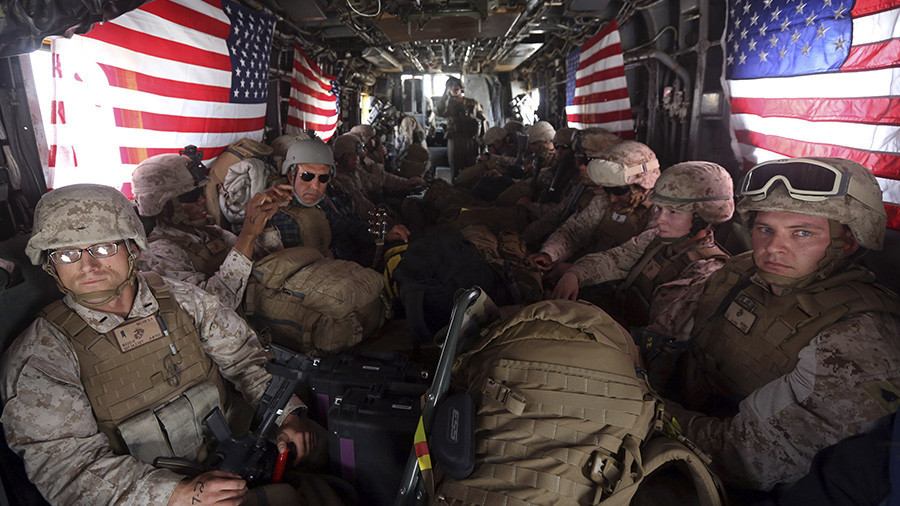
In a major setback to Washington, Iraq has denied permission to US for setting up its permanent military bases on its territory under “any circumstances” as it would be a violation of its sovereignty.

Iraq’s foreign minister Ibrahim Jaafari, while talking to journalists in Moscow during his extended visit on Friday said, “Baghdad firmly rejects the construction of US military bases on its soil”. He asserted that Iraq will “not stand on ceremony” when it comes to the protection of its sovereignty.

Jaafari told that Moscow and Baghdad exchange information on a regular basis and Iraq is receiving assistance from Russia in ensuring security.

TASS had quoted Iraqi foreign minister saying on Wednesday that “It is difficult for a country to be restored after the war alone. Russia is also providing assistance in security area”.

During his interaction with media in Moscow, Iraq’s foreign minister said that in 2014, when Baghdad asked for international help in fighting against Daesh terrorists, it said the potential contribution had to meet the requirements of Iraq’s sovereignty and independence. “Iraq’s sovereignty is our red line” he said.
Iraq not to allow US military bases to save sovereignty

Iraqi foreign minister Ibrahim al-Jaafari further said that the presence of permanent US military bases in “South Korea, Turkey, Japan and many other countries” long after the end of World War II were in violation of those countries’ sovereignty.

Earlier on Tuesday, Jaafari told reporters in Moscow that Baghdad was thoroughly considering  to purchase Russia’s surface-t—air S-400 missile defense systems.

A report from Baghdad said on Thursday that Iraq’s parliament had voted to urge the government to set a timetable for the withdrawal of foreign troops from the country, two months after it declared victory over Daesh (IS) militants.

Earlier in February, Saad al-Hadithi, a spokesperson of the Iraqi cabinet, said that it was logical that (the US-led) coalition would reduce the number of its troops in Iraq after the victory was declared over Daesh (IS) in December.

According to US government there are about 9000 American troops in Iraq. However Department of Defense puts the number far lower. Recently there were reports of moving US troops from Iraq to Afghanistan. However, exact figures about the forces’ redeployment are no clear.

In 2003, US invaded Iraq to topple Saddam Hussein regime under the false pretext of Baghdad possessing weapons of mass destruction. Iraq is the first country in the history of US military presence worldwide where Baghdad virtually forced Washington to withdraw its forces from its territory in December 2011, the first announced withdrawal schedule.

Nuri al-Maliki, the then PM had made it clear that Iraqi parliament could not evolve consensus for their longer stay and asked Washington to withdraw their troops as announced earlier.  Maliki had to leave the office after persistent pressure build up by media campaign projecting him to be responsible for so-called mass killings of Sunni Muslims.

In Late February, Heather Neuert, the spokeswomen of US State Department had warned Iraq for the consequences of extending military cooperation with Russia and striking deals to purchase advanced weapons, especially the S-400 missile systems.

Observers believe that generally US administration succeeds in ‘convincing the host government’ to formally request for extension of their stay. But due to irrevocable Iranian influence in Baghdad no extension was given to the US military presence.

In the recent years Tehran has build up its influence in Iraq and Syria by sending its military advisors and weapons in their fight against Daesh and other armed groups.
Latest world news

Bangladesh student leader killing sparks allegation against Yunus-led interim government over February polls

The killing of Bangladesh student leader Sharif Osman Hadi has led to protests and serious allegations against the Yunus-led interim government over the February national election.

Published

on

The killing of Bangladesh student leader Sharif Osman Hadi has triggered sharp political allegations, with his family accusing elements within the Muhammad Yunus-led interim government of attempting to derail the country’s upcoming national election scheduled for February.

Sharif Osman Hadi, spokesperson of Inquilab Moncho — a cultural platform that emerged from the July 2024 uprising — was shot at close range in Dhaka on December 12. He was later airlifted to Singapore for advanced treatment, where he succumbed to his injuries on December 18. His death led to violent protests in parts of the capital, including attacks on offices of newspapers and cultural organisations.

Brother alleges political motive behind killing

At a protest gathering in Shahbagh, Sharif Osman Hadi’s brother, Sharif Omar Hadi, accused a section of the interim government of orchestrating the killing to disrupt the election process.

“You had Osman Hadi killed, and now you are trying to foil the election by using this as an issue,” Omar said while addressing protesters. He claimed that his brother was firm on holding the national election by February and did not align himself with any agency or “foreign masters”.

Omar demanded a swift and transparent trial, warning that delays would damage the election environment. He alleged that the authorities have failed to show any visible progress in the investigation so far.

“If justice for Osman Hadi is not delivered, you too will be compelled to flee Bangladesh one day,” Omar said, drawing an apparent reference to former Prime Minister Sheikh Hasina, who left the country following last year’s nationwide protests that resulted in a change of regime.

Claims of wider conspiracy surface

Leaders of Inquilab Moncho also alleged that the killing was part of a broader conspiracy to undermine the gains of the July uprising and weaken Bangladesh’s sovereignty. They claimed that international intelligence agencies and their local collaborators were involved in the murder.

The group demanded that the government identify and present the accused through an investigation meeting international standards within a fixed timeframe. They warned that protests would intensify if their demands were not met.

Protesters said demonstrations would continue until justice is delivered for Sharif Osman Hadi.

Protest plans and political developments

Leaders of Inquilab Moncho announced that they would not hold any programmes on December 25, the day when Bangladesh Nationalist Party’s acting chairman Tarique Rahman is scheduled to return to the country. They expressed hope that Rahman would extend solidarity to their movement demanding justice.

The allegations and ongoing protests have added to political tensions in Bangladesh as the interim government faces growing scrutiny ahead of the proposed February election.

Continue Reading

Latest world news

H-1B visa renewal delays leave hundreds of Indian workers stranded amid US social media checks

Hundreds of Indian H-1B visa holders remain stranded after US consular interviews were delayed due to enhanced social media screening.

Published

on

visa apply

Hundreds of Indian professionals holding H-1B visas are facing unexpected uncertainty after travelling to India for routine visa renewals, only to find their US consular interviews postponed to next year due to a new social media vetting policy introduced by the US administration

Many of these workers had scheduled appointments between December 15 and 26, a window that coincided with the US holiday season. However, interviews planned for mid to late December have now reportedly been pushed to as late as March, leaving employees unable to return to their jobs in the United States.

Appointments postponed without clarity

Immigration law firms say they are dealing with a large number of affected clients. Some attorneys have described the situation as unprecedented, highlighting the lack of clarity around how long the delays may last. Workers who travelled for personal reasons, including family events, now face the risk of prolonged stays in India while their employment continues overseas.

In one reported case, a US-based professional who returned to India this month had two consular appointments scheduled in December, both of which have since expired. Experts have raised concerns over how long US employers may be willing to wait for employees whose return timelines remain uncertain.

US embassy advisory and vetting policy

Earlier this month, the US Embassy in India issued an advisory stating that applicants who arrive at a consulate on a previously scheduled interview date, after being informed of a reschedule, will not be allowed entry. Applicants have been asked to wait for their new appointment dates.

According to official communication, the delays are linked to enhanced social media screening. The policy requires visa applicants to keep their social media profiles public so authorities can assess whether any applicant poses a risk to national security or public safety. While such scrutiny earlier applied to students and exchange visitors, it has now been extended to H-1B and dependent H-4 visa applicants.

Impact on Indian professionals and tech firms

India accounts for nearly three-fourths of all H-1B visa holders, according to data released earlier this year by US immigration authorities. The current delays therefore have a disproportionate impact on Indian professionals working in the US technology and services sectors.

Some US-based technology companies have reportedly cautioned employees against international travel after learning that visa re-entry processing delays at American embassies and consulates could stretch for several months. Legal advisers have warned that overseas travel at this stage could result in extended stays outside the US.

Growing scrutiny of the H-1B programme

The social media vetting requirement is part of a broader tightening of the H-1B programme under the Donald Trump administration. The skilled worker visa pathway has faced increased scrutiny in recent months, including the imposition of a one-time fee on new H-1B visas. The US has also paused certain immigration applications from select countries following security-related concerns.

For now, affected workers and their employers are left waiting, as uncertainty continues over when regular visa processing timelines will resume.

Continue Reading

Latest world news

Hindu man lynched and set on fire in Bangladesh during anti-India protests

A Hindu man was lynched and set on fire in Bangladesh’s Mymensingh district amid rising anti-India protests after the death of a radical student leader.

Published

on

Hindu man set to fire in Bangladesh

A disturbing incident of mob violence against a minority community has been reported from Bangladesh, where a Hindu man was lynched and his body set on fire amid escalating anti-India protests following the death of a radical student leader.

Mob lynching reported from Mymensingh district

A 30-year-old Hindu man, Dipu Chandra Das, was lynched by a mob in Bhaluka Upazila of Mymensingh district after allegations surfaced that he had insulted Islam. According to media reports, the incident took place on Thursday night at an industrial area where Das was employed.

Das was accused of making derogatory remarks about Islam and Prophet Muhammad during an event organised at his workplace to mark World Arabic Language Day. The allegations spread rapidly within the factory premises and nearby areas, leading to heightened tension.

Eyewitness accounts cited in media reports said Das was assaulted by an angry crowd and died on the spot. After his death, the mob allegedly tied his body to a tree, beat it while raising slogans, and later set it on fire.

Body burnt at multiple locations, traffic disrupted

The violence did not stop there. Reports suggest the mob later moved Das’s body to a nearby bus stand area and again set it ablaze. Subsequently, the body was taken to the Dhaka–Mymensingh highway, where it was burned once more, leading to panic among locals and a temporary disruption of traffic on the busy stretch.

Confirming the incident, the local administration said a person was killed following allegations of insulting the Prophet. Officials added that the body has been taken into police custody and the situation is being monitored.

Interim government condemns violence

The lynching took place against the backdrop of widespread protests across Bangladesh following the death of Sharif Osman Hadi, a prominent leader linked to the July Uprising. The Muhammad Yunus-led interim government strongly condemned the killing, stating that there is no place for such violence in the country.

In an official statement, the government appealed to citizens to reject hatred and violence, stressing that those responsible for the crime would not be spared.

Anti-India sentiment intensifies after Hadi’s death

Tensions have been high in Bangladesh since Hadi’s death, with protests, vandalism and arson reported in several cities. Demonstrators targeted prominent media offices and symbolic locations linked to the country’s political history.

Hadi was known for his sharp criticism of India and the former prime minister, whose government was ousted during last year’s uprising. Groups formed after the political upheaval have been actively mobilising street protests and campaigns that fuel anti-India sentiment, particularly after the former premier went into exile in India.

The lynching of Dipu Chandra Das has further raised concerns over the safety of minority communities amid the ongoing unrest in the country.

Continue Reading

Trending

© Copyright 2022 APNLIVE.com