English हिन्दी
Connect with us

Latest world news

Trump rejects Iran peace plan as tensions rise, Tehran signals military readiness

Trump rejects Iran’s peace plan, keeping focus on nuclear concerns as Tehran signals readiness and tensions continue to rise.

Published

on

Donald Trump statement

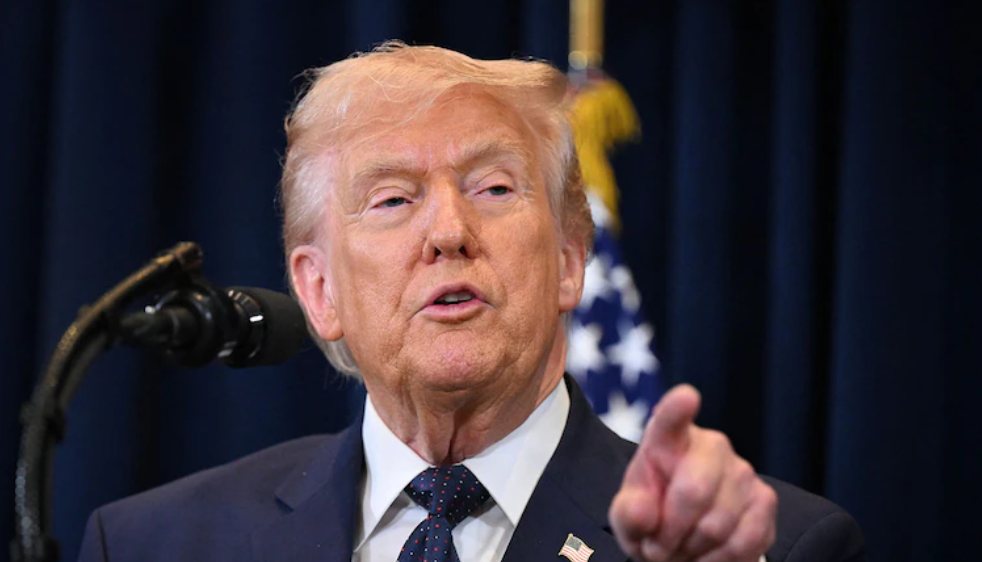
U.S. President Donald Trump has rejected a proposal from Iran aimed at easing ongoing tensions, signaling a continued deadlock between the two countries.

The proposal reportedly included steps linked to easing restrictions around the Strait of Hormuz, a key global oil route. However, the United States declined the offer, maintaining that any agreement must address concerns related to Iran’s nuclear programme.

Washington has made it clear that resolving nuclear issues remains a priority and that partial measures without broader commitments will not be accepted.

Nuclear issue remains central

The U.S. position continues to focus on preventing Iran from advancing its nuclear capabilities. Officials believe that without a comprehensive agreement, temporary arrangements could delay a long-term resolution.

The rejection of the proposal indicates that negotiations remain stalled, with both sides holding firm on key demands.

Iran issues warning

Following the rejection, Iranian officials have issued strong statements, indicating readiness to respond if pressure from the U.S. continues.

Reports suggest that Iran has asserted its military preparedness, warning that any escalation could lead to serious consequences. The remarks reflect growing tensions as diplomatic efforts struggle to produce results.

Rising geopolitical tension

The situation remains volatile, with both countries engaged in a prolonged standoff. Measures such as restrictions on trade routes and strategic pressure points continue to impact the broader region.

The Strait of Hormuz remains a critical factor in the conflict, given its importance for global energy supplies.

Outlook uncertain

With no immediate breakthrough in sight, tensions between the United States and Iran are expected to persist. The lack of agreement on key issues, particularly the nuclear programme, continues to hinder progress toward de-escalation.

Latest world news

Outrage erupts over Norwegian daily’s cartoon portraying PM Modi as snake charmer

A major controversy has erupted after Norway’s largest newspaper published a cartoon depicting PM Narendra Modi as a snake charmer, drawing widespread allegations of racism and a colonial mindset.

Published

on

PM Modi

A major diplomatic and social media row has erupted following the publication of a highly controversial cartoon by Norway’s largest broadsheet newspaper, Aftenposten, which depicts Indian Prime Minister Narendra Modi as a “snake charmer”. The illustration has drawn widespread condemnation online, with critics, journalists, and citizens calling it “blatantly racist,” “derogatory,” and deeply rooted in old colonial-era stereotypes.

The cartoon, created by illustrator Marvin Halleraker, accompanied an opinion piece written by staff commentator Frank Rossavik ahead of the Prime Minister’s official visit to Oslo for the India-Nordic summit. The article featured a headline that auto-translates from Norwegian to “A clever and slightly annoying man” (or “A cunning and slightly disturbing man” in alternative translations). In the visual caricature, the Prime Minister of the world’s most populous country is shown cross-legged, holding a fuel-station pump nozzle shaped like a serpent rising out of a basket.

Lingering colonial mindsets in Western media

The “snake charmer” trope has historically been used by European colonial powers as an Orientalist shorthand to portray India as an exotic, primitive, and backward civilization rather than a technologically advancing global power. Netizens quickly highlighted the hypocrisy and irony of the imagery, noting that Western media frequently falls back on archaic visual slurs when they cannot counter India’s modern achievements, such as its massive digital public infrastructure and leading GDP growth rates.

The controversy has also drawn parallels to a similar incident in October 2022, when a prominent Spanish newspaper faced intense backlash for using snake-charmer symbolism to illustrate India’s economic rise. Social media users pointed out the deep irony that the Prime Minister himself has previously spoken at global forums—including his famous 2014 Madison Square Garden speech—about how India has successfully transitioned from being stereotyped as a “land of snake charmers” to a globally recognized powerhouse of technology-driven “mouse charmers”.

Simmering press row in Oslo

The inflammatory cartoon landed right in the middle of an already tense situation during the Prime Minister’s state visit to Norway. Earlier, a confrontation sparked online after a local commentator, Helle Lyng, publicly questioned why the Prime Minister did not open the floor to media queries during a joint press appearance with Norwegian Prime Minister Jonas Gahr Støre. Lyng recorded the interaction and posted it on social media platforms, questioning whether international partners should trust New Delhi amid allegations concerning press freedom and human rights.

Responding firmly to the allegations during a subsequent press briefing, India’s Ministry of External Affairs Secretary, Sibi George, vehemently defended the nation’s democratic framework and robust press environment. The diplomat rebuked critics for forming highly distorted opinions based on selective reports published by “ignorant NGOs” without understanding the sheer scale, depth, and institutional complexity of modern India.

He highlighted that Delhi alone possesses at least 200 vibrant 24/7 news channels broadcasting across English, Hindi, and regional languages. The diplomat concluded by reaffirming that the Constitution fully guarantees fundamental rights and provides comprehensive legal remedies to all its citizens, countering the narrative pushed by sections of the European commentariat.

Continue Reading

Latest world news

Italian Prime Minister Meloni welcomes friend PM Modi to Rome with viral Colosseum selfie

Prime Minister Narendra Modi arrived in Rome for the final leg of his five-nation tour, receiving a warm welcome from Italian PM Giorgia Meloni, who shared an iconic selfie from the Colosseum. The visit aims to boost bilateral ties and review the Joint Strategic Action Plan.

Published

on

Prime Minister Narendra Modi has arrived in Rome, Italy, marking the final and crucial leg of his five-nation international tour. Commemorating the significant visit, Italian Prime Minister Giorgia Meloni extended a warm welcome to her Indian counterpart by sharing a candid selfie on the social media platform X. The photograph, captured against the illuminated backdrop of the historic Colosseum—originally known as the Flavian Amphitheatre—instantly took the internet by storm. Sharing the post, Meloni affectionately captioned it, “Welcome to Rome, my friend!” alongside the national flags of Italy and India.

The viral image quickly generated massive traction online, amassing millions of views and thousands of interactions within hours. Social media users globally celebrated the popular diplomatic reunion, frequently referring to their camaraderie with the trending “Melodi” moniker, a portmanteau representing the close friendship between the two leaders. This follows similar high-profile social media moments between them, including a viral selfie video during the G7 summit in Apulia in 2024 and a popular click at the COP28 climate summit in Dubai in 2023.

Strong diaspora welcome and official engagements

Upon touching down at the airport, PM Modi was formally received by Italy’s Deputy Prime Minister and Minister of Foreign Affairs and International Cooperation, Antonio Tajani. Following his arrival, the Prime Minister received an enthusiastic welcome from members of the Indian diaspora at his hotel. He witnessed vibrant cultural performances and interacted closely with the gathering, even signing an autograph for a young child who presented him with a hand-drawn portrait. PM Modi also viewed an Indian culture-inspired painting depicting the traditional ghats of Varanasi, created by a local Italian artist.

Taking to X to acknowledge his arrival from Oslo, Norway, where he had been participating in the 3rd India-Nordic Summit, PM Modi outlined the strategic objectives of his visit. He confirmed that he will be holding high-level discussions with both Italian President Sergio Mattarella and Prime Minister Giorgia Meloni.

Boosting economic and strategic cooperation

The ongoing state visit lands at a time of robust momentum for India-Italy relations, as both nations actively look to review and advance the Joint Strategic Action Plan 2025–2029. “This visit will focus on how to boost India-Italy cooperation, especially focusing on the India-Middle East-Europe Economic Corridor (IMEC),” PM Modi stated, underlining the massive infrastructure and connectivity project that remains a core focal point for both administrations.

In addition to the bilateral dialogues, the Prime Minister’s itinerary includes an official visit to the headquarters of the United Nations Food and Agriculture Organization (FAO) located in Rome, reinforcing India’s commitment to global food security and multilateral diplomatic efforts.

Continue Reading

Latest world news

India rejects press freedom concerns raised during PM Modi’s Oslo visit

India rejected criticism over press freedom and human rights during PM Narendra Modi’s Oslo visit, with MEA official Sibi George defending the country’s democratic system.

Published

on

India rejects press freedom concerns raised during PM Modi’s Oslo visit

India firmly pushed back against concerns over press freedom and human rights raised during Prime Minister Narendra Modi’s visit to Oslo, with a senior Ministry of External Affairs official describing certain international NGO reports as “ignorant” and lacking an understanding of India’s scale and diversity.

The remarks came during a media interaction in Norway, where a journalist questioned India’s democratic credentials and asked why the country should be trusted on issues related to media freedom and minority rights.

Responding to the query, MEA Secretary (West) Sibi George defended India’s constitutional framework and democratic institutions. He said India’s Constitution guarantees fundamental rights and provides legal remedies for citizens if those rights are violated.

“We are one-sixth of the total population of the world, but not one-sixth of the problems of the world,” the diplomat said while stressing that India believes in equality, human rights and the rule of law.

He also highlighted the size and diversity of India’s media ecosystem, pointing to the large number of television channels and multilingual news coverage operating across the country. According to him, many foreign observers fail to fully understand India’s complexity and instead rely on selective reports published by NGOs.

The exchange took place during PM Modi’s Norway visit, where he held talks with Norwegian Prime Minister Jonas Gahr Støre on trade, green technology, blue economy and investment cooperation.

The sharp response from the Indian side also followed recent criticism reportedly linked to remarks from Dutch political leaders concerning press freedom and minority rights in India. New Delhi had rejected those observations as well, calling India a vibrant democracy with strong constitutional protections.

India highlights democratic framework during Norway visit

During the interaction, the Indian diplomat reiterated that the country follows the rule of law and maintains democratic accountability through courts and constitutional mechanisms. He said India’s diversity and scale often make it difficult for outsiders to fully understand domestic debates and governance challenges.

PM Modi’s Norway visit is part of broader diplomatic engagements with Nordic countries aimed at strengthening partnerships in trade, clean energy, technology and maritime sectors.

Continue Reading

Trending

© Copyright 2022 APNLIVE.com