
Latest world news
Syria: Chemical weapon factory unearthed in Eastern Ghouta


US and its allies used to allege Damascus of using chemical weapons
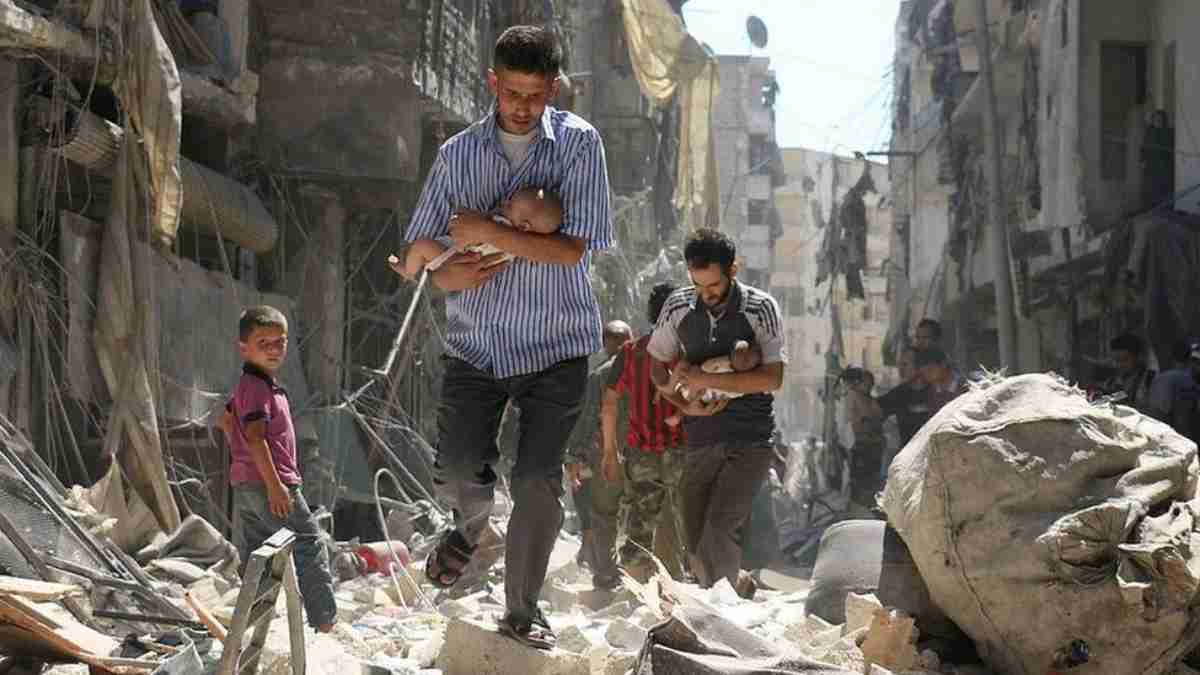
Syrian army has discovered a workshop used by terrorists for manufacturing toxic chemical weapons in Eastern Ghouta, where US has recently threatened to “act if necessary” criticizing Syria and Russia for not implementing UN Resolution for a 30-day ceasefire. However, five-hour ceasefire is being observed each day for evacuating civilians from the enclave.
According to Syria’s official news agency SANA’s Tuesday report, the clandestine workshop was uncovered near recently-liberated al-Shefounieh town in the volatile enclave as Syrian soldiers were combing the area for possible improvised explosive devices planted by outfits including Jaish al-Islam before its defeat.
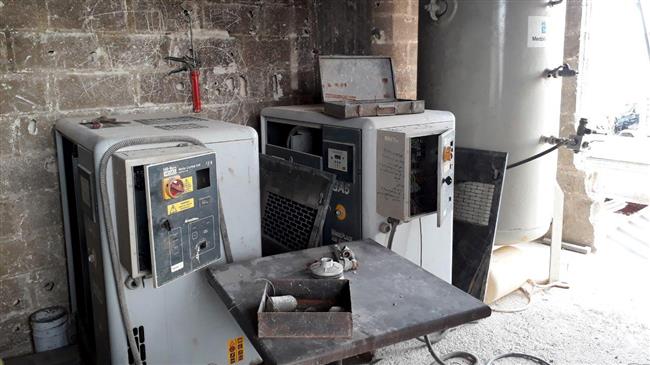
The agency has cited an unnamed military commander saying that the plant housed in a two-story building with a basement located between Douma and al-Shefounieh included a lab for making toxic chemicals containing equipment of “Saudi origin” and materials and protection gear of “Western origin.”
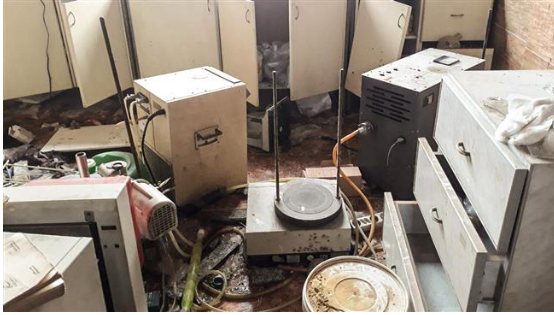 The captured lab contained vials for mixing chemicals as well as vats and mixing and heating equipment. A variety of materials used to make lethal chemicals and explosives, including substances containing chlorine, as well as Saudi manuals and booklets with the logo of the Takfiri outfit were also captured from the building, the commander said.
Read More:- UN: North Korea provides material for Syrian chemical weapons
The workshop houses high-tech equipment and installations, indicating “the involvement” of European and Saudi Arabia’s experts and chemists.
The Eastern Ghouta, home to some 400,000 people, has been under the control of multiple terror groups, particularly Jaish al-Islam and Jabhat Fateh al-Sham, formerly known as al-Nusra Front. The terrorists have reportedly used civilians as human shield.
 The Syrian army has launched a full-scale offensive to crush the terror outfits in Eastern Ghouta and elsewhere. The Ghouta based militants are trying to prevent civilians from leaving the enclave and have been targeting them while trying to escape through safe passages of al-Wafideen and Jisreen.
Following the alleged use of chemical weapons in Eastern Ghouta in January, US Secretary of State Rex Tillerson claimed that the Syrian government could be using chemical weapons and accused Moscow of being responsible for the victims.
In late January, US accused Syrian government of a chlorine gas attack on civilians in Eastern Ghouta. Its ambassador to UN Nikki Haley and Secretary of State Rex Tillerson in Paris had rebuked Russia for what they called its failure to stop such assaults, which are war crimes under international law. Russians called the American accusations “baseless.”
Read More:- Syria: Western Countries providing Chemical Weapons to Terrorists
Syria has been gripped by Daesh (IS), Jabhat al-Nusra and several other terrorist groups’ attacks since March 2011. Damascus says the Israeli regime and its Western and regional allies have been aiding the groups wreaking havoc in the country.
According to the so-called Syrian Observatory for Human Rights, around 511,000 people have been killed in Syria militancy began some seven years ago. However, it has recently acknowledged succeeding in identifying 350,000 of those killed.





Latest world news
S Jaishankar says India is a natural option for Russia amid Europe tensions
External Affairs Minister S Jaishankar said India remained a natural option for Russia as Moscow increasingly turned towards Asia amid strained relations with Europe. He highlighted the continuity of India-Russia ties and their significance for the balance of power in Asia.


Latest world news
Putin praises PM Modi, says he has very good ideas on Ukraine war
Russian President Vladimir Putin has praised Prime Minister Narendra Modi for repeatedly raising the need to end the Ukraine war, describing his ideas for a settlement as “very good”.

Latest world news
S Jaishankar calls Pakistan a “serial practitioner of terrorism” at UN
S Jaishankar criticised Pakistan at the UN General Assembly, referring to a “serial practitioner of terrorism” and warning against attempts to normalise terrorism.

Supreme Court stays defamation case against Rahul Gandhi over PM Modi remarks

Rahul Gandhi hosts high tea for INDIA bloc after Gyanesh Kumar protests

L Murugan quits Union ministry to strengthen BJP in Tamil Nadu

Amit Shah attacks Rahul Gandhi over Congress poll losses, questions SIR row

BJP focuses on religion as opposition pushes BDM strategy in UP

PM Modi speaks to Mark Carney as India and Canada push to strengthen ties

S Jaishankar says India is a natural option for Russia amid Europe tensions

CJP leaders Saurav Das, Ashutosh Ranka, Ajinkya Shinde sent to 5-day judicial custody
BJP focuses on religion as opposition pushes BDM strategy in UP
L Murugan quits Union ministry to strengthen BJP in Tamil Nadu

Afghan Men Try To Hang With The Jet Engine Of The Aircraft in Kabul- Afghanistan News – Kabul News
Trending Top 10 News: 10000 Crore Fine on Flipkart, Apple to Launch Unique Feature, Hdfc Bank Job Ad

Trending Top 10 News: Nokia 6310, Apple sales, Bachpan ka Pyar Video Kid, Dainik Bhaskar IT Raid

Trending Top 10 News: Canada bans Indian flights, Rain in Delhi NCR, AIMIM Twitter hacked, Raj Kundra case

Trending Top 10 News: Shein India, Apple New Service, Pocket Oxygen, Oppo Launched New Phone
-
 India News23 hours ago
Supreme Court stays defamation case against Rahul Gandhi over PM Modi remarks
-
 India News15 hours ago
Rahul Gandhi hosts high tea for INDIA bloc after Gyanesh Kumar protests
-
 India News14 hours ago
L Murugan quits Union ministry to strengthen BJP in Tamil Nadu
-
 India News14 hours ago
Amit Shah attacks Rahul Gandhi over Congress poll losses, questions SIR row
-
 India News13 hours ago
BJP focuses on religion as opposition pushes BDM strategy in UP
-
 India News2 hours ago
CJP leaders Saurav Das, Ashutosh Ranka, Ajinkya Shinde sent to 5-day judicial custody
-
 Latest world news2 hours ago
S Jaishankar says India is a natural option for Russia amid Europe tensions
-
 India News2 hours ago
PM Modi speaks to Mark Carney as India and Canada push to strengthen ties
