English हिन्दी
Connect with us

Economy news

India a bright spot amid projected decline in global growth: IMF

The International Monetary Fund (IMF) has projected India’s growth to dip slightly from 6.1 percent to 6.8 percent during the current fiscal year ending on March 31. IMF also expects some minor slowdown in the Indian economy in the next fiscal year.


Published

on

International Monetary Fund

The International Monetary Fund (IMF) has projected India’s growth to dip slightly from 6.1 percent to 6.8 percent during the current fiscal year ending on March 31. IMF also expects some minor slowdown in the Indian economy in the next fiscal year.
According to the January update of the World Economic Outlook released by global fiscal body on Tuesday, global growth is projected to fall from a projected 3.4 percent in 2022 to 2.9 percent in 2023, then rise to 3.1 percent in 2024.

Pierre-Olivier Gourinchas, Chief Economist and Director, Research Department of the IMF said in a statement that the IMF’s projections for India remain unchanged from its October update as they predict a 6.8 percent growth curve for the Indian economy for the current fiscal and an expected minor dip to 6.1 percent in the next fiscal.

According to the IMF World Economic Outlook, the slowdown is largely driven by external factors, adding that the India’s growth will once again see an upward curve and go up to 6.8 percent in 2024 due to resilient domestic demand despite external factors.

The report expects a rise in growth in developing Asian nations in 2023 and 2024 to 5.3 percent and 5.2 percent, respectively, after the slowdown in 2022 to 4.3 percent.

For the first time in the last four decades, China’s growth fell below the global average in the fourth quarter of 2022 which saw a 0.2 percentage point downgrade, settling at 3.0 percent. However, China’s growth is expected to rise to 5.2 percent in 2023 and fall to 4.5 percent in 2024 before settling at below 4 percent over the medium term amid declining business dynamism and slow progress on structural reforms.

Read Also: Railways cancel over 350 trains, divert route of 16 trains, check full list here

Gourinchas pointed out that emerging market economies and developing economies are already on the way up and have seen a slight rise in growth for the region from 3.9 percent in 2022 to 4 percent in 2023.

He stressed that India and China combined account for almost 50 percent of world growth in 2023, adding that IMF’s positive view on India’s growth curve remains unchanged.

Gourinchas in a blog post termed India as a bright spot which, together with China, will account for half of the global growth in 2023, compared to the US and Euro area, who account for just a 10th of the world’s growth.

Gourinchas also forecasted a much more pronounced slowdown for advanced economies with a decline from 2.7 percent last year to 1.2 percent and 1.4 percent this year and next.

Nine out of 10 advanced economies will likely decelerate, he added.

He predicted that the US’ growth will slow to 1.4 percent in 2023 as Federal Reserve interest-rate hikes work their way through the economy. Euro area conditions are more challenging despite signs of resilience to the energy crisis, a mild winter, and generous fiscal support, he said.

Haryana man killed in road mishap, police say; family claims beaten to death by cow vigilantes

Peshawar suicide bombing: Death toll rises to 83, over 150 wounded

Economy news

ITR filing last date today: What taxpayers must know about penalties and delays

The deadline for ITR filing ends today, September 15. Missing it may lead to penalties, interest charges, refund delays, and loss of tax benefits.


Published

on

Income Tax Return

The deadline to file Income Tax Returns (ITR) for most taxpayers, including salaried individuals, pensioners, and small businesses not requiring audit, ends today, September 15. Those who miss the due date face penalties, interest charges, and loss of certain tax benefits.

Penalties for late filing

If the return is not filed by the deadline, taxpayers can still file a belated return until December 31. However, under Section 234F of the Income Tax Act, late filing attracts penalties.

  • For income up to Rs5 lakh: penalty is capped at Rs1,000.
  • For income above Rs5 lakh: penalty increases to Rs5,000.

Additionally, if any tax remains unpaid, Section 234A imposes an interest of 1% per month (or part thereof) until the return is filed.

Consequences of missing deadline

  • Loss of certain tax benefits: Belated filers cannot carry forward specific losses such as business or capital losses.
  • Restrictions on tax regime change: Taxpayers lose the option to switch between old and new tax regimes after the deadline.
  • Refund delays: Those eligible for refunds will face delays compared to timely filers.

Steps to file before time runs out

  • Gather documents: Form 16, Form 26AS, Annual Information Statement (AIS), bank interest certificates, and proofs of investments or deductions.
  • Use the e-filing portal: File immediately to avoid last-minute portal congestion.
  • Verify your return: Ensure the ITR is verified electronically or physically for it to be considered valid.

Continue Reading

Economy news

India’s GDP surges 7.8% in Q1, outpaces estimates and China

India’s GDP surged 7.8% in Q1 2025-26, the highest in five quarters, driven by strong services and agriculture sector growth, according to NSO data.
Published

on

GDP Growth

India’s economy recorded a sharp growth of 7.8% in the April-June quarter (Q1) of 2025-26, surpassing the earlier estimate of 6.5% and outpacing China’s 5.2% growth in the same period. The figure also marks a notable rise from the 6.5% growth in the corresponding quarter last year, making it the fastest expansion in the last five quarters.

Strong performance across key sectors

According to data released by the National Statistical Office (NSO), the surge was driven primarily by the services sector, which expanded 9.3% compared to 6.8% a year ago, and the agriculture sector, which rose 3.7% against 1.5% last year.

The construction sector, however, witnessed a slowdown, growing 7.6% compared to 10.1% in the same quarter of the previous fiscal.

RBI’s earlier forecast

Earlier this month, the Reserve Bank of India (RBI) had projected a more modest Q1 growth of 6.5%, with overall real GDP growth for 2025-26 expected at 6.5%. RBI Governor Sanjay Malhotra attributed the positive outlook to favorable conditions, including a good monsoon, lower inflation, and strong government capital expenditure.

He said, “The above normal southwest monsoon, lower inflation, rising capacity utilisation and congenial financial conditions continue to support domestic economic activity. The supportive monetary, regulatory and fiscal policies, including robust government capital expenditure, should also boost demand. The services sector is expected to remain buoyant, with sustained growth in construction and trade in the coming months.”

India remains fastest-growing major economy

With China reporting 5.2% growth in April-June, India has retained its position as the world’s fastest-growing major economy. The latest figures highlight resilience in the face of external pressures, including recent US tariffs on Indian imports.

Continue Reading

Economy news

Sensex falls 600 points, nifty slips 180 as US tariffs hit Indian markets

Indian equity markets witnessed sharp declines as US tariffs on Indian imports took effect. Sensex dropped over 600 points, while Nifty fell nearly 180 points in early trade.
Published

on

Stock market crash

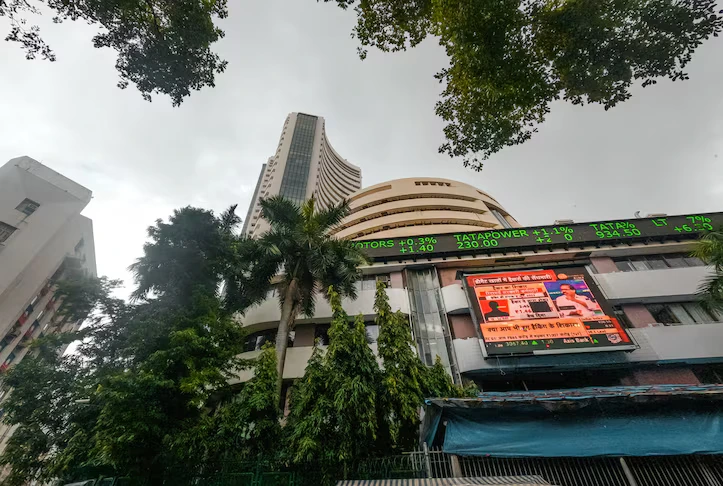
Indian stock markets opened lower on Thursday, reeling under the pressure of fresh US tariffs imposed on Indian goods.

At 9:17 am, the BSE Sensex dropped over 600 points to trade at 80,315, while the Nifty 50 declined nearly 180 points to 24,583. This comes a day after Washington enforced an additional 25% duty on Indian imports, raising the total tariff to 50%.

Broad-based sell-off across sectors

Market sentiment remained weak with 14 of the 16 major sectors posting losses. Small-cap and mid-cap indices also dipped, losing 0.2% and 0.1%, respectively.

The fall follows a steep correction earlier this week. On Tuesday, before the tariff announcement, both Nifty and Sensex fell by around 1% — their sharpest single-day decline in three months. Domestic markets remained closed on Wednesday for a local holiday.

Analysts warn of near-term pressure

According to market experts, Indian equities are likely to witness further volatility as investors digest the impact of the US action. The tariffs were imposed in retaliation for India’s continued crude oil imports from Russia, a move that has escalated trade tensions between the two nations.

Continue Reading

Trending

© Copyright 2022 APNLIVE.com