
Latest world news
India wins Kishangana battle against Pakistan at International Court


World Bank asks Pakistan to withdraw petition and accept neutral expert
India has won another diplomatic war against Pakistan on Kishanganga dam issue. The World Bank has advised Pakistan to withdraw from its stand of referring the dispute to the International Court of Arbitration (ICA) and instead accept India’s offer of appointing a “neutral expert”.
According to Pakistan’s leading daily Dawn, World Bank president Jim Yong Kim has, last week, advised Islamabad to withdraw from its stand of taking the matter to the ICA.
India describes Kishanganga dam issue as differences between two countries over the design of the dam and, therefore, it should be addressed by some neutral experts.
But Pakistan considers the construction of the dam in Jammu and Kashmir over the waters flowing into the western rivers a violation of the Indus Waters Treaty 1960. Islamabad considers that it will not only alter the course of the river but also deplete the water level of the rivers flowing into Pakistan. Hence the dispute should be referred to the international court of arbitration.
Read More: Dawn: Pakistan lost diplomatic battle on Kishanganga dam
Dawn, quoting a source privy to the development, reports that Pakistan believed that acceding to India’s proposal of referring the dispute to neutral experts or withdrawing its stand would mean closing the doors of arbitration and surrendering its right of raising disputes before international courts. The unnamed official said, “It will become a precedent and every time a dispute emerges between Pakistan and India, the latter will always opt for dispute resolution through neutral experts.”
 In November 2016, The World Bank had even picked a US chief justice, the rector of Imperial College, London, and the WB president for appointing chairman of the court to resolve the dispute over the dam.
However, in December 2016, the WB president had informed Pakistan that he had decided to “pause” the process of appointing the International Court of Arbitration (ICA) chairman as well as the neutral expert.
The World Bank did not heed to Pakistan’s concern when provided with satellite images showing the ongoing construction at the dam. The bank even did not allow staying the construction of the dam.
Read More: World Bank fails to reach agreement with Pakistan on Indus Waters dispute
The 1960 treaty recognizes the WB as an arbitrator in water disputes between the two countries as played it played a key role in concluding this agreement. It allows India to have control over the water flowing into three eastern rivers- Beas, Ravi and Sutlej, also permitting India to use the water of western rivers-Chenab, Jhelum and Indus. However, it does not allow India to divert the flow of the water.
India considers this as a permission to build “run-of-the-river” hydel projects that neither change the course of the river nor deplete the water level downstream.
According to Wikipedia, the Kishanganga Hydroelectric Plant is part of a run-of- the-river hydroelectric scheme that is designed to divert water from the Kishanganga River to a power plant in the Jhelum river basin. It is located 5-km north of Bandipore in Jammu and Kashmir.
 The construction of the dam was temporarily halted by ICA in October 2011 due to Pakistan’s protest of its effect on the flow of the Kishanganga River, which is known as Neelam River in Pakistan.
Read More: Pakistan reaches to World Bank against India on Kishanganga dam
However, in February 2013, the ICA ruled that India could divert all the water leaving a minimum amount to the downstream of the dam for the purpose of environmental flows.
First unit of 110 MW capacity was tested in March this year, while all three units of equal capacity were commissioned and synchronized with the electricity grid by 30 March. Prime Minister Narendra Modi inaugurated the project on 19 May 2018.








Latest world news
S Jaishankar defends Russian oil imports, says it won’t end Ukraine war
S Jaishankar defended India’s Russian oil purchases, saying the Ukraine war can only be resolved through dialogue, diplomacy and negotiations


Latest world news
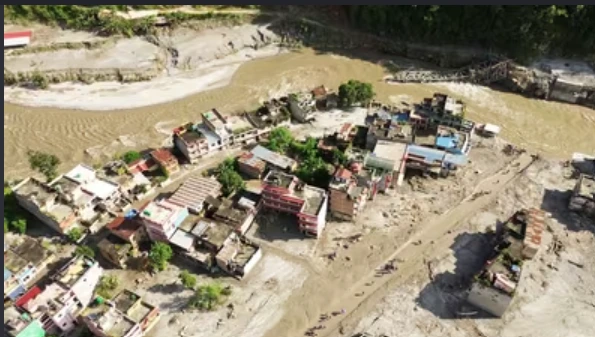
Nepal seeks climate compensation from India, China and US for deadly floods
Nepal has sought climate compensation from India, China and the US after a devastating flash flood killed more than 1,100 people and left nearly 4,500 missing.
Latest world news
Bank of America VP Erin Piacenti killed in New York stabbing
Bank of America vice-president Erin Piacenti, 32, was fatally stabbed in an apparently random attack in New York’s Times Square.


S Jaishankar defends Russian oil imports, says it won’t end Ukraine war

PM Modi hails ISRO after successful GSLV-F17 launch, calls it proud moment

Nagaland Assembly urges Centre to withdraw Protected Area Permit regime

India offers forensic DNA support to identify Nepal flood victims

OpenAI launches GPT-6 Astra with major upgrades in AI reasoning, coding and computer use

Air India sacks Phuket-Delhi flight pilot after failing drug test
OpenAI launches GPT-6 Astra with major upgrades in AI reasoning, coding and computer use

Musician Bhagirath Bhatt breaks silence on Bigg Boss 20 entry, says not going
India offers forensic DNA support to identify Nepal flood victims
PM Modi hails ISRO after successful GSLV-F17 launch, calls it proud moment

Afghan Men Try To Hang With The Jet Engine Of The Aircraft in Kabul- Afghanistan News – Kabul News
Trending Top 10 News: 10000 Crore Fine on Flipkart, Apple to Launch Unique Feature, Hdfc Bank Job Ad

Trending Top 10 News: Nokia 6310, Apple sales, Bachpan ka Pyar Video Kid, Dainik Bhaskar IT Raid

Trending Top 10 News: Canada bans Indian flights, Rain in Delhi NCR, AIMIM Twitter hacked, Raj Kundra case

Trending Top 10 News: Shein India, Apple New Service, Pocket Oxygen, Oppo Launched New Phone
-
 Latest world news15 hours ago
S Jaishankar defends Russian oil imports, says it won’t end Ukraine war
-
 India News15 hours ago
PM Modi hails ISRO after successful GSLV-F17 launch, calls it proud moment
-
 India News15 hours ago
Nagaland Assembly urges Centre to withdraw Protected Area Permit regime
-
 India News10 hours ago
India offers forensic DNA support to identify Nepal flood victims
-
 Tech9 hours ago
OpenAI launches GPT-6 Astra with major upgrades in AI reasoning, coding and computer use
-
 Entertainment10 hours ago
Musician Bhagirath Bhatt breaks silence on Bigg Boss 20 entry, says not going
-
 India News5 hours ago
Air India sacks Phuket-Delhi flight pilot after failing drug test
