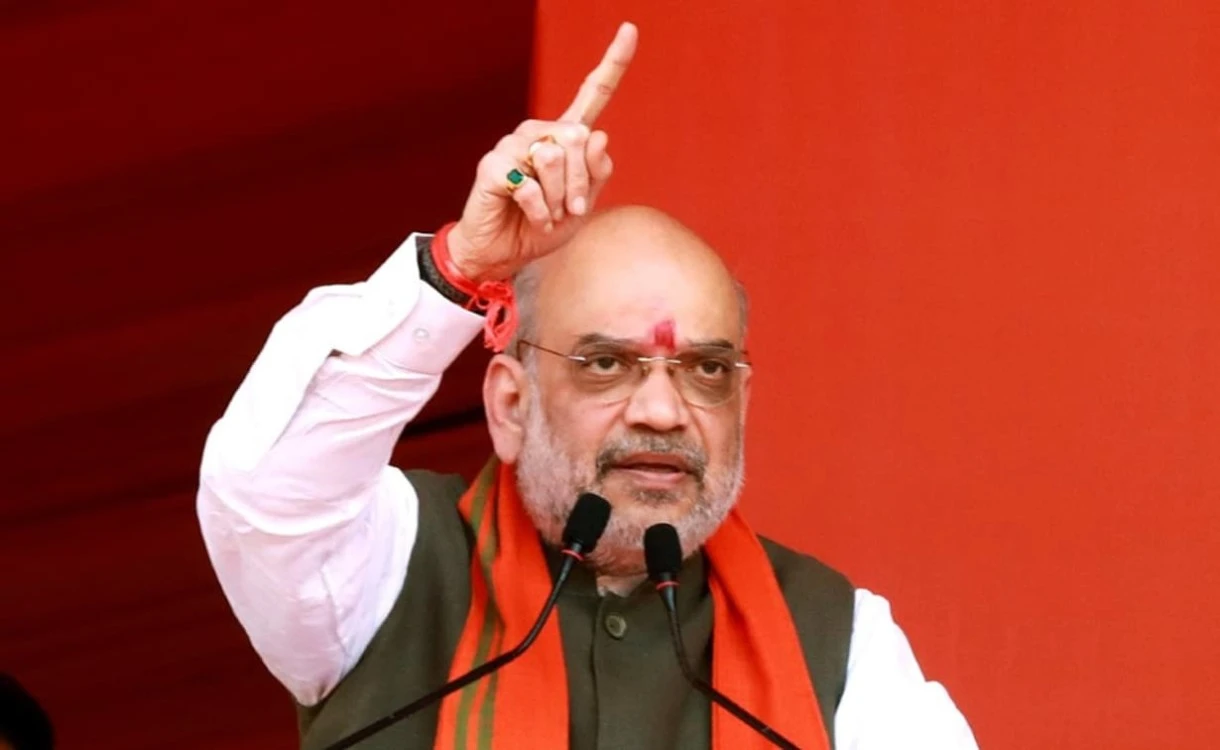
[vc_row][vc_column][vc_column_text]A RTI report has named a district cooperative bank which has BJP president Amit Shah as a director as netting the highest deposits among such banks of banned Rs 500 and Rs 1,000 notes within five days of demonetisation on November 8, 2016.
The reply to a RTI query by a Mumbai-based activist said Ahmedabad District Cooperative Bank (ADCB) secured deposits of Rs 745.59 crore of the spiked notes – in just five days after Prime Minister Narendra Modi made the demonetisation announcement.
Notably, all the district cooperative banks were banned from accepting deposits of the banned currency notes from the public after November 14, 2016 – five days after demonetisation – on fears that black money would be laundered through this route.
According to the bank’s website, Shah continues to be a director with the bank and has been in that position for several years, said media reports. He was also the bank’s chairman in 2000. ADCB’s total deposits on March 31, 2017, were Rs 5,050 crore and its net profit for 2016-17 was Rs 14.31 crore.
Right behind ADCB is the Rajkot District Cooperative Bank, whose chairman JayeshbhaiVitthalbhaiRadadiya is a cabinet minister in Gujarat Chief Minister Vijay Rupani’s government. It got deposits of old currencies worth Rs 693.19 crore.
Interestingly, the figures of these DCCBs of Ahmedabad and Rajkot DCCBs are much higher than the apex Gujarat State Cooperative Bank Ltd, which got deposits of a mere Rs 1.11 crore.
“The amount of deposits made in the State Cooperative Banks (SCBs) and District Central Cooperative Banks (DCCBs) – revealed under RTI for first time since demonetisation – are astounding,” Manoranjan S Roy, the RTI activist who made the effort to get the information, told IANS.
The RTI information was given by the Chief General Manager and Appellate Authority, S Saravanavel, of the National Bank for Agriculture & Rural Development (NABARD).
RTI queries also revealed that only seven public sector banks (PSBs), 32 SCBs, 370 DCCBs, and a little over three-dozen post offices across India collected Rs 7.91 lakh crore — more than half (52 per cent) of the total amount of old currencies of Rs 15.28 lakh crore deposited with the RBI.
The break-up of Rs 7.91 lakh crore mentioned in the RTI replies showsthat the value of spiked notes deposited with the RBI was
Seven PSBs – Rs 7.57 lakh crore
32 SCBs – Rs 6,407 crore
370 DCCBs – Rs 22,271 crore.
Old notes deposited by 39 post offices were worth Rs 4,408 crore.
Information from all the SCBs and DCCBs across India were received through the replies. The seven PSBs account for around 29,000 branches — out of the over 92,500 branches of the 21 PSBs in India — according to data published by the RBI. The 14 other PSBs declined to give information on one ground or the other.
Of the total 21 PSBs, State Bank of India, Bank of Baroda, Bank of Maharashtra, Central Bank of India, Dena Bank, Indian Overseas Bank, Punjab & Sindh Bank, Vijaya Bank, Andhra Bank, Syndicate Bank, UCO Bank, United Bank of India, Oriental Bank of Commerce, and IDBI Bank (14 banks) — with over 63,500 branches amongst them — did not give any information on deposits.
Fifteen months after demonetisation, the government had announced that Rs 15.28 Lakh crore — or 99 per cent of the cancelled notes worth Rs 15.44 lakh crore — were returned to the RBI treasury.
Roy said it was a serious matter if only a few banks and their branches and a handful post offices, apart from SCBs and DCCBs, accounted for over half the old currency notes.
“At this rate, serious questions arise about the actual collection of spiked notes through the remaining 14 mega-PSBs, besides rural-urban banks, private banks (like ICICI, HDFC and others), local cooperatives, Jankalyan Banks and credit cooperatives and other entities with banking licenses, the figures of which are not made available under RTI,” he said.
NABARD issued a statement defending the ADCB.
The apex institution for rural economy credit in India, noted that all the bank accounts into which the demonetised notes were deposited were verified and checked to see if they had complied with ‘know-your-customer’ (KYC) regulations.
“NABARD conducted 100 % verification in Ahmedabad DCCB which revealed that the bank had complied with all the KYC Guidelines of the RBI while accepting the demonetised notes,” it said in a statement released on Friday afternoon.
“As per the verification report of NABARD, required under the extant guidelines, the bank had also submitted the required Cash Transaction Reports (CTRs) and STRs to FlU-India wherever required,” it added.
The agricultural and rural institution also curiously makes two other points in defence of ADCB.
Firstly, it notes that district central cooperative banks in Gujarat received less demonetised notes when compared to their counterparts in Kerala and Maharashtra.
Secondly, it notes that the amount of money that was deposited in the days after demonetisation in ADCB was in complete “proportion to the size and number of accounts in the bank”.
“Of the total 16 lakh accounts with the DCCB, deposits/ exchanges were made only by 1.60 lakh customers i.e. 9.37% of the total deposit accounts,” NABARD’s statement notes.
Out of these 1.60 lakh customers, less than Rs 2.5 lakh was deposited in 98.66% of the accounts. Out of the bank’s total accounts, 0.09% of accounts saw deposits above Rs 2.5 lakh made.
“The average deposit amount in Ahmedabad DCCB was Rs. 46,795 which was lower than average per depositor in 18 DCCBs of Gujarat. During this intervening period 1.60 lakh customers of the bank deposited/ exchanged demonetised notes aggregating to Rs 746 crore which was only about 15 % of total deposits of the bank,” the statement emphasises.
The Opposition, however, mounted a strong attack on the BJP and its president. Congress president Rahul Gandhi said: “Congratulations Amit Shah ji , Director, Ahmedabad Dist. Cooperative Bank, on your bank winning 1st prize in the conversion of old notes to new race. 750 Cr in 5 days! Millions of Indians whose lives were destroyed by Demonetisation, salute your achievement.”[/vc_column_text][vc_raw_html]JTNDYmxvY2txdW90ZSUyMGNsYXNzJTNEJTIydHdpdHRlci10d2VldCUyMiUyMGRhdGEtbGFuZyUzRCUyMmVuJTIyJTNFJTNDcCUyMGxhbmclM0QlMjJlbiUyMiUyMGRpciUzRCUyMmx0ciUyMiUzRUNvbmdyYXR1bGF0aW9ucyUyMEFtaXQlMjBTaGFoJTIwamklMjAlMkMlMjBEaXJlY3RvciUyQyUyMEFobWVkYWJhZCUyMERpc3QuJTIwQ29vcGVyYXRpdmUlMjBCYW5rJTJDJTIwb24lMjB5b3VyJTIwYmFuayUyMHdpbm5pbmclMjAxc3QlMjBwcml6ZSUyMGluJTIwdGhlJTIwY29udmVyc2lvbiUyMG9mJTIwb2xkJTIwbm90ZXMlMjB0byUyMG5ldyUyMHJhY2UuJTIwNzUwJTIwQ3IlMjBpbiUyMDUlMjBkYXlzJTIxJTNDYnIlM0UlM0NiciUzRU1pbGxpb25zJTIwb2YlMjBJbmRpYW5zJTIwd2hvc2UlMjBsaXZlcyUyMHdlcmUlMjBkZXN0cm95ZWQlMjBieSUyMERlbW9uZXRpc2F0aW9uJTJDJTIwc2FsdXRlJTIweW91ciUyMGFjaGlldmVtZW50LiUyMCUzQ2ElMjBocmVmJTNEJTIyaHR0cHMlM0ElMkYlMkZ0d2l0dGVyLmNvbSUyRmhhc2h0YWclMkZTaGFoWnlhZGFLaGFHYXlhJTNGc3JjJTNEaGFzaCUyNmFtcCUzQnJlZl9zcmMlM0R0d3NyYyUyNTVFdGZ3JTIyJTNFJTIzU2hhaFp5YWRhS2hhR2F5YSUzQyUyRmElM0UlM0NhJTIwaHJlZiUzRCUyMmh0dHBzJTNBJTJGJTJGdC5jbyUyRnJmMVFhR216eFYlMjIlM0VwaWMudHdpdHRlci5jb20lMkZyZjFRYUdtenhWJTNDJTJGYSUzRSUzQyUyRnAlM0UlMjZtZGFzaCUzQiUyMFJhaHVsJTIwR2FuZGhpJTIwJTI4JTQwUmFodWxHYW5kaGklMjklMjAlM0NhJTIwaHJlZiUzRCUyMmh0dHBzJTNBJTJGJTJGdHdpdHRlci5jb20lMkZSYWh1bEdhbmRoaSUyRnN0YXR1cyUyRjEwMTAwNzg1Njc0MTIyNDAzODQlM0ZyZWZfc3JjJTNEdHdzcmMlMjU1RXRmdyUyMiUzRUp1bmUlMjAyMiUyQyUyMDIwMTglM0MlMkZhJTNFJTNDJTJGYmxvY2txdW90ZSUzRSUwQSUzQ3NjcmlwdCUyMGFzeW5jJTIwc3JjJTNEJTIyaHR0cHMlM0ElMkYlMkZwbGF0Zm9ybS50d2l0dGVyLmNvbSUyRndpZGdldHMuanMlMjIlMjBjaGFyc2V0JTNEJTIydXRmLTglMjIlM0UlM0MlMkZzY3JpcHQlM0UlMEE=[/vc_raw_html][vc_column_text]The Congress tweeted: “Is it really a surprise that two-thirds of the demonetised currency was collected in banks in BJP ruled states?”[/vc_column_text][vc_raw_html]JTNDYmxvY2txdW90ZSUyMGNsYXNzJTNEJTIydHdpdHRlci10d2VldCUyMiUyMGRhdGEtbGFuZyUzRCUyMmVuJTIyJTNFJTNDcCUyMGxhbmclM0QlMjJlbiUyMiUyMGRpciUzRCUyMmx0ciUyMiUzRUlzJTIwaXQlMjByZWFsbHklMjBhJTIwc3VycHJpc2UlMjB0aGF0JTIwdHdvLXRoaXJkcyUyMG9mJTIwdGhlJTIwZGVtb25ldGlzZWQlMjBjdXJyZW5jeSUyMHdhcyUyMGNvbGxlY3RlZCUyMGluJTIwYmFua3MlMjBpbiUyMEJKUCUyMHJ1bGVkJTIwc3RhdGVzJTNGJTIwJTNDYSUyMGhyZWYlM0QlMjJodHRwcyUzQSUyRiUyRnR3aXR0ZXIuY29tJTJGaGFzaHRhZyUyRlNoYWhaeWFkYUtoYUdheWElM0ZzcmMlM0RoYXNoJTI2YW1wJTNCcmVmX3NyYyUzRHR3c3JjJTI1NUV0ZnclMjIlM0UlMjNTaGFoWnlhZGFLaGFHYXlhJTNDJTJGYSUzRSUzQ2ElMjBocmVmJTNEJTIyaHR0cHMlM0ElMkYlMkZ0LmNvJTJGdk5xelkzUjdUMiUyMiUzRXBpYy50d2l0dGVyLmNvbSUyRnZOcXpZM1I3VDIlM0MlMkZhJTNFJTNDJTJGcCUzRSUyNm1kYXNoJTNCJTIwQ29uZ3Jlc3MlMjAlMjglNDBJTkNJbmRpYSUyOSUyMCUzQ2ElMjBocmVmJTNEJTIyaHR0cHMlM0ElMkYlMkZ0d2l0dGVyLmNvbSUyRklOQ0luZGlhJTJGc3RhdHVzJTJGMTAxMDEyNDA2NjMwMzI5NTQ4OSUzRnJlZl9zcmMlM0R0d3NyYyUyNTVFdGZ3JTIyJTNFSnVuZSUyMDIyJTJDJTIwMjAxOCUzQyUyRmElM0UlM0MlMkZibG9ja3F1b3RlJTNFJTBBJTNDc2NyaXB0JTIwYXN5bmMlMjBzcmMlM0QlMjJodHRwcyUzQSUyRiUyRnBsYXRmb3JtLnR3aXR0ZXIuY29tJTJGd2lkZ2V0cy5qcyUyMiUyMGNoYXJzZXQlM0QlMjJ1dGYtOCUyMiUzRSUzQyUyRnNjcmlwdCUzRSUwQQ==[/vc_raw_html][vc_column_text]CPI(M) general secretary Sitaram Yechury said: “The poor could not get their demonetised notes exchanged, more than 100 died in queues for their own hard-earned money. But Shri Amit Shah ji’s bank had the maximum currency exchanged after notebandi. SaafNiyat or SahiNeeyat, now? #NoteScam”[/vc_column_text][/vc_column][/vc_row]