English हिन्दी
Connect with us

India News

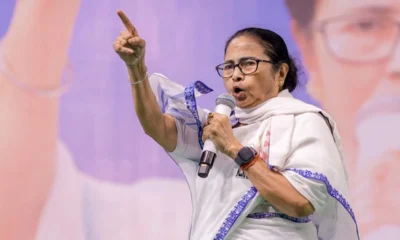
Mamata Banerjee condoles demise of former West Bengal Chief Minister Buddhadeb Bhattacharjee

Banerjee said she has known him for the last several decades and visited him a few times when he was ill and effectively confined to home in the last few years.

Published

on

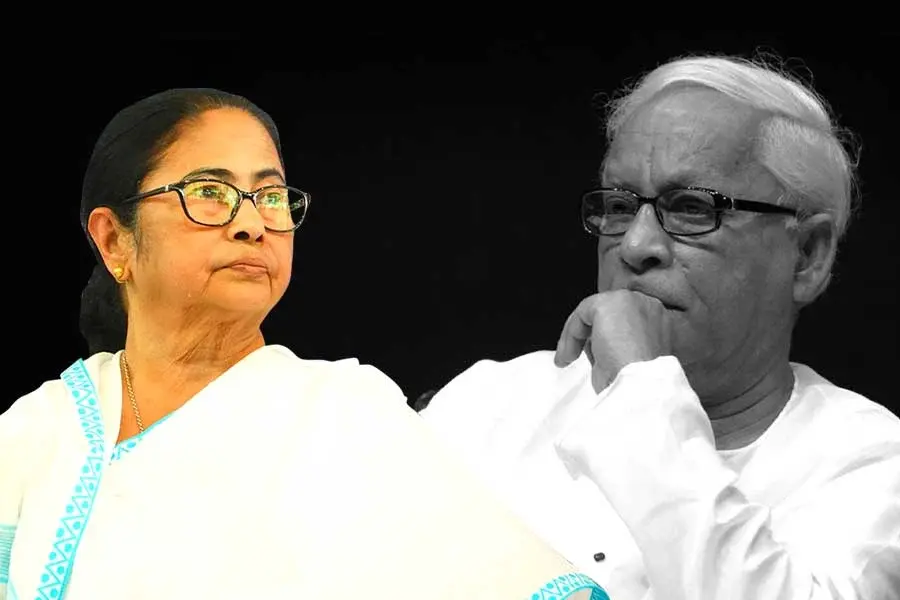
West Bengal Chief Minister Mamata Banerjee on Thursday condoled the demise of former Chief Minister of State Buddhadeb Bhattacharjee and said she was shocked and saddened by the sudden demise of the former CM.

Banerjee said she has known him for the last several decades and visited him a few times when he was ill and effectively confined to home in the last few years.
“My very sincere condolences to Meeradi and Suchetan at this hour of grief. I communicate my condolences to the members of the CPI(M) party and all his followers. We have already taken a decision that we shall give him full respect and ceremonial honour during his last journey and rites”, West Bengal CM said in a post on X.

Veteran Left leader Bhattacharjee died at his south Kolkata residence early this morning. He was 80. He had been suffering from ill-health for several years, chiefly against respiratory problems that often landed him in hospitals. Last year, he was put on life support when a bout of pneumonia hit him, but the fightful CPM leader he was, made a remarkable recovery. He leaves behind his wife Meera and son Suchetan.

A former politburo member of the apex decision-making body of the CPM, Bhattacharjee led the Bengal Chief Ministership between 2000 to 2011 succeeding Jyoti Basu. Under his leadership, CPM fought the 2011 state elections, which the Mamata Banerjee-led TMC convincingly won ending the 34-year Communist regime in the state.

The 77-year-old Bhattacharjee, known for his austere life, died at the simple two-room house on Palm Avenue where, ironically, he had led the administration of the state. His organs would be donated for medical research in accordance with his wish. His body would be taken to the CPI headquarters for people to pay homage. The last rites would be performed on Saturday.

Bhattacharjee is an alumnus of Presidency College, Kolkata, and became a full-time politician after starting his career as a school teacher. An MLA and a state minister, he was being groomed for greater things to come as he was elevated as Deputy Chief Minister soon after Basu’s resignation in 2000. As Chief Minister, he led the CPM to electoral victories in the 2001 and 2006 Assembly polls.

His tenure has taken a comparatively liberal stand toward business, as compared with that of the Jyoti Basu era. Ironically, it was precisely this policy, coupled with the controversial land acquisitions for industrialization, that caused the Left to suffer an ignominious defeat in the 2011 election.

The Trinamool Congress, which managed to win only 30 seats in the 2006 polls, led the fight against the Tata Motors project at Singur. It was finally shifted out of the State to Gujarat in 2008 by Ratan Tata, who cited Banerjee’s agitation as the reason. The development marked a severe embarrassment to Bhattacharjee’s Government. No less damaging was the Nandigram violence, in which 14 people died when police fired on those protesting acquisition of land for a chemical hub.

The benefiting party, Banerjee’s Trinamool Congress, rode to power in 2011 with 184 seats on the wave of anti-incumbency sentiment against the Left Front and the negative perception of the land acquisition policies of the state government. The defeat completed the slide into a decline from which it has yet to recover. A decade later, the BJP is now the principal Opposition, pushing the Left to a minor force in a state it once ruled unchallenged for decades.

Condoling his death, Bengal Governor CV Ananda Bose said that it marked the end of an era of politics. Chief Minister Banerjee said in her condolence message: “I am deeply saddened. My condolences to Meera di, Suchetan, and all CPM supporters. We have decided to accord him full respect and ceremonial honours during his last journey and rites.”.

Leader of the Opposition, BJP’s Suvendu Adhikari, took to Twitter to condone his “deep sadness over the death to the family and fans” of Bhattacharjee.

Long-time fellow and CPM general secretary, Sitaram Yechury, described the news of Bhattacharjee’s passing as “shattering”. “His commitment to the party, West Bengal, our shared ideals and his foresight will always be a guiding star,” he said.

India News

P Chidambaram avoids commenting on Trump’s dead economy remark echoed by Rahul Gandhi

Chidambaram stays silent on Trump’s ‘dead economy’ remark echoed by Rahul Gandhi as Congress critiques Union Budget 2026.

Published

on

P Chidambaram

Finance Minister Nirmala Sitharaman on Sunday presented her ninth consecutive union budget, stopping just short of Morarji Desai’s record of ten.

Congress MP P Chidambaram, however, avoided commenting on the ‘India is a dead economy’ statement made by former US President Donald Trump last July, which was later echoed by Rahul Gandhi.

Speaking to reporters after reviewing the budget, Chidambaram said he could not respond as he lacked the full context of Trump’s original remarks.

The comment by Trump followed India’s continued purchase of Russian crude oil, which the US had criticized as indirectly funding military action in Ukraine. Trump imposed a 25 per cent penalty tariff on Indian imports and added: “I don’t care what India does with Russia. They can take their dead economies down together, for all I care.”

Rahul Gandhi later supported the statement, saying, “He is right, everybody knows this except the Prime Minister and Finance Minister. I am glad President Trump stated a fact…”

The remark sparked a political debate, with BJP leaders criticizing Gandhi, while some Congress members, including Rajya Sabha MP Rajiv Shukla, called the statement “completely wrong.”

Ahead of the budget, Gandhi had highlighted the impact of US tariffs on small textile businesses, noting on X: “50 per cent US tariffs are badly hurting textile exporters. Job losses, shutdowns… are reality of our ‘dead economy’.”

The debate gained traction following the budget announcement, which did not offer immediate relief to middle-class taxpayers and saw markets react sharply, with the Sensex closing 1,500 points lower on Sunday.

Chidambaram, as usual, led Congress’ critique of the budget, pointing to a decrease in capital expenditure as a percentage of GDP from 3.2 per cent in FY25 to 3.1 per cent, despite the proposal of Rs 12.2 lakh crore for capex. He added, “Revenue receipts short by Rs 78,086 crore… total expenditure short by Rs 1,00,503 crore… revenue expenditure short by Rs 75,168 crore… capex was cut by Rs 1,44,376 crore… not a word was said to explain this…”

Rahul Gandhi echoed the criticism, highlighting issues such as unemployment, farmers’ distress, declining household savings, and low investment. “A budget that refuses course correction and is blind to India’s real crises,” he said on X.

Responding to the criticism, Finance Minister Sitharaman said, “With due respects, I don’t know what course correction he is referring to. The economy and its fundamentals are strong.”

Continue Reading

India News

Earthquake of 4.6 magnitude hits Andaman and Nicobar Islands

A 4.6 magnitude earthquake struck the Nicobar Islands at 10 km depth, highlighting the region’s seismic activity and potential risks from shallow tremors.

Published

on

earthquake-tremors

An earthquake measuring 4.6 on the Richter scale struck the Andaman and Nicobar Islands early Monday at around 3:30 am, the National Center of Seismology (NCS) reported.

According to the NCS, the tremor occurred at a shallow depth of 10 km. The earthquake’s epicenter was located at a latitude of 9.03° North and a longitude of 92.78° East, placing it in the Nicobar Islands region.

In a post on X, the NCS confirmed the details: “EQ of M: 4.6, On: 02/02/2026 03:31:12 IST, Lat: 9.03 N, Long: 92.78 E, Depth: 10 Km, Location: Nicobar Islands.”

The Andaman and Nicobar Islands fall under Seismic Zone V, according to India’s seismic zoning map (1893-1984), making them one of the most earthquake-prone regions in the world. Historically, the islands have experienced several major earthquakes, including the devastating tremor on December 26, 2004, which caused significant land displacement and triggered tsunami waves, resulting in heavy loss of life and property.

Experts note that shallow earthquakes, like the one recorded on Monday, can be more hazardous than deeper ones. Seismic waves from shallow quakes travel a shorter distance to the surface, causing stronger ground shaking and posing higher risks to structures and human safety.

Continue Reading

India News

Parliament Budget Session 2026 set to begin with Lok Sabha debate on President’s address

The Parliament Budget Session 2026 is set to begin with the Lok Sabha scheduled to debate President Droupadi Murmu’s address for 18 hours.

Published

on

Parliament

The Parliament Budget Session 2026 is set to begin on Monday, with the Lok Sabha scheduled to take up discussions on President Droupadi Murmu’s address, a day after Finance Minister Nirmala Sitharaman presented the Union Budget 2026-27 in the House.

The Lok Sabha is scheduled to meet at 11:00 am for a busy day of proceedings. A total of 18 hours has been allocated for the debate on the President’s address, which lays out the government’s policy priorities and broad agenda.

Prime Minister Narendra Modi is slated to reply to the discussion on February 4, while Finance Minister Nirmala Sitharaman is expected to respond on February 11.

As per the session calendar, the Budget Session will comprise 30 sittings spread over 65 days and is scheduled to conclude on April 2. Both the Lok Sabha and the Rajya Sabha will adjourn for a recess on February 13 and reconvene on March 9. During the recess period, Standing Committees are expected to examine the Demands for Grants of various ministries and departments.

In addition to legislative business, Budget documents tabled in Parliament are set to provide a detailed break-up of government revenues and expenditure, outlining how funds are raised and allocated.

The opening of the Budget Session also comes amid discussions on the government’s economic approach, including measures announced in the Union Budget aimed at supporting key sectors and addressing global trade challenges.

Continue Reading

Trending

© Copyright 2022 APNLIVE.com