English हिन्दी
Connect with us

India News

Pakistan calls India’s move on Indus Waters Treaty as an act of war

The committee concluded by asserting that Pakistan’s armed forces are fully prepared to defend the nation’s territorial integrity against any misadventure, urging the international community to take note of India’s provocative actions.

Published

on

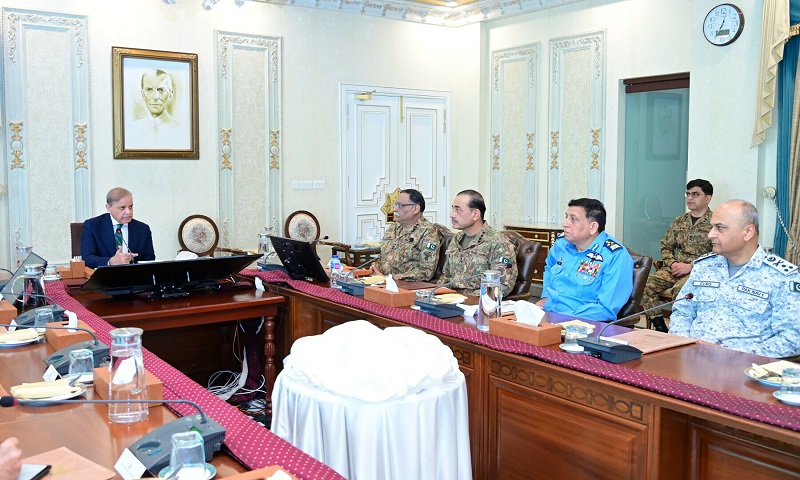
In a sharp escalation of tensions following India’s decision to suspend the Indus Waters Treaty, Pakistan’s Prime Minister’s Office issued a stern warning on Thursday, April 24, 2025, declaring that any attempt to disrupt water flows to Pakistan would be considered an “act of war.”

The statement came after a high-level meeting of Pakistan’s National Security Committee (NSC), chaired by Prime Minister Shehbaz Sharif, which outlined a series of retaliatory measures, including the closure of its airspace to Indian airlines and a complete halt to all trade activities with India.

The NSC, attended by senior civilian and military leaders, addressed the recent terror attack in Pahalgam, Jammu and Kashmir, which claimed 26 lives. While unequivocally condemning the violence, Pakistan rejected India’s attempts to attribute the attack to it, dismissing such claims as “frivolous” and lacking credible evidence.

The committee reiterated Pakistan’s longstanding position that Kashmir remains an unresolved dispute, emphasizing the Kashmiri people’s right to self-determination as recognized by UN resolutions.

It accused India of perpetuating violence through state oppression, demographic changes, and the marginalization of minorities, particularly Muslims, citing recent legislative moves like the Waqf Bill as evidence of systemic persecution.

Pakistan’s strongest rebuke was reserved for India’s announcement to hold the Indus Waters Treaty in abeyance. The 1960 treaty, brokered by the World Bank, has been a cornerstone of water-sharing between the two nations, surviving three wars. The NSC underscored that the agreement contains no provision for unilateral suspension and described water as a “vital national interest” for Pakistan’s 240 million people.

“Any attempt to stop or divert Pakistan’s rightful share of water under the treaty, or to usurp the rights of a lower riparian state, will be treated as an act of war and met with a comprehensive response across all domains of national power,” the statement read.

In response to India’s measures, Pakistan announced a sweeping suspension of all bilateral agreements, including the Simla Pact, accusing India of violating international norms and fostering terrorism. The Wagah border post was ordered closed immediately, with cross-border transit halted, though those with valid endorsements may return by April 30, 2025.

Pakistan also revoked all SAARC Visa Exemption Scheme (SVES) visas for Indian nationals, except for Sikh pilgrims, and instructed Indians in Pakistan to leave within 48 hours. Indian defence, naval, and air advisors in Islamabad were declared persona non grata and given until April 30 to depart, with their posts deemed annulled. The Indian High Commission in Islamabad will see its staff reduced from 55 to 30 by the same date.

Further, Pakistan closed its airspace to all Indian-owned or -operated airlines and suspended all trade with India, including third-country trade routed through Pakistan. The NSC accused India of exploiting the Pahalgam attack to advance a narrow political agenda, pointing to the case of Kulbhushan Jadhav, a serving Indian Navy officer in Pakistan’s custody, as evidence of India’s alleged state-sponsored terrorism. It also criticized India’s “irresponsible warmongering” through state-controlled media, warning that such rhetoric fuels regional instability.

The committee expressed deep sorrow for the loss of lives in Pahalgam but labeled India’s retaliatory measures—announced on April 23—as unilateral, unjust, and politically driven. It argued that India’s narrative of victimhood obscures its own role in regional violence, including alleged extraterritorial assassinations exposed by Pakistan and other nations. Pakistan vowed to pursue justice for those responsible for terrorism and to respond firmly to any threats to its sovereignty.

Reaffirming its commitment to counter-terrorism, the NSC highlighted Pakistan’s sacrifices as a frontline state against terrorism, having endured significant human and economic losses. It called on India to abandon its “reflexive blame game” and take responsibility for its security failures in Jammu and Kashmir. The committee concluded by asserting that Pakistan’s armed forces are fully prepared to defend the nation’s territorial integrity against any misadventure, urging the international community to take note of India’s provocative actions.
As the region braces for heightened tensions, Pakistan’s measures signal a deepening rift with India, with both nations adopting hardline stances in the aftermath of the Pahalgam tragedy.

India News

Delhi to install 305 mist sprayers across 9 major pollution hotspots

Chief Minister Rekha Gupta announced that 305 mist sprayers will be installed across nine pollution hotspots in Delhi, alongside expert-led planning and coordinated measures to reduce dust and biomass-related pollution.

Published

on

Delhi-NCR air quality

The Delhi government has announced a large-scale deployment of mist sprayer technology to tackle rising air pollution, with Chief Minister Rekha Gupta confirming that 305 mist sprayers will be installed across nine pollution hotspots in the capital.

Mist sprayers to curb dust at critical locations

During an inspection at ITO, Gupta said the mist sprayers already operational at the site are performing effectively. She noted that 35 poles at ITO have been fitted with these machines, which are helping suppress dust—a major contributor to air pollution in Delhi.

According to the Chief Minister, trials conducted in certain NDMC areas have shown promising results, reinforcing confidence in the technology.

High-level committee to guide pollution-control measures

Gupta announced the formation of a high-level expert committee that will advise the government on effective measures to reduce pollution. The panel will include senior officials from various departments as well as environmental specialists, including experts from IITs. Officials stated that the committee will receive special powers to implement pollution-mitigation strategies.

Departments directed to repair roads, add greenery

The Chief Minister said departments including PWD, DSIIDC and DDA have been instructed to fix potholes, repair and carpet roads, plant foliage along dividers and islands, and take other measures to reduce pollution sources.

She urged residents to report potholes on the government portal for quicker action.

Appeal to RWAs to prevent biomass burning

To curb winter pollution, Gupta advised Resident Welfare Associations (RWAs) to distribute electric heaters to security guards to discourage biomass burning, which significantly contributes to seasonal pollution spikes.

Continue Reading

India News

PM Modi welcomes Vladimir Putin with warm hug as Russian President begins India visit

Russian President Vladimir Putin began a high-profile visit to India on Thursday, welcomed by PM Narendra Modi as both nations prepare to discuss defence, energy and trade cooperation.

Published

on

Vladimir Putin rides in Indian PM Narendra Modi's car on India visit

Russian President Vladimir Putin arrived in New Delhi on Thursday evening for a 27-hour visit focused on strengthening defence, energy and trade cooperation. The visit, marked by a warm embrace and a brief car ride shared with Prime Minister Narendra Modi, underscores the continuity of the India-Russia strategic partnership amid shifting global geopolitics.

Putin receives ceremonial welcome and packed schedule ahead

Putin landed in Delhi around 6:35 pm, where PM Modi personally received him at Palam airport. The two leaders shared a hug before leaving together, with the Prime Minister set to host a private dinner in honour of the visiting President — a reciprocal gesture to the hospitality extended during Modi’s Moscow visit last year.

On Friday, Putin will begin his official engagements with a ceremonial welcome at Rashtrapati Bhavan, followed by a visit to Rajghat to pay homage to Mahatma Gandhi. He is also scheduled to attend the India-Russia Annual Summit at Hyderabad House, where both sides will hold a working lunch.

The Russian President will later inaugurate a new India-based channel of Russia’s state broadcaster and attend a state banquet hosted by President Droupadi Murmu, before departing India on Friday night.

Defence, energy and trade to dominate agenda

Officials have indicated that discussions will centre on defence, energy and trade — the three pillars of the bilateral relationship. Agreements are expected across sectors including shipping, healthcare, fertilisers and connectivity.

Ahead of the summit, defence ministers from both countries held extensive talks, covering additional procurement of S-400 air defence systems and delayed military hardware shipments affected by the Ukraine war. The S-400 platform, procured under a USD 5 billion deal, played a major role during Operation Sindoor.

The Kremlin has also hinted that Russia may propose the Su-57 fifth-generation fighter jet, which would put Moscow in direct competition with Western aircraft makers.

Energy ties face renewed pressure

India remains among the largest buyers of discounted Russian crude. However, fresh US sanctions on key Russian oil producers have led to a dip in purchases.

Putin’s visit also comes at a time of strain in India-US ties, with Washington recently imposing steep tariffs on Indian goods — including measures linked directly to India’s continued oil trade with Russia.

Massive security deployment in Delhi

Delhi Police have stationed over 5,000 personnel across central and New Delhi districts, supported by SWAT teams, anti-terror units, snipers, quick-reaction teams, anti-drone systems, HD-CCTV networks and layered surveillance measures for the visit.

Continue Reading

India News

Rahul Gandhi attacks Centre ahead of Vladimir Putin’s India visit

Rahul Gandhi alleged that the government discourages visiting foreign dignitaries from meeting Opposition leaders, calling it a sign of “insecurity,” hours before Russian President Vladimir Putin arrives in Delhi.

Published

on

Rahul Gandhi

As Russian President Vladimir Putin arrives in Delhi today for the India-Russia Annual Summit, Leader of the Opposition Rahul Gandhi has renewed his charge that the Centre discourages visiting foreign leaders from meeting Opposition representatives. He called it a sign of “insecurity” within the government.

Rahul Gandhi alleges break in long-followed tradition

Speaking outside Parliament, Rahul Gandhi said that it has traditionally been the norm for visiting foreign leaders to meet the Leader of the Opposition, a practice he claims continued during the tenures of Atal Bihari Vajpayee and Manmohan Singh.

He alleged that the present government advises foreign dignitaries against such meetings. “When foreign leaders come, the government suggests they should not meet the Leader of the Opposition. This is their policy,” Gandhi said. He added that a meeting with the Opposition offers visiting leaders a broader perspective, as “we too represent India.”

Gandhi further stated that this approach reflects the government’s reluctance to allow engagement between the Opposition and foreign guests.

Former Foreign Secretary counters Gandhi’s remarks

Responding to Gandhi’s allegations, former Foreign Secretary and Rajya Sabha MP Harsh Vardhan Shringla said visiting leaders operate on very tight schedules and there is no protocol mandating a meeting with the Leader of the Opposition. He stressed that such interactions depend entirely on the guest’s time and preference, noting that the required meetings are those with the President and the Prime Minister.

Putin’s schedule packed with bilateral engagements

Russian President Vladimir Putin is set to land in Delhi this evening on Prime Minister Narendra Modi’s invitation. His itinerary includes:

  • A private dinner with PM Modi
  • Visit to Mahatma Gandhi’s memorial at Raj Ghat
  • Engagements at Bharat Mandapam and Hyderabad House
  • A banquet hosted by President Droupadi Murmu

The visit forms part of the 23rd India-Russia Annual Summit.

Continue Reading

Trending

© Copyright 2022 APNLIVE.com