[vc_row][vc_column][vc_column_text]
By Rajesh Sinha
The entire discourse on Congress promise to scrap the sedition law, painting it as anti-national and pro-secessionist is based on a distorted picture projected successfully by the BJP to grab the initiative in setting the agenda for debate.
Section 124A that deals with sedition is only one of the ten in Chapter VI of IPC for offences against the state and scrapping it does not enable anyone to commit treason.
When the Congress came out with its manifesto promising to address a host of critical issues like jobs, minimum income guarantee, separate budget for farmers, hike in allocation for education and health, it was expected that these would set the agenda for the country in the 2019 Lok Sabha election.
However, the BJP led by Prime Minister Narendra Modi, latched on to a couple of rather innocuous points like promise to scrap sedition law and review of Armed Forces Special Powers Act in specific areas and successfully projected a distorted, twisted picture to slam the Congress as anti-national and supporter of ‘tukde-tukde gang’ (separatists intent on dividing India) and the manifesto as ‘made in Pakistan’.
The Congress released its manifesto on Tuesday, April 2. The very next day, PM Modi slammed the Congress promise to wind up the sedition law, saying the party was encouraging anti-national sentiments and strengthening the hands of secessionists.
Other BJP leaders raised the pitch and to the credit of BJP’s effective, noisy propaganda machinery and dominance in means of mass communication, aided in no small measure by a passive, lazy Congress, nationalism vs anti-nationalism was back as the talking point. So much so, that many Congress leaders became jittery and criticised the party leadership for including such points in the manifesto and providing ammunition to the BJP.
“It is suicidal to give Modi a chance to build a narrative of Congress supporting anti-nationals,” a Congress leader was reported to have said.
They had not done their home work to rebut Modi and the BJP.
The Congress manifesto has promised to scrap Section 124A of Indian Penal Code (IPC) which is about government and not about the country (‘state’), and has been misused to throttle criticism.
It says: Whoever, by words, either spoken or written, or by signs, or by visible representation, or otherwise, brings or attempts to bring into hatred or contempt, or excites or attempts to excite disaffection towards the Government established by law in India, shall be punished with imprisonment for life, to which fine may be added, or with imprisonment which may extend to three years, to which fine may be added, or with fine.”
Section 124A is only one of the ten sections, Section 121-130, in Chapter VI of IPC which deals with Offences Against the State.
Chapter VI
|
Of Offences Against The State
|
| 121 |
Waging, or attempting to wage war, or abetting waging of war, against the Government of India |
| 121A |
Conspiracy to commit offences punishable by section 121 |
| 122 |
Collecting arms, etc., with intention of waging war against the Government of India |
| 123 |
Concealing with intent to facilitate design to wage war |
| 124 |
Assaulting President, Governor, etc., with intent to compel or restrain the exercise of any lawful power |
| 124A |
Sedition |
| 125 |
Waging war against any Asiatic Power in alliance with the Government of India |
| 126 |
Committing depredation on territories of Power at peace with the Government of India |
| 127 |
Receiving property taken by war on depredation mentioned in sections 125 and 126- |
| 128 |
Public servant voluntarily allowing prisoner of State or war to escape |
| 129 |
Public servant negligently suffering such prisoner to escape |
| 130 |
Aiding escape of, rescuing or harboring such prisoner |
It is not as if simply removing the provision against criticising the government sets people free to commit treason or wage war against the country, as the BJP has been projecting.
It is, however, quite in line with the BJP under Modi-Amit Shah to brand opponents as anti-national and call the manifesto ‘made in Pakistan’, with their cohorts picking up the chant of ‘go to Pakistan’.
Some instances of how they projected a distorted picture”
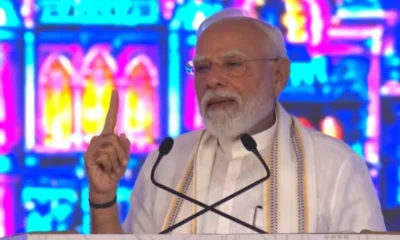
* Addressing a rally at Pasighat in Arunachal Pradesh, PM Modi said, “The Congress wants to encourage those who burn the Tricolour, do not chant ‘Jai Hind’ like you and me and instead make divisive cries like “Bharat tere tukre tukre”, play into foreign hands, disrespect the Constitution and break statues of saint-like Baba Saheb Bhimrao Ambedkar.”
“Shouldn’t we have a sedition law to deal with those who work against the country and its Constitution,” he asked. The Congress wanted to scrap the sedition law, he added.
Remarking that the Congress can stoop too low to come back to power, he said, “Is it not a step to strengthen the hands of secessionists? Is the Congress with secessionists or patriots?”
* Uttar Pradesh Chief Minister Yogi Adityanath lashed out at the Congress on Wednesday for promising to scrap the law of sedition, which the party mentioned in its recently released manifesto.
Speaking at an election rally, Yogi Adityanath said, “It is shameful that the Congress in its manifesto has promised to scrap the provision on sedition, which is used against terrorists and those involved in terror activities, if the party comes to power.”
* In an interaction with villagers in Saharanpur on Wednesday morning, BJP candidate Raghv Lakhanpal said, “It appears the Congress manifesto was printed in Pakistan. Such a manifesto cannot be printed by Indians.”
“The Congress has said they will repeal sedition law. Shouldn’t there be a law to punish those who raise slogans like ‘Bharat Tere Tukde Honge’,” Lakhanpal added.
Even the law commission recommended doing away with the Colonial era relic not too long ago. In August 2018, the commission invited public opinion on the repeal or restructuring of Section 124A saying the right to free speech and expression was an “essential ingredient of democracy”.
In a consultation paper published later, the Centre’s top legal advisory body said an expression of disappointment over the state of affairs cannot be treated as sedition and India should not retain the sedition law, which was introduced by British to oppress Indians.
Law Commission of India, Consultation paper on Sedition, Aug 30, 2018
8.1 In a democracy, singing from the same songbook is not a benchmark of patriotism. People should be at liberty to show their affection towards their country in their own way. For doing the same, one might indulge in constructive criticism or debates, pointing out the loopholes in the policy of the Government. Expressions used in such thoughts might be harsh and unpleasant to some, but that does not render the actions to be branded seditious. Section 124A should be invoked only in cases where the intention behind any actis to disrupt public order or to overthrow the Government with violence and illegal means.
8.2 Every irresponsible exercise of right to free speech and expression cannot be termed seditious. For merely expressing a thought that is not in consonance with the policy of the Government of the day, a person should not be charged under the section. Expression of frustration over the state of affairs, for instance, calling India no country for women‘, or a country that is racist for its obsession with skin colour as a marker of beauty are critiques that do not threaten the idea of a nation. Berating the country or a particular aspect of it, cannot and should not be treated as sedition. If the country is not open to positive criticism, there lies little difference between the pre-and post-independence eras. Right to criticise one‘s own history and the right to offend are rights protected under free speech.
8.3 While it is essential to protect national integrity, it should not be misused as free speech. Dissent and criticism are essential ingredients of a robust public debate on policy issues as part of vibrant democracy. Therefore, every restriction on free speech and expression must be carefully scrutinised to avoid unwarranted restrictions.[/vc_column_text][/vc_column][/vc_row]