English हिन्दी
Connect with us

India News

SC interim order provides various reliefs to migrant workers.

The apex court passed interim order in the suo motu matter on the COVID-19 migrant crisis. A Bench of Justices Ashok Bhushan, SK Kaul and MR Shah ordered that migrant workers will not have to pay either train or bus fare to reach their home states.

Published

on

Supreme-Court

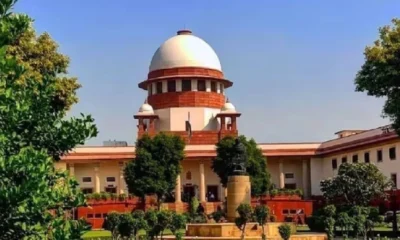
May 28, 2020: The Supreme Court on Thursday provided various relief measures to stranded migrant workers during COVID 19 lockdown.

The apex court passed interim order in the suo motu matter on the COVID-19 migrant crisis. A Bench of Justices Ashok Bhushan, SK Kaul and MR Shah ordered that migrant workers will not have to pay either train or bus fare to reach their home states.
Directing that states must share the travel fare of migrant workers, the Bench said: “Originating state shall provide meal and water at station. Railways shall provide meals to migrant workers during train journey and states shall provide meals for migrants in buses. Thereafter, states shall provide transport, meals from stations to their villages.”

The Supreme Court also ordered that states must provide food, water to stranded migrant workers. “Migrant workers who are stranded shall be provided food by the concerned state at places which shall be publicised and notified.”

The SC has also ordered setting up of help kiosks to register stranded migrant workers.

The Bench observed that even after registration, migrants have to wait for their turn to board the train or bus. Hence, a large number of migrants are still proceeding by foot.

“We further direct that those migrant workers found walking on the roads, immediately be taken to shelters and provided food and all facilities should be provided to them,” said the apex court.

It further directed that the state shall oversee the registration of migrant workers and states will ensure that after registration, migrant workers are made to board the train or bus. Further ensuring smooth return of migrant workers, the Bench said, “As and when the state governments put in a request for trains, railways has to provide them.”

After passing the interim orders, the Supreme Court asked the Centre and States to submit their detailed reports by June 5, which is the next date of hearing in the case. The Court further directed that all necessary details regarding the number of migrants, plan for transportation mechanism of registration and other details should be brought on record in the reply.

Earlier, Solicitor General Tushar Mehta informed the Court about the steps taken in the migrant worker crisis. He said that around one crore migrant workers have been shifted to their homes by train and buses.

“We have shifted over one crore migrant workers. But there are also workers who did not shift due to the reopening of activities. Migrants are walking because of anxiety or local level instigation where they are said ‘walk now, trains won’t run, lockdown is extended’,” SG Mehta told the Bench.

On the last date of hearing, Solicitor General Tushar Mehta was asked to apprise the Court on the steps taken by the Central government to deal with the crisis faced by migrant workers.

When Justice Kaul asked the SG how long it will take to transport all the migrant workers to their home states, he repiled that the Centre would file a comprehensive report soon. The SG added that the Centre will only be able to give details of stranded migrants when the state governments provide such information.

India News

Dead frog found in Gwalior school meal sparks probe into hygiene lapses

A dead frog discovered in a Mid-Day Meal at a Gwalior school has led to a district investigation following earlier complaints of poor food quality.

Published

on

A disturbing incident at a government primary school in Gwalior has triggered an official inquiry after a dead frog was found in food prepared under the Mid-Day Meal scheme. The discovery has renewed concerns over food safety standards in schools across Madhya Pradesh.

Viral image prompts swift action by district authorities

A photo circulating online showed a dead frog in a cooked vegetable dish reportedly served at the Government Primary School in Gokulpura. The incident came to light when teachers noticed the contamination before lunchtime. They recorded a video, alerted authorities and pointed out that complaints about foul smell, insects and poor-quality food had been raised earlier as well.

The uproar prompted immediate intervention from the District Panchayat. The Chief Executive Officer ordered a detailed probe, directing District Education Officer Hariom Chaturvedi to verify the video’s authenticity and review how the contamination occurred.

Separately, senior officials, including Collector Ruchika Chauhan, have sought reports from the school administration and the Mid-Day Meal provider. Authorities have stated that strict disciplinary action will follow if negligence is confirmed.

Renewed scrutiny of the Mid-Day Meal programme

This incident adds to ongoing concerns about hygiene and monitoring under the meal scheme, which is meant to improve child nutrition and encourage school attendance. Despite being a key welfare initiative, repeated lapses in food quality have been reported in the state, raising questions about oversight and accountability.

Continue Reading

India News

Delhi records sharp early December temperature dip as cold wave threat grows

Delhi recorded its lowest early December minimum in more than a decade as IMD warns of an approaching cold wave.

Published

on

Delhi started the month on an unexpectedly cold note, with temperatures dropping much lower than what the capital typically experiences in early December. The India Meteorological Department (IMD) reported a minimum of 5.7°C on December 1 — the lowest first-week December reading in more than a decade.

Unusual chill grips the capital

IMD data shows that early December temperatures in Delhi usually remain between 7°C and 11°C. Instances of colder starts have been rare, with only a few years — such as 2012 and 2017 — recording single-digit lows around this period. In recent years, the mercury has seldom dipped below 8°C at the beginning of the month, making this year’s drop particularly notable.

IMD anticipates that the cold spell may continue, with parts of Delhi likely to meet cold wave criteria. Typically, the capital slides below 5°C only after December 10. Last year, temperatures reached 4.9°C by December 11, while in 2023, the minimum fell below 5°C on December 15. In 2022, the lowest was 5°C recorded on December 25.

Delhi’s all-time December minimum remains 0°C, recorded on December 27, 1930.

Winter forecast indicates longer, stronger cold spells

IMD’s seasonal projection for December 2025 to February 2026 suggests normal to below-normal temperatures across central and northwest India, while southern states and the Northeast may witness warmer-than-usual minimum temperatures. Parts of Rajasthan near the border are also expected to experience above-normal nighttime temperatures.

Delhi is already close to entering a cold wave phase — defined as a minimum below 10°C and 4.5°C or more below normal at two or more stations. The last time the capital recorded a December cold wave was in 2021, spanning four days.

IMD also predicts 2–5 additional cold wave days in Madhya Pradesh, Uttar Pradesh, and Bihar this season. Meanwhile, regions such as Rajasthan, Punjab, and the Northeast may see fewer cold wave days, indicating a stronger winter in central India and milder spells in some northwestern and northeastern areas.

Continue Reading

India News

Sanchar Saathi not mandatory, clarifies Jyotiraditya Scindia amid privacy outrage

Communications Minister Jyotiraditya Scindia has clarified that the Sanchar Saathi app is not mandatory on new phones and can be deleted, countering Opposition claims of surveillance.

Published

on

Jyotiraditya Scindia

Amid the growing political storm over the Centre’s directive asking mobile phone makers to pre-install the Sanchar Saathi app on all new devices, Communications Minister Jyotiraditya Scindia has clarified that the app is not mandatory and users are free to delete it if they choose.

Minister says app is optional, aims to protect users

Responding to concerns flagged by the Opposition over alleged surveillance risks, Scindia said users will have full control over the app. He compared it to other pre-installed apps that users can choose to keep or remove.

“Don’t activate it. If you want to keep it in your phone, keep it. If you want to delete it, do so,” he said, adding that the app will remain dormant if not used.

The minister emphasised that Sanchar Saathi is designed to safeguard citizens against cyber fraud. “This is a matter of customer protection. There is nothing mandatory. If you do not want to register it, don’t. And if you want to delete it, delete it,” he said, noting that many people are unaware such a tool exists.

Opposition flags privacy concerns, calls move “surveillance”

Congress leaders have accused the government of enabling intrusive monitoring.

  • KC Venugopal said the decision was “beyond unconstitutional”, citing the fundamental right to privacy.
  • Priyanka Gandhi Vadra called Sanchar Saathi a “snooping app”, saying citizens’ privacy was under threat.
  • Priyanka Chaturvedi termed it “another surveillance moment”.
  • Karti Chidambaram alleged the move mirrored actions in authoritarian regimes.

Government rejects criticism, cites rising cyber fraud

Countering Opposition remarks, Scindia said the government was attempting to clear misconceptions. He stated that cyber fraud worth ₹22,800 crore took place in 2024, and Sanchar Saathi was developed to help citizens report fraud, track lost phones, and prevent misuse of telecom resources.

“When we are giving Sanchar Saathi to the common citizen, they are saying it is Pegasus. We cannot show truth to those who don’t want to see it,” Scindia said.

Continue Reading

Trending

© Copyright 2022 APNLIVE.com