English हिन्दी
Connect with us

India News

Violence, abuse against front-line workers not acceptable: Modi

Prime Minister Narendra Modi on Monday said that violence, abuse and rude behaviour against front-line workers is not acceptable. He made this remark in his digital address on the ocassion of the 25th Foundation Day of Rajiv Gandhi University of Health Sciences, Karnataka.

Published

on

Prime Minister Narendra Modi

Prime Minister Narendra Modi on Monday said that violence, abuse and rude behaviour against front-line workers is not acceptable. He made this remark in his digital address on the ocassion of the 25th Foundation Day of Rajiv Gandhi University of Health Sciences, Karnataka.
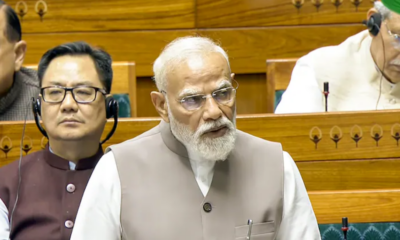
“Due to a mob mentality, those working on the front-lines, those on duty be it doctors, nurses, Safai workers, others are subject to violence. I want to state it clearly – violence, abuse and rude behaviour is not acceptable.   Steps have been taken to protect you against any form of violence. We have also provided an insurance cover of Rupees fifty lakh for those on the front-line,” Modi said.

Talking about Covid-19 crisis, the prime minister said that today the world is facing one of the biggest crisis since the two world wars. Like the world changed pre and post-World Wars, the same way the pre and post Covid world will be different.

“At such a time, the world is looking up to our doctors, nurses, medical staff & scientific community with hope and gratitude. The world seeks both ‘care’ and ‘cure’ from you,” the prime minister said.

He termed doctors and medical staff as soldiers without uniform and said they will surely register win over invisible virus.

 “In fact, doctors and medical workers are like soldiers, but without the soldiers’ uniform.  The virus may be an invisible enemy, but our Corona warriors, medical workers are invincible.  In the battle of Invisible versus Invincible, our medical workers are sure to win.”

The prime minister said that his government has taken many initiatives in health-care and medical education.

He said the government is broadly working on four pillars: The first is – preventive healthcare, affordable healthcare, improvements on the supply side, and mission mode implementation.

Talking about preventive healthcare initiatives, Modi said the thrust is on Yoga, Ayurveda and general fitness.

“More than forty thousand wellness centres have been opened where a key focus is on controlling life-style related diseases. The success of the Swacchh Bharat Mission is another key part of preventive healthcare.”

Citing Ayushman Bharat Scheme as an example of affordable healthcare, the prime minister said that the world’s largest healthcare scheme belongs to India.

“In less than two years, one crore people have benefitted from this scheme.  Women and those staying in villages are among the major beneficiaries of this scheme.”

Talking about the third initiative, Modi said that work is under-way to ensure a medical college or post-graduate medical institute in every district of the country.

“The country has seen rapid progress in setting up 22 more AIIMS.  Over the last five years, we have been able to add over Thirty thousand seats in MBBS and fifteen thousand seats in post-graduation. The Medical Council of India has been replaced by a new National Medical Commission through an Act of the Parliament.”

The prime minister added that his government’s thrust is on the mission mode implementation of the ideas because “a well-thought of idea on paper makes it only a good idea.  And, a good idea well implemented makes it a great one”.

Modi also exhorted the attendees to have maximum discussion and participation on three things: advances in tele-medicine, ‘Make in India’ in the health sector, and IT related tools for healthier societies.

He also congratulated the varsity on the milestone and said that 25 years mean Rajiv Gandhi University of Health Sciences is in the prime of its youth.

“This is the age to think even bigger and do even better. I am confident that the University will continue to scale new heights of excellence in the times to come.”

The prime minister also appreciated the efforts of the Karnataka Government in handling the Covid-19 situation.

India News

Telegram CEO Pavel Durov criticises India restriction, says leak networks shifted to other apps

Telegram founder Pavel Durov has responded to India’s temporary restriction on the platform ahead of the NEET-UG 2026 re-examination, arguing that the move affected ordinary users without stopping alleged leak networks.

Published

on

Telegram founder and CEO Pavel Durov has criticised India’s decision to temporarily restrict access to the messaging platform, arguing that the move failed to curb alleged exam leak operations and instead affected millions of legitimate users.

The restriction was imposed ahead of the NEET-UG 2026 re-examination as authorities sought to prevent the spread of leaked exam-related material and disrupt networks allegedly involved in malpractice.

In a public response, Durov said the action had inconvenienced a large number of users across India while those responsible for sharing leaked content had simply migrated to alternative platforms.

According to Durov, restricting access to Telegram did not eliminate the problem authorities were trying to address. He claimed that groups involved in distributing exam-related leaks quickly shifted their activities elsewhere, raising questions about the effectiveness of platform-specific restrictions.

The temporary curbs were announced by the government in the lead-up to the NEET-UG re-test scheduled for June 21. Officials said the move was aimed at safeguarding the integrity of the examination process following concerns about the circulation of leaked material online.

The restriction is currently expected to remain in place until June 22.

Durov also stressed that millions of Indian users rely on Telegram for communication, education, business activities and community engagement. He argued that measures targeting an entire platform can have wider consequences for users who have no connection to alleged wrongdoing.

The government’s action came amid broader efforts to prevent cheating and malpractice in competitive examinations. Authorities have been closely monitoring digital platforms and messaging services after reports that exam-related content was being circulated through online channels.

The debate has sparked discussions about how governments and technology platforms should balance examination security with access to digital communication services. While officials maintain that strong measures are necessary to protect the fairness of high-stakes examinations, critics argue that restrictions on entire platforms may not effectively stop determined offenders.

For now, Telegram remains at the centre of the discussion as authorities continue efforts to ensure a fair and secure conduct of the NEET-UG 2026 re-examination.

Continue Reading

India News

Telegram restricted ahead of NEET-UG re-exam, NTA backs move to curb exam fraud

NTA has welcomed the Centre’s decision to temporarily restrict Telegram ahead of the NEET-UG 2026 re-examination, citing the need to prevent fraud and misinformation.

Published

on

NEET

The Centre has imposed temporary restrictions on messaging platform Telegram ahead of the NEET-UG 2026 re-examination, with the National Testing Agency (NTA) welcoming the decision as part of efforts to prevent exam-related fraud and misinformation.

The temporary curbs will remain in place until June 22, a day after the NEET-UG re-exam scheduled for June 21. Authorities said the action was taken following concerns that the platform was being misused by cheating networks and individuals circulating misleading claims related to the examination.

NTA says move aimed at protecting exam integrity

According to the NTA, the restrictions are intended to safeguard candidates from fraudulent activities and false information that could affect the fairness of the examination process. The agency stated that maintaining the integrity of the re-examination remains a priority as lakhs of students prepare to appear for the test.

The NEET-UG re-exam is being conducted after the original examination was cancelled amid allegations of question paper leaks and irregularities. Since then, authorities have been monitoring online platforms for suspicious activity and misleading content targeting candidates.

Restrictions linked to concerns over fake paper leak claims

In recent weeks, several reports surfaced about Telegram channels allegedly offering access to leaked examination papers. The NTA had repeatedly advised students not to trust such claims and referred suspicious links and posts for verification by cybercrime authorities. No official confirmation of any genuine leaked re-exam paper had been issued.

Authorities believe the temporary restrictions will help limit the spread of fake content and reduce opportunities for organised exam fraud in the days leading up to the re-test.

Wider efforts to secure the re-examination

The government and examination authorities have introduced several measures ahead of the re-exam, including monitoring social media platforms and creating channels for reporting suspicious claims related to NEET-UG 2026. The NTA has also urged candidates to rely only on official communications for updates regarding the examination.

With the re-examination approaching, officials say the latest action is part of a broader effort to ensure a fair and transparent process for all candidates.

Continue Reading

India News

Abhishek Banerjee says will not bow to BJP after nearly 11 hours of ED questioning

After spending nearly 11 hours before the Enforcement Directorate, TMC leader Abhishek Banerjee said he would not bow to the BJP and accused the ruling party of using investigative agencies for political purposes.

Published

on

Abhishek Banerjee

Trinamool Congress leader and Diamond Harbour MP Abhishek Banerjee on Tuesday said he would not bow to the BJP after spending nearly 11 hours being questioned by the Enforcement Directorate (ED) in connection with an ongoing investigation.

Speaking after the questioning, Banerjee alleged that central agencies were being used to target opposition leaders and asserted that he would continue his political fight despite what he described as sustained pressure.

The TMC leader has repeatedly maintained that investigations involving him are politically motivated, a charge he has made on several previous occasions while appearing before central agencies.

His appearance before the ED comes amid a period of heightened political activity and multiple investigations involving leaders in West Bengal. Recent days have also seen Banerjee face summons and questioning in separate matters by state investigative agencies.

After leaving the ED office, Banerjee reiterated that he would not be intimidated and said he remained committed to his political responsibilities. He also accused the BJP of attempting to weaken opposition parties through investigative action, an allegation that the BJP has rejected in the past.

The Enforcement Directorate has not publicly commented on Banerjee’s remarks. The investigation related to the questioning remains ongoing.

Continue Reading

Trending

© Copyright 2022 APNLIVE.com