English हिन्दी
Connect with us

Education

Happiness, the final frontier that can revive employee engagement levels in the corporate world

Published

on

employee

Happiness is going to be the litmus test that would decide the ultimate retention policy of your company, says Susheel Agarwal, Happiness Coach at Ethika Insurance Broking Pvt. Ltd. 

It is counterintuitive how it took an adversity – the pandemic – to enlighten us on aspects of life that are important to us, he adds. Staring death at our doorsteps during Covid made us reassess our priorities – what was important to us and what are we willing to compromise for.

Susheel can be considered a pioneer of sorts. He introduced value added services like Employee Engagement Programs, Employee Assistance Programs to the insurance broking portfolio that his company was traditionally offering. This was way before “the start-up” culture was in vogue. 

His latest offering ‘The Science and Art of being Happy’ seems to have come about at the right time. Employee dissatisfaction levels in companies are at their highest; employee engagement programs no longer seem to be working. It is as if he has peeked into the future and is creating a pathway for companies to adapt to it.

In 2020, when the pandemic struck, Mr Susheel Agrawal observed something unusual in the market. The market seemed divided into two sets of companies – ones that were using the pandemic to fire employees left right and center, at times despite making profits, and others who were barely surviving and yet retaining most of its staff. 

What was going on here? Wasn’t profit maximization one of the foremost business virtues? Why did some businesses appear to be extremely anxious, while others treated it as yet another day? 

He realized while he was equally anxious about how things would turn out, work was his sacred space, he looked forward to it, day after day, everyday. Even in those glib times, work was something that gave him the opportunity to help others and thereby a sense of being a part of a larger whole. As it turns out, this ability – to be able to be of service to others – is one of the biggest keys to happiness. 

Susheel also realized that his team at Ethika shared a similar DNA with him. All of his colleagues are self directed individuals with a service orientation par excellence. Susheels profound realization – When every employee behaves like a CEO, the job of a CEO morphs into that of an Human Resource Manager, is also thanks to his wonderful team at Ethika. 

Well, we couldn’t agree more. 

The growing startup ecosystem has brought about a spurt of white collar jobs, but the cost has been grinding mental instability; a sense of anxiety pervades the existence of millenials and Gen Z – the population that forms the largest employable chunk. It is as if this young demographic is spinning at full speed between the fear of missing out on life at one end, and the anxiety brought about by work, on the other. The sad part about all of this however is, by the time these folks realize the damning repercussions of the situation, damage would have been done. 

Stress, anxiety, and depression are commonplace today. The intertwined spheres of professional, personal and financial worlds overwhelm the hell out of employees. Technology, which was to bring us liberation has unfortunately pushed us further down this rabbit hole. Our inability to control technology’s impact on society has now seeped to aspects of life that can lead to gruesome circumstances if we continue down this road.

Two of the biggest sources of our unhappiness stem from our inability to stay married to the task at hand and our inability to stop comparing our material possessions with those of people we know. Technology ensures that we are pinged by some irrelevant notification every ten seconds and that most of these notifications are designed to make us feel incomplete in the moment – it could be a friend vacationing at some exotic beach or a sale you better not miss. 

Technology has also conquered newer peaks with its omnipresence – work hours seem to have become irrelevant as a concept. When the engagement hours of work have almost doubled, it was about time, the human resource department started channelizing energies toward employee happiness to ensure employee retention.

The increase in yield of India’s demographic dividend will ensure that the war for talent will only intensify in the future. If talent acquisition used to be a challenge, retention just took away this cake. And in all this insanity, happiness continues to remain the elusive kastoori.

But Susheel feels identification of the problem is a battle half won.

He thinks the current business environment would mark a paradigm shift in the way businesses treat employees. Businesses can no longer afford to offer mere lip service about employee wellbeing. If the employee isn’t being well, it is as much an employer’s headache as it is the employee’s. 

Prod him further and he reveals The Happiness workshop he had designed as a prototype has been tested on a couple of clients and the results have been encouraging. 

Some of the elements from the workshop that Corporates have benefitted from include 

  1. Open architecture of policies – let policies be defined by don’ts rather than do’s. 
  2. Once you have trusted someone with a certain piece of work, trust them with delivery – Micromanaging is a strict no-no. 
  3. Encourage employees to change the way they communicate with themselves – A lot of our problems stem from the way we communicate with ourselves i.e. inwards. Our efficacy takes a natural hit when we demean ourselves. Changing this outlook, puts the choice of action in our hands, which inturn makes employees feel responsible, instead of being directed by factors out of their control.

In his own words “The battle for talent promises to transition into a war without an end in sight. The last man standing is going to be one, who is able to turn workplaces into places employees want to come to, and don’t feel compelled to come to. A happy employee is an engaged employee and a productive one.”

Continue Reading

Jobs

Amazon to cut 30,000 corporate jobs amid AI-driven restructuring

Amazon will lay off 30,000 corporate employees this week, its biggest cut since 2022, as CEO Andy Jassy drives AI-led efficiency and cost reductions.


Published

on

Amazon

Amazon is preparing to lay off around 30,000 corporate employees this week, marking its biggest job reduction since late 2022, when it eliminated about 27,000 positions. The move is part of CEO Andy Jassy’s ongoing effort to streamline operations and counter overhiring during the pandemic-driven boom.

Largest corporate layoff since 2022

The planned layoffs will affect nearly 10% of Amazon’s corporate workforce — roughly 350,000 employees — though it represents a small portion of the company’s overall 1.55 million-strong staff. The job cuts are expected across multiple departments, including human resources (People Experience and Technology), operations, devices and services, and Amazon Web Services (AWS).

Managers in affected teams were trained on Monday to handle the layoff process before email notifications began rolling out Tuesday morning.

Efficiency push and AI automation

The restructuring comes as Jassy pushes to reduce “bureaucracy” and simplify management layers. Amazon has even introduced an anonymous complaint line to flag inefficiencies, reportedly leading to over 450 process changes.

The company’s increased adoption of artificial intelligence tools has accelerated the shift. Jassy previously said AI automation would eliminate repetitive tasks, potentially reducing headcount. Analysts believe Amazon is realizing significant productivity gains through these technologies, supporting its decision to trim staff.

Pressure on AWS and holiday hiring plans

While AWS remains Amazon’s largest profit driver, its recent growth has lagged behind competitors. AWS reported $30.9 billion in second-quarter sales — up 17.5% — compared to 39% for Microsoft Azure and 32% for Google Cloud. Estimates indicate AWS revenue rose to $32 billion in the third quarter, marking a slight slowdown.

Despite the layoffs, Amazon plans to hire 250,000 seasonal workers ahead of the holiday shopping season, maintaining the same level as the previous two years.

Stock reaction and internal reshuffling

Amazon shares rose 1.2% to $226.97 on Monday, just days ahead of its third-quarter earnings announcement. The company also reorganized a segment of its human resources division focused on diversity initiatives, promoting several employees into new roles.

Continue Reading

Education

CBSE releases tentative datesheets for Class 10, 12 board exams 2026

CBSE has released the tentative schedule for Class 10 and 12 board exams 2026. The exams will run from February 17 to July 15, 2026, for over 45 lakh students across India and 26 countries.

Published

on

CBSE releases tentative datesheets for Class 10, 12 board exams 2026

The Central Board of Secondary Education (CBSE) has announced the tentative datesheets for the Class 10 and Class 12 board examinations for the academic year 2025-26. According to the notification, the exams will be conducted between February 17 and July 15, 2026.

CBSE said that around 45 lakh students are expected to appear in the board examinations, covering 204 subjects across India and 26 countries abroad.

Exams To Be Conducted

The schedule covers multiple categories of examinations, including:

  • Main Examinations for Classes 10 and 12
  • Examinations for Sports Students (Class 12)
  • Second Board Examinations (Class 10)
  • Supplementary Examinations (Class 12)

Along with the written tests, the board will also coordinate practical exams, evaluation, and post-result processes to ensure timely completion and declaration of results.

Evaluation Timeline

CBSE has outlined a structured plan for evaluation. The checking of answer sheets will begin about 10 days after each subject’s exam and is expected to be completed within 12 days.

For example, if the Class 12 Physics exam is held on February 20, 2026, the evaluation process will start on March 3 and conclude by March 15.

Tentative Datesheets

The board clarified that these date sheets are tentative. The final versions will be released after schools submit the final list of candidates appearing for the examinations.

The CBSE has urged schools and students to treat these dates as indicative and to continue their preparations in accordance with the tentative schedule.

Continue Reading

Education

SBI clerk recruitment 2025: Registration begins for 6,589 vacancies, apply now

State Bank of India has initiated the recruitment for 6,589 clerk posts. Online application is now open for eligible candidates with exams scheduled for September and November 2025.
Published

on

SBI clerk recruitment

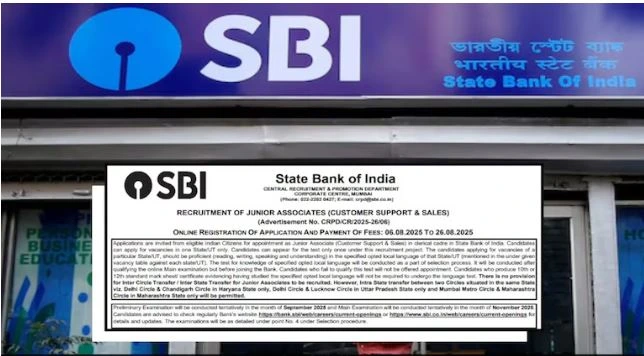
The State Bank of India (SBI) has officially started the registration process for SBI Clerk Recruitment 2025, inviting applications for 6,589 Junior Associate (Clerk) posts. The online application window opened on August 6, 2025, and interested candidates can apply through the official SBI website.

Of the total vacancies, 5,180 are regular and 1,409 are backlog vacancies. The category-wise breakdown includes 2,255 for General, 788 for SC, 450 for ST, 1,179 for OBC, and 508 for EWS candidates.

Eligibility criteria

Educational Qualification:
Applicants must hold a graduation degree in any discipline from a recognised university. Final-year students are also eligible, provided they complete their degree by December 31, 2025.

Age Limit:
Candidates should be between 20 to 28 years as of April 1, 2025 (born between April 2, 1997 and April 1, 2005). Age relaxation is applicable as per government rules.

Selection process

The recruitment process involves three stages:

  1. Preliminary Examination:
    A 100-mark online test to screen candidates.
  2. Main Examination:
    Comprises 190 questions, carrying 200 marks, with a duration of 2 hours and 40 minutes.
  3. Language Proficiency Test:
    Required for those who haven’t studied the local language in Class 10 or 12.

Importantly, only the marks scored in the Main Exam will determine the final merit list, subject to document verification and the language test.

Exam schedule

  • Preliminary Exam (Tier 1): September 2025
  • Main Exam (Tier 2): November 2025

Application fee

  • General/OBC/EWS: ₹750
  • SC/ST/PwBD/Ex-Servicemen: Exempted from fee

Salary and benefits

Selected candidates will receive a monthly salary ranging from ₹24,050 to ₹64,480 as per the SBI pay scale.

Continue Reading

Trending

© Copyright 2022 APNLIVE.com