English हिन्दी
Connect with us

India News

Bulandshahr violence: suspicions of conspiracy, but cow slaughter is CM Adityanath’s concern

Published

on

[vc_row][vc_column][vc_column_text]Uttar Pradesh Director General of Police (DGP) OP Singh said the police suspect a conspiracy behind Monday’s mob violence in Bulandshahr over cow slaughter when a nearly-400 strong mob attacked the police force and two people, including Inspector Subodh Kumar Singh, were killed.

The police had booked Bajrang Dal district chief Yogesh Raj, BJP youth wing member Shikhar Agrawal, Vishwa Hindu Parishad (VHP) member Upendra Raghav among as 27 people in two FIRs, while cases have been lodged against 50 to 60 unidentified people, the police said. So far, four arrests have been made.

Today (Wednesday, Dec 5) reports said a district court remanded three persons into judicial custody for 14 days  in connection with the killing of Inspector Subodh Kumar Singh and a 20-year-old man Sumit in yesterday’s Bulandshahr violence. However, the main accused Yogesh Raj, who is said to be a Bajrang Dal activist is still on run. It has been reported that Raj led the violent mob which allegedly attacked the police team and killed Inspector Singh.

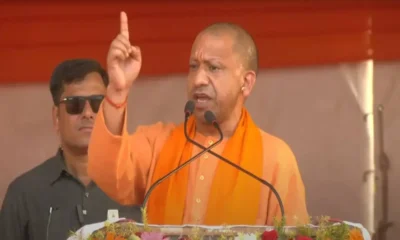
Chief minister Yogi Adityanath held a late night security review yesterday, but kept the focus firmly on cow slaughter. A government statement on the meeting last night indicates he ordered officers to speed up arrests for cow slaughter but there was not a word about the cop’s murder.

“The incident is part of a bigger conspiracy, and hence all those directly or indirectly related to cow slaughter should be arrested in a time-bound manner,” the official statement said.

After he was criticised for lopsided, weird priorities, a second statement put out this morning said Yogi Adityanath would meet the family of the policeman.

According to the opposition, Adityanath seems to be more concerned about catching cow slaughterers than the killers of a policeman.

Also, Adityanath announced a Rs 10-lakh financial assistance to the family members of the youth Sumit Kumar who was killed in the violence. He is reported to be named among the accused in mob violence.

For the meeting in Lucknow, chief minister Yogi Adityanath flew down from his home-base Gorakhpur, where he attended a sound and light show on Monday night and a kabaddi tournament on Tuesday.

This morning, the chief minister flew out of the state again to perform his other role as the BJP’s headline campaigner in state polls. He has three rallies in Telangana, which will vote on Friday along with Rajasthan.

Two cases were filed after the Monday incident – one on the murders and the other on cow slaughter.

Yogesh Raj, the main accused in the mob-killing and an activist of the right-wing group Bajrang Dal, is the complainant in the cow killing case and he is “missing”.

He had named seven people from a village near the spot where the dead cows were found. Two of them are boys, 11 and 12 years old, and four others appear to be fake names. The children were forced to spend hours in a police station last evening. “The cops brought us to the police station and kept us there for four hours. They took the names of the boys and took my phone number. I was told we would be called again if required,” said the father of one of the boys. The boys were not questioned or even detained, according to media reports.[/vc_column_text][/vc_column][/vc_row][vc_row][vc_column][vc_column_text css=”.vc_custom_1544016677996{border-top-width: 10px !important;border-right-width: 10px !important;border-bottom-width: 10px !important;border-left-width: 10px !important;padding-top: 10px !important;padding-right: 10px !important;padding-bottom: 10px !important;padding-left: 10px !important;background-color: #d6d6d6 !important;border-radius: 10px !important;}”]Uttar Pradesh has reported 11 cases of violence related to cow vigilantism since the BJP government of Yogi Adityanath took oath in March 2017. The state has reported a total of 16 such incidents since 2012 with nine deaths. The country witnessed 97 recorded cases of violence over cow protection with 39 deaths.[/vc_column_text][/vc_column][/vc_row][vc_row][vc_column][vc_column_text]Initial investigation by Uttar Pradesh police as well as eyewitness accounts from the spot, where a police officer and a civilian were killed on Monday, 3 December, in Bulandshahr, hint at an organised attempt at fuelling communal tension in the area.

There were conflicting claims on who discovered the “carcasses” — and the nature of what was found in the first place.

Raj, the absconding main accused in cop’s murder, claimed he and his associates saw “seven people slaughtering cows”.

However, the neighbour of the man on whose field the “carcasses” were found said farm workers had first flagged them.

Prem Jeet Singh (45), also a former pradhan, said: “My land is next to Rajkumar’s (plot) and he was informed by labourers working on the field about the incident. I went with him to the spot. It started with four or five villagers expressing their anger but later the crowd burgeoned.”

The sequence of events that led to rioting and violence in Bulandshahr all raise questions that still remain unanswered, reported TheQuint.

  1. Why Were Carcasses of Cows Hung in an Open Field?


Tehsildar Rajkumar Bhaskar, one of the first administrative officers to reach the spot in Mahaw village, told News18 that head and skin of a dead cow was hung in a sugarcane field. He pointed out that anyone who is involved in cow slaughtering will not publicly display a cow carcass, knowing the situation in the state where incidents of mob lynchings in the name of cow vigilantism have taken place.

  1. How Did a Mob of 300-500 People Gather so Quickly?

The tehsildar, while speaking with the news channel, said that as soon as the news of the dead meat spread, a large crowd consisting of members from different Hindu outfits, including the Bajrang Dal, gathered at the spot. The crowd then loaded the dead body of the cow in a tractor and headed towards the Bulandhshahr-Garhmukteshwar State Highway to protest.

  1. Location and Timing of the Incident Fuels Suspicion

The clashes broke out on the last day of a three-day congregation of Muslims – Tablighi Ijtema – in Bulandshahr. Around 10 lakh devotees, who were said to have attended the gathering, were supposed to take the same state highway where the protestors took the carcasses.

Almost a hundred men in tractors reportedly reached the Chingravati police post on the highway, where the crowd multiplied in size. Although the police tried to reason with the crowd, trying to calm them down, the mob refused to budge.

  1. Slain Officer Was Investigating Dadri Lynching Case

Siyana SHO Subodh Kumar, who was shot dead while trying to pacify the crowd at the Chingravati police chowk, was an investigating officer in the mob lynching of Md Akhlaq in Dadri from 28 September 2015 till 9 November 2015. However, the charge sheet was filed in the case by a different investigating officer in March 2016. Kumar played a key role in giving the meat samples in the case to forensic lab, DNA reported.

According to the News18 report, several police officers who were present at the spot, said the mob did not allow the injured SHO to be taken to the hospital.

The police told News18 that the SHO and the accompanying policemen were cornered by the mob. They added that an initial round of firing in the air fuelled the anger of the crowd further.[/vc_column_text][/vc_column][/vc_row]

India News

Amit Shah counters delimitation concerns, says southern states to gain Lok Sabha seats

Amit Shah assures Parliament that southern states will gain Lok Sabha seats after delimitation, countering opposition criticism during the women’s reservation debate.

Published

on

Amit Shah

Union Home Minister Amit Shah on Thursday addressed concerns over the proposed delimitation exercise, asserting in the Lok Sabha that southern states will not lose representation but instead see an increase in their number of seats.

His remarks came during a heated debate linked to the implementation of women’s reservation, where opposition parties have raised fears that population-based delimitation could reduce the political weight of southern states.

Shah rejected these claims, calling them misleading, and said the proposed framework ensures fairness while expanding the overall strength of the Lok Sabha.

Seat count to rise with expansion of Lok Sabha

The government has indicated that the total number of Lok Sabha seats could increase significantly as part of the delimitation process. In this expanded House, the combined representation of southern states is expected to rise from 129 seats at present to around 195 seats.

Shah emphasised that no state will lose seats in absolute terms, and the exercise is designed to reflect population changes while maintaining balance across regions.

State-wise projections shared in Parliament

During his address, Shah also provided indicative figures for individual southern states, suggesting notable increases in representation. According to the projections:

  • Tamil Nadu could see its seats rise substantially
  • Kerala, Telangana, and Andhra Pradesh are also expected to gain additional seats
  • Karnataka’s representation may increase as well

These figures were presented to counter the argument that delimitation would disproportionately favour northern states.

Political debate intensifies over linkage with women’s quota

The delimitation exercise has been closely linked to the rollout of women’s reservation, which proposes one-third seats for women in Parliament and state assemblies.

Opposition leaders have questioned this linkage, arguing that tying reservation to delimitation could delay its implementation and raise federal concerns. Some leaders have also warned that the move could impact national unity if apprehensions among states are not addressed.

The government, however, maintains that the reforms are necessary to ensure equitable representation and to align the electoral system with demographic realities.

Centre dismisses ‘false narrative’ on southern states

Shah reiterated that concerns about southern states losing influence are unfounded. He said the delimitation process will increase representation across regions and described the criticism as a “false narrative” aimed at creating confusion.

The issue is expected to remain a key flashpoint as Parliament continues discussions on the women’s reservation framework and related legislative changes.

Continue Reading

India News

PM Modi assures no discrimination in women’s quota, delimitation debate intensifies in Parliament

PM Narendra Modi has assured that women’s reservation will be implemented without discrimination, amid a heated debate over delimitation in Parliament.

Published

on

PM modi

Prime Minister Narendra Modi has assured that there will be no discrimination in the implementation of women’s reservation, as Parliament witnessed a sharp debate over the proposed linkage between the quota and delimitation exercise.

During the ongoing special session, the government reiterated its commitment to ensuring fair representation while addressing concerns raised by opposition parties regarding the timing and structure of the legislation.

The proposed framework aims to reserve 33 percent of seats for women in the Lok Sabha and state assemblies. However, its implementation is tied to a fresh delimitation exercise, which is expected after the next census.

Opposition questions timing and intent

Opposition leaders have raised concerns that linking the women’s quota to delimitation could delay its implementation. They argue that the process of redrawing constituencies may push the actual rollout further into the future.

The issue has triggered a broader political confrontation, with multiple parties questioning whether the move could alter representation across states.

Some critics have also alleged that the delimitation exercise could disproportionately benefit certain regions based on population, a charge the government has rejected.

Government reiterates commitment to fair implementation

Responding to these concerns, the Centre has maintained that the reforms are necessary to ensure accurate and updated representation based on population data.

Leaders from the ruling side have repeatedly emphasized that the process will be carried out transparently and without bias. The assurance that there will be “no discrimination” is aimed at addressing fears among states and opposition parties.

The debate marks a key moment in Parliament, with both sides engaging in intense exchanges over one of the most significant electoral reforms in recent years.

Continue Reading

India News

Give all tickets to Muslim women, Amit Shah says, attacking Akhilesh Yadav on sub-quota demand

A sharp exchange between Amit Shah and Akhilesh Yadav in Parliament over sub-quota for Muslim women highlights key divisions on women’s reservation implementation.

Published

on

A heated exchange broke out in Parliament during discussions on the women’s reservation framework, with Union Home Minister Amit Shah and Samajwadi Party chief Akhilesh Yadav locking horns over the demand for a sub-quota for Muslim women.

The debate unfolded as the government pushed forward key legislative measures to implement 33% reservation for women in the Lok Sabha and state assemblies.

Akhilesh Yadav argued that the proposed reservation must ensure representation for women from marginalised communities, including Other Backward Classes (OBCs) and Muslim women. He said that without such provisions, large sections could remain excluded from political participation.

He also questioned the timing of the bill, alleging that the Centre was avoiding a caste census. According to him, a census would lead to renewed demands for caste-based reservations, which the government is reluctant to address.

Government rejects religion-based quota

Responding to the demand, Amit Shah made it clear that reservation based on religion is not permitted under the Constitution.

He stated that any proposal to provide quota to Muslims on religious grounds would be unconstitutional, firmly rejecting the idea of a separate sub-quota for Muslim women within the broader reservation framework.

The government has maintained that the existing framework already includes provisions for Scheduled Castes (SC) and Scheduled Tribes (ST) women within the overall reservation structure.

Wider political divide over implementation

The issue of sub-categorisation within the women’s quota has emerged as a major flashpoint, even as most opposition parties broadly support the idea of women’s reservation.

Samajwadi Party leaders reiterated that their support for the bill depends on inclusion of OBC and minority women, while the government continues to defend its constitutional position.

The debate is part of a broader discussion during the special Parliament session, where multiple bills linked to delimitation and implementation of the women’s quota are being taken up.

Continue Reading

Trending

© Copyright 2022 APNLIVE.com