English हिन्दी
Connect with us

India News

Can Tharoor be a PM alternative for Congress?

Published

on

Can Tharoor be a PM alternative for Congress?

[vc_row][vc_column][vc_column_text]An online petition on these lines might have set the cat among the Congress coterie mice

~By Meha Mathur[/vc_column_text][vc_column_text]The election results for the Uttar Pradesh and Uttarakhand assemblies have cemented Prime Minister Narendra Modi’s stature as the tallest national leader and at the same time eclipsed all other leaders.

None can come close to him in mass following, even opposition leaders concede. So much so that National Conference leader Omar Abdullah tweeted: “In a nutshell there is no leader today with a pan-India acceptability who can take on Modi and the BJP in 2019. At this rate we might as well forget 2019 and start planning/hoping for 2024,”

And Congress stalwart P Chidambaram admitted: “The elections today have clearly established that the most dominant political figure in India is Prime Minister Modi. And he has a pan-India appeal.” For this, he has been rebuked by the top Congress leadership.

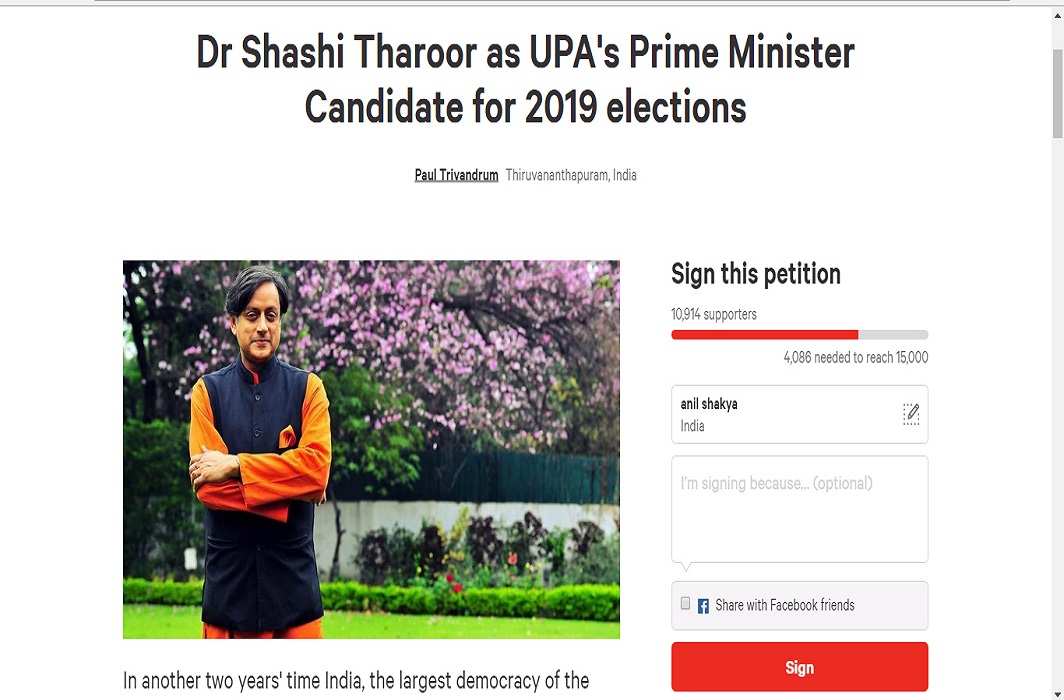
Now that Rahul Gandhi has clearly failed to garner votes for his party – the victory in Punjab was more a result of the personal charisma of Captain Amarinder Singh, and had little to do with the Nehru-Gandhi family — the desperation to find a viable competitor to Modi is gaining ground. And a petition on Change.org—an online petition portal, mobilising opinion globally on social, developmental and political issues—is a step in that direction. With more than 10,000 signatures already, this petition wants Congress MP from Thiruvananthapuram, Shashi Tharoor, to be Congress’ prime ministerial face for the 2019 elections.

The petition, addressed to President Indian National Congress, All India Congress Committee and the UPA, states: “In another two years’ time India, the largest democracy of the world will face another national election. Success of a democratic country requires a strong public interest-based opposition led by a visionary leader capable of Prime Ministership…

“Dr Shashi Tharoor is a man well qualified, with deep knowledge of international and national issues, who can connect with the people of India and with world leaders. We nominate Dr Shashi Tharoor to be the Prime Ministerial candidate of UPA in the run up to 2019.

“In best interest of the World’s Largest Democracy and to rejuvenate the opposition,” says the petitioner, hailing from Thiruvanthapuram, identifying himself as just Paul.

Among the positives that the petition lists are:

  • After retirement, he (Tharoor) chose to serve India and joined Indian politics; did not choose (the) UK/US citizenship option available since he was born in United Kingdom and worked in UN@NYC for long.
  • He chose to be elected by the people, not the soft entry option through Rajya Sabha
  • Initiated development activities in his first 5-year term as MP that won wide acclaim
  • Won again in 2014 against the anti-incumbent wave lashing the country.
  • Available throughout the year to his constituents in Thiruvananthapuram

This says a lot about Tharoor’s credentials.  The erudite and suave UN official first came to light when he wrote The Great Indian Novel in 1989, in which he had drawn parallels between The Mahabharata and the Independence Movement and early years of Independent India. In the novel, he had ripped apart the Gandhi-Nehru legacy, likening Bhishma to Mahatma Gandhi, Dhritarashtra to Nehru and Duryodhana to Indira Gandhi.

He contested for the post of UN Secretary General in 2006, but lost to Ban Ki-moon. He then ventured into Indian politics, and was surprisingly lapped up by the Congress despite the scathing novel. He contested and won from the parliamentary constituency of Thiruvananthapuram in the 2009 Lok Sabha elections.

He endeared himself to the Twitterati and ruffled quite a few feathers with his tweets during his stint in the Ministry of External Affairs.

The Congress leader has been mired in controversy following the death of his wife Sunanda Pushkar in suspicious circumstances in January 2014, but has still kept himself afloat, winning his Thiruvananthapuram seat even in the otherwise disastrous Lok Sabha elections in 2014.

Earlier, in 2010, he had to step down as Minister of State for External Affairs following a cricket (IPL) scandal—he was working as an advisor to a cricket consortium in which his wife Sunanda Pushkar had the main stake.

Despite the political and personal setbacks, Tharoor has held his ground in academic and intellectual circles. His arguments at the Oxford Union debate in 2015, wherein he argued that Britain owes India an apology for mercilessly exploiting the colony for 200 years, and the follow-up book that he wrote An Era of Darkness, in which he elaborated his argument, have caught attention of social media globally.

The question is, is he a match for Modi? Would his erudition add anything to his charisma, vis-a-vis the ordinary Indian? Well, in terms of statesmanship, definitely. An urbane, articulate politician, with a global appeal, he definitely makes the cut. His addresses are well reasoned, well researched, factually sound, and, at the same time, carry an emotional appeal. His understanding of historical and political processes lends to his inclusive approach, in contrast to the divisive approach of Modi.

But the statesmanship and erudition might still not make him a match for Modi, who has his ears and nose to the ground, who has a grand vision for country, even if it’s problematic as far as social cohesion and environmental implications are concerned. Modi has specifically focused on big infrastructure projects, down to the small details; job generation, skills development, and the voter has bought that vision. His comment on “Harvard versus hard work” has appealed to the common sensibilities.

If Tharoor has an international standing, thanks to his long years with the UN, Modi has captured international imagination notches higher and has also ingratiated himself to the world leaders on the strength of economic hardsell, after facing years of boycott.

The murky murder case of Sunanda Pushkar also hangs like an albatross around Tharoor’s neck. Strangely for a person of secular credentials, Tharoor had lapped up the first opportunity to praise Modi as an “avatar of modernity” in June 2014, soon after Modi had taken over as PM. What was the hurry, we wonder. Modi, in turn, showered praise on Tharoor in 2015, following his Oxford speech. So far, it’s congenial. But will the bonhomie remain if the demand for Tharoor as PM candidate gains strength?

Of course, he has openly criticised the communal stance of Modi at several points of time. When the assembly election results were announced, Tharoor commented: “When a ruling party in a state has not even one member from a substantial minority, that to my mind is injustice.”

The biggest stumbling block in Tharoor’s ascendency will be the party high command’s approach, in all likelihood. It’s a tired leadership with a lackadaisical Rahul-Priyanka duo hitting the campaign trail each time (mother Sonia being unwell), but Congress has become so entrenched in family leadership that no leader can raise doubts on leadership. There have been outsiders no doubt. The family did allow Manmohan Singh to run the show, but it was Sonia who continued to wield final authority.

Now, even if the family is willing to open the gates to outsiders again, will Tharoor be able to break the queue? Or will the baton pass on to the more hardened Chidambaram?[/vc_column_text][/vc_column][/vc_row]

India News

Maharashtra MLC Polls: MVA finalizes 15 seats, tussle remains over two key constituencies

The Maha Vikas Aghadi has ironed out differences across 15 Maharashtra Legislative Council seats, leaving Nashik and Nanded as the final points of contention between Congress and Shiv Sena (UBT).

Published

on

The Maha Vikas Aghadi (MVA) coalition, which includes Congress, Shiv Sena (Uddhav Balasaheb Thackeray), and the Nationalist Congress Party (Sharadchandra Pawar), has successfully reached a seat-sharing understanding for 15 out of 17 seats in the upcoming Maharashtra Legislative Council elections. While a major breakthrough has been achieved, the alliance is currently witnessing a stalemate over Nashik and Nanded, as multiple constituent partners assert their presence in these regions.

According to sources, the distribution plan was designed to prevent internal rifts by respecting the geographic and organizational strongholds of each party.

Congress secures maximum share of seats

Under the initial draft layout, Congress has come out as the largest stakeholder with seven seats in its quota. The party has been assigned constituencies across northern Maharashtra, western Maharashtra, and Vidarbha, where its ground-level network remains sturdy.

The locations likely allocated to Congress feature Solapur, Chandrapur, Yavatmal, Bhandara, Dharashiv, Amravati, and Ahilyanagar. To gear up for the electoral challenge, state party president Harshvardhan Sapkal has already designated senior leaders to observe and coordinate at the constituency level.

Five seats assigned to Uddhav Thackeray faction

The Uddhav Thackeray-led Shiv Sena (UBT) has been allotted five seats under the proposed arrangement, focusing its reach on the Konkan region and Marathwada. The seats projected for the party encompass Chhatrapati Sambhajinagar, Jalgaon, Hingoli, Raigad, and Parbhani.

Concurrently, the Sharad Pawar-led NCP faction is expected to field its candidates from three constituencies: Thane, Pune, and the joint Satara-Sangli seat. Even though Thane has been known as a core stronghold of the traditional Shiv Sena, evolving dynamics inside state politics led to this assignment during discussions.

Stalemate over two key constituencies

Despite finding common ground on most locations, Nashik and Nanded continue to be sources of disagreement. Media reports show that both Congress and Shiv Sena (UBT) want the Nashik seat, pointing to their local machinery. On the other hand, Nanded has traditionally stayed a bastion for Congress, but shifting political landscapes have led to claims from alliance partners too.

Leaders from the opposition have stressed that their core objective is to challenge the ruling Mahayuti coalition and prevent votes from splitting through friendly contests. Senior members are expected to hold more rounds of talks over the coming days to untangle the deadlock.

Ruling alliance formula takes shape

Sources close to the matter suggest that the ruling Mahayuti coalition has also neared completion of its election blueprint. Under their anticipated plan, the Ajit Pawar-led NCP faction might contest Pune and Raigad, whereas the Eknath Shinde-led Shiv Sena is tipped to take over Nashik, Thane, Parbhani, and Yavatmal. The remaining council seats are expected to be contested by the BJP.

Political experts are keeping a sharp watch on prospective inner rebellion inside the ruling camp, especially in regions like Nashik and Chhatrapati Sambhajinagar, where disgruntled figures might look to explore options alongside independent candidates.

Continue Reading

Auto

2026 Tata Tiago facelift launched in India at Rs 4.69 lakh with sharper design and segment-first features

Tata Motors has launched the 2026 Tiago facelift in India with prices starting at Rs 4.69 lakh (ex-showroom). The updated hatchback features a sharper exterior, dual-tone interiors, a 360-degree camera, and multiple powertrain options.

Published

on

Tata Motors has officially launched the 2026 Tiago facelift in India, introducing a comprehensive design overhaul, a heavily updated cabin, and a substantially longer feature list. The updated hatchback enters the market at a starting price of Rs 4.69 lakh (ex-showroom) and is being offered across six distinct variants, stretching up to Rs 8.55 lakh for the top-tier trim.

Sharper and edgier exterior design

Moving away from the familiar rounded contours of the outgoing model, the 2026 vehicle adopts a much sharper and edgier form language. The front fascia is headlined by sleek rectangular LED headlamps integrated with eyebrow-style LED daytime running lights (DRLs), giving the car a more modern and premium aesthetic. Media reports indicate that the traditional chrome strip across the grille has been removed to create a cleaner look.

The front bumper undergoes a complete redesign, featuring enlarged air intakes alongside pixel-style LED fog lamps nestled within prominent black surrounds. While the side profile retains the silhouette of its predecessor, the addition of black cladding around the wheel arches introduces a subtle, rugged touch. The hatchback is available in six unique body color options: Varanasi Vibrance, Pangong Pulse, Sobo Surge, Pristine White, Pure Gray, and Daytona Gray.

Revamped cabin and segment-first premium upgrades

Inside, the cabin receives significant alterations aimed at elevating the overall user experience. The older all-black layout is replaced by a sophisticated dual-tone light grey and black color theme that makes the interior space appear more airy and expansive. Gloss-black accents are applied generously across the center console, steering wheel, and door trims.

A major highlight inside the vehicle is the inclusion of a standalone, free-standing digital driver’s display, which replaces the older analogue instrument setup. Additionally, the center console features dual wireless phone chargers—making it a standout option within this vehicle segment.

Enhanced tech, comfort, and safety features

The updated hatchback comes equipped with a larger 10.25-inch touchscreen infotainment display that supports wireless Android Auto and Apple CarPlay. Comfort and utility are enhanced via a chunky steering wheel with mounted cruise and audio controls, a 4-speaker sound system, automatic climate control, rear AC vents, Type-C charging ports, ambient lighting, and auto-folding outside rearview mirrors (ORVMs).

In terms of technology and safety, a major segment-first addition comes in the form of a 360-degree camera system utilizing cameras on the front bumper and ORVMs. This setup is further augmented by a blind view monitor. Standard safety equipment includes six airbags, electronic stability control (ESC), hill hold control, anti-lock braking system (ABS) with electronic brakeforce distribution (EBD), a tyre pressure monitoring system (TPMS), rear parking sensors, and ISOFIX child seat anchorages.

Proven powertrain options

The mechanical performance of the vehicle continues to rely on its reliable engine configurations. Buyers can choose between a standard 1.2-litre naturally aspirated petrol motor generating 86 PS and 113 Nm of torque, or a bi-fuel petrol+CNG option producing 86 PS in petrol mode and 73.4 PS / 95 Nm when running on CNG. Transmission duties are handled by either a 5-speed manual gearbox or a 5-speed automated manual transmission (AMT), which is available across both the petrol and CNG variants.

Continue Reading

India News

Strong winds, rain bring relief from heatwave in Delhi-NCR as IMD forecasts more weather changes

Delhi-NCR witnesses relief from intense heatwave as rain, thunderstorms and strong winds lower temperatures, while IMD predicts more unstable weather ahead.

Published

on

Delhi weather update

Delhi-NCR has finally received a breather from the intense heatwave conditions, as strong winds, thunderstorms and intermittent rainfall swept across parts of the region. According to the weather department, the shift is linked to changing atmospheric conditions, with more unstable weather expected in the coming days.

Rain and thunderstorms ease severe heat conditions

Several parts of Delhi and adjoining NCR cities witnessed rain showers and dust storms, bringing a noticeable drop in temperature after days of scorching heat. Gusty winds accompanied the weather change, with some areas reporting wind speeds strong enough to disrupt daily movement and transport activity.

The sudden weather shift provided temporary relief to residents who had been facing extreme daytime temperatures hovering in the mid-40s Celsius during the peak of the heatwave spell.

IMD forecasts continued weather volatility

The India Meteorological Department (IMD) has indicated that this relief may not be short-lived. A western disturbance and moisture incursion are expected to keep weather conditions unstable across northwest India, including Delhi-NCR.

Forecasts suggest the possibility of more thunderstorms, dust storms, and intermittent rainfall over the next few days. Some regions may also witness hailstorms and strong surface winds, indicating highly variable weather conditions.

Temperature likely to drop further

Meteorological updates suggest that maximum temperatures may gradually ease by a few degrees as rain and cloud cover persist. In some forecasts, a drop of around 2–3°C is expected, offering partial respite from the prolonged heatwave conditions.

However, officials have cautioned that heatwave-like conditions may still persist in short intervals, depending on local atmospheric shifts.

Advisory for residents

Authorities have advised residents to remain cautious during periods of thunderstorms and strong winds, as these conditions can lead to reduced visibility, traffic disruptions, and temporary power fluctuations.

People have been urged to stay updated with official weather alerts, avoid unnecessary travel during intense storm activity, and take precautions against lightning and gusty winds.

Continue Reading

Trending

© Copyright 2022 APNLIVE.com