
India News
Decks cleared for Dr Kafeel Khan release as Allahabad HC drops NSA charges
The Allahabad High Court on Tuesday dropped charges under the National Security Act (NSA) against Dr Kafeel Khan. Khan has been incarcerated in Mathura jail for the last six months.


New Delhi: The Allahabad High Court on Tuesday dropped charges under the National Security Act (NSA) against Dr Kafeel Khan. Khan has been incarcerated in Mathura jail for the last six months.

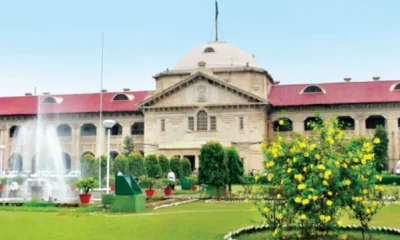
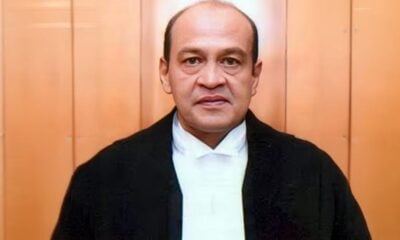
The Division Bench comprising Chief Justice Govind Mathur and Allahabad High Court held that prima facie the speech is not such that a reasonable man could have arrived at a conclusion as the inference drawn by the District Magistrate, Aligarh, who passed the detention order against Dr Khan in February this year.
The petitioner’s counsel submitted that Khan was earlier granted bail by a court and he was due to be released. However, charges under the NSA were imposed against him. Hence, his detention was illegal. Under the NSA, a person can be detained without a charge for up to 12 months if authorities are satisfied that they are a threat to national security or law and order.
Khan’s counsel said he was arrested from Mumbai in January this year, for allegedly giving a provocative speech at the Aligarh Muslim University on December 13, 2019, amidst the protests against the Citizenship Amendment Act (CAA). Khan had been granted bail by the court of CJM, Aligarh on February 10. But he continues to be in jail under the NSA, which was slapped on him by the Aligarh DM on February 15.
The Court observed that State failed to discharge its burden to establish that Kafeel Khan’s December speech had “such a deleterious effect on the public order in district Aligarh as had continued to exist up to 13.02.2020 necessitating preventive detention of the detenue”.
The Court further observed that when the alleged provocative speech was delivered in December 2019, the District Administration, Aligarh did not find Khan’s speech sufficient for preventive detention. However, only when the CJM allowed his bail application on February 10, the Aligarh DM initiated the process for detaining Dr Khan under the NSA.
The Court held that no recommendation, even at the time of Dr Khan’s bail hearing, was made for invoking powers under sub-Section (2) of Section 3 of the National Security Act, 1980. Hence, the Court held that the “causal link” between the Act and the detention order is missing/ completely broken.
Moreover, state authorities have failed to discharge their “bounden burden” to establish that the lecture delivered by Dr Khan in December 2019 had such a deleterious effect on the public order in district Aligarh as had continued to exist up to 13.02.2020, necessitating preventive detention of the detenue on that later date.
The Court observed, “Preventive detention is an exceptional mode to curtail liberty and freedom of a person in exceptionally rare circumstances. Under Article 21 of the Constitution of India along with the right to life, the right to personal liberty is a precious fundamental right. This precious fundamental right must always be protected.”
The Bench clarified that the delay in passing of detention orders or in recording subjective satisfaction to preventively detain a person may not be a subject matter of a hard and fast rule. Nevertheless, it observed, the record must itself indicate that there existed a “continuing casual link” between the satisfaction claimed to have been recorded and the offending act.








India News
BJP releases first list of 47 candidates for Kerala assembly polls
The BJP has released its first list of 47 candidates for the Kerala Assembly elections scheduled for April 9, including three former Union ministers.


India News
Fire in ICU at SCB medical college hospital in Cuttack kills 10 patients
Ten patients died after a fire broke out in the trauma ICU at SCB medical college hospital in Cuttack early Monday morning. Odisha Chief Minister Mohan Charan Majhi announced compensation and ordered a judicial probe.

India News
Arvind Kejriwal moves Supreme Court against Delhi High Court order in excise policy case
Arvind Kejriwal has approached the Supreme Court challenging a Delhi High Court order related to proceedings in the excise policy case and alleging violation of his fundamental rights.


Fire near Dubai International Airport after drone incident, flights temporarily suspended

Arvind Kejriwal moves Supreme Court against Delhi High Court order in excise policy case

Fire in ICU at SCB medical college hospital in Cuttack kills 10 patients

Rajya Sabha elections Voting begins for 37 seats across 10 states

BJP releases first list of 47 candidates for Kerala assembly polls
BJP releases first list of 47 candidates for Kerala assembly polls
Fire in ICU at SCB medical college hospital in Cuttack kills 10 patients
Arvind Kejriwal moves Supreme Court against Delhi High Court order in excise policy case
Rajya Sabha elections Voting begins for 37 seats across 10 states
Fire near Dubai International Airport after drone incident, flights temporarily suspended

Afghan Men Try To Hang With The Jet Engine Of The Aircraft in Kabul- Afghanistan News – Kabul News
Trending Top 10 News: 10000 Crore Fine on Flipkart, Apple to Launch Unique Feature, Hdfc Bank Job Ad

Trending Top 10 News: Nokia 6310, Apple sales, Bachpan ka Pyar Video Kid, Dainik Bhaskar IT Raid

Trending Top 10 News: Canada bans Indian flights, Rain in Delhi NCR, AIMIM Twitter hacked, Raj Kundra case

Trending Top 10 News: Shein India, Apple New Service, Pocket Oxygen, Oppo Launched New Phone
-
 Latest world news24 hours ago
Fire near Dubai International Airport after drone incident, flights temporarily suspended
-
 India News23 hours ago
Arvind Kejriwal moves Supreme Court against Delhi High Court order in excise policy case
-
 India News23 hours ago
Fire in ICU at SCB medical college hospital in Cuttack kills 10 patients
-
 India News24 hours ago
Rajya Sabha elections Voting begins for 37 seats across 10 states
-
 India News13 hours ago
BJP releases first list of 47 candidates for Kerala assembly polls
