English हिन्दी
Connect with us

India News

Enact law banning triple talaq, don’t use courts for politics, say lawyers

Published

on

Enact law banning triple talaq, don’t use courts for politics, say lawyers
[vc_row][vc_column][vc_column_text]South Asian Minorities Lawyers Association says triple talaq should not be a weapon in the hands of politicians

By Abu Turab

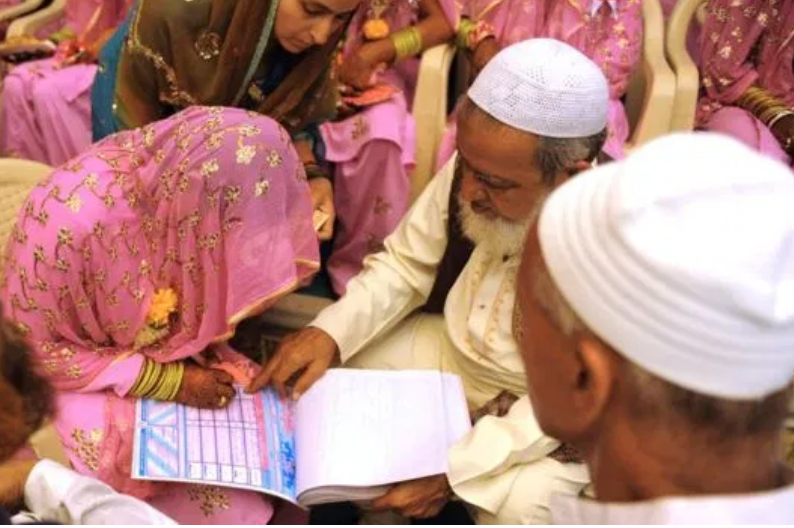
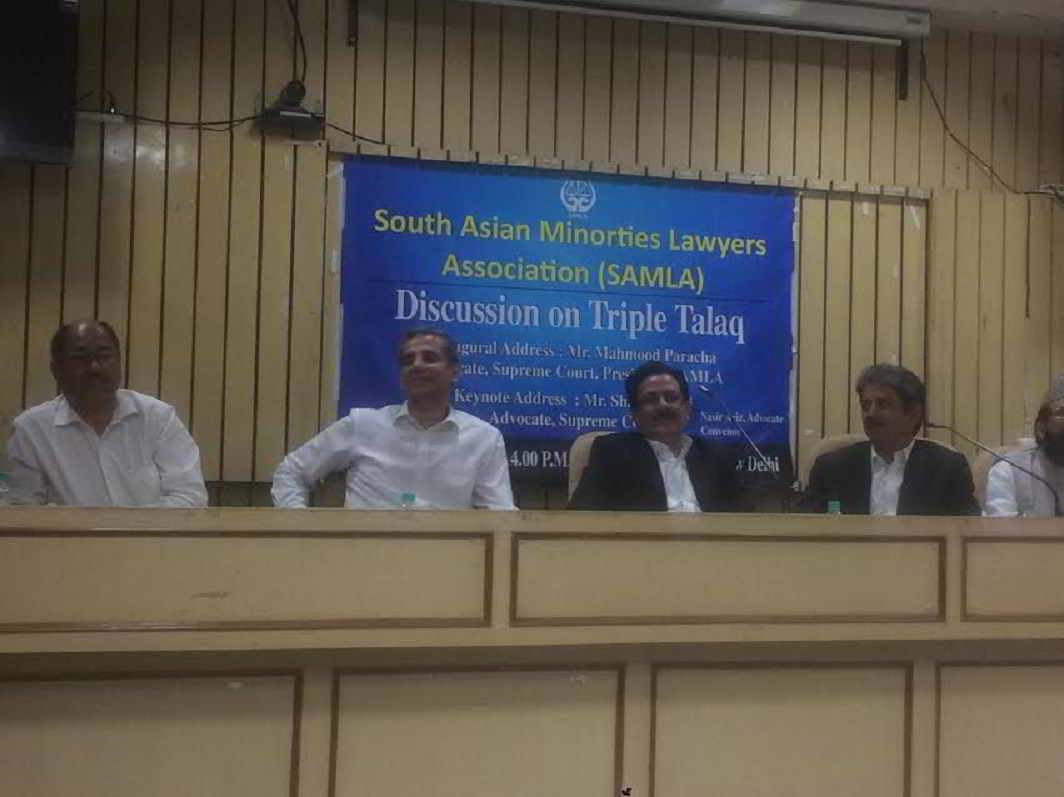
The government should bring in legislation to ban triple talaq under the Penal Code, said senior advocates associated with the South Asian Minorities Lawyers Association (SAMLA), and not leave it to courts to intervene in issues related to Muslim Personal Law.

The advocates called upon community leaders to introspect and come up an unanimous opinion on the vexed issue.

Addressing a discussion on triple talaq at Indian Law Institute in New Delhi on Thursday, senior lawyer Mehmood Pracha, who is also the president of the regional organization, claimed Muslim women enjoy maximum liberty as marriage is basically a contract where both parties can include conditions before entering into a matrimonial relationship.

He said triple talaq in one sitting is already banned in Delhi, Maharashtra and Jammu and Kashmir because of certain court orders, which has certainly not empowered Muslim women.

Pracha said women, irrespective of religion, were already protected by the Domestic Violence Act, Section  25 of the CRPC and Section 125 B of the Indian Penal Code, where special provision of maintenance is mandatory. In case of former husband’s inability to bear the costs, the woman is eligible to receive financial assistance from state waqf boards.

Pracha, who is also member of All India Muslim Personal law Board (AIMPLB), believed that being an NGO, the Muslim body does not have executive power. At most, they may ask community members to boycott the person who misuses provision of triple talaq.

He advised that courts should not allowed to be misused for political reasons. It should be clear that formulating legislation is government’s duty and not  that of the judiciary. The issue of triple talaq is being misused for political ends.  If  the government is really concerned about the welfare of women, it should come up with legislation having provision of huge penalty and imprisonment for triple talaq in one sitting.

Suggesting a solution, Pracha said the Domestic Violence Act should be made more effective and the provision of granting 75 percent of husband’s assets to the woman should be made mandatory. Make the law of divorce so fearsome that triple talaq is prohibited, he added.

He criticised the present law saying that women have no right to complaint against adultery and are forced to bear the harassment every day.

Maulana Mohammad Jafar of the Jamaat-e-Islami Hind and convener of Muslim Personal Law Awareness Campaign, said the government was responsible to bring in legislations and getting them executed.

He said triple talaq in one sitting was condemned by Prophet Muhammad. It does not have the sanctity like other Islamic laws. He acknowledged that some people misused Islamic laws by giving triple talaq in one sitting. “We all should work together to prohibit misuse of any law,” he said.

Mushtaq Ahmed, another senior advocate, supported the government which has submitted an affidavit in the Supreme Court saying triple talaq was incorrect. He advised all Muslims to adopt Shia and Ahl-e-Hadees jurisprudence rejecting triple talaq.

Suhel Ayubi said Muslims should be advised the solution to the triple talaq controversy based on Islamic law and scriptures.

Niyaz Farooqui, one of the senior thinkers of Jamiat Ulema-e-Hind, advised that no sect can assert that their practices were right while those of others were wrong. Each jurisprudence was free to interpret Islamic law as it deems fit. However nobody should be allowed to sow seeds of difference on such issues.

Shahid Rizvi, while delivering keynote address, said that practice of talaq was rampant among Arabs before the advent of Islam. In fact Prophet Muhammad reformed the provisions of talaq for safeguarding the interests of the women.

He observed that Muslim religious and social leaders have not done anything to correct the course of the triple talaq practice. In fact, we are wrong when we expect a non-Muslim judge and advocates to understand Islamic laws as we desire. Community should come forward with solution of the vexed issue. He referred to several verses of the Holy Quran describing the process of talaq and rights of men and women. He asserted that Islam is easy and straight forward religion. “We must have our own mechanism to resolve the issues,” he suggested.

It was decided that SAMLA will also organise a discussion about the Hindu personal law for creating awareness among the law practitioners and the general public.[/vc_column_text][/vc_column][/vc_row]

India News

Four militants killed as rival Naga groups clash in Manipur village

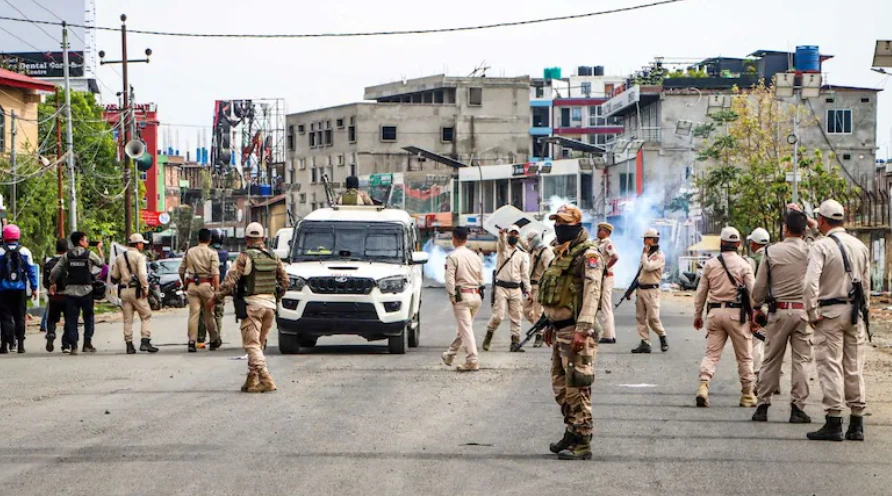
Four militants were killed in a gunfight between suspected rival Naga groups at Taodaijang village in Manipur’s Noney district on Wednesday.

Published

on

Manipur violence

At least four militants were killed in a gunfight between suspected rival Naga militant groups in Manipur’s Noney district on Wednesday, November 4.

The exchange of fire took place at Taodaijang village in the Khoupum area of the Naga-majority district. According to officials, the cadres involved were suspected to belong to rival Naga militant outfits, including the Zeliangrong United Front-Jenchui (ZUF-J) and the Zeliangrong United Front-Kamson (ZUF-K).

Initial reports indicated that the gunfight continued for several hours, leaving three cadres of ZUF-J and one cadre of ZUF-K dead.

The bodies of the deceased militants were subsequently recovered by local residents.

Residents appeal to armed groups to stop firing

Following the gunfight, local residents, including women, reached the spot in an attempt to prevent further violence between the rival groups.

They also used a public address system to appeal to the armed cadres to stop firing and prevent the situation from escalating further.

Further details about the circumstances surrounding the clash were awaited.

Manipur government reviews security situation

In a separate development, Manipur Chief Minister Yumnam Khemchand Singh directed senior security officials to identify active armed groups suspected of involvement in recent incidents of violence in the state.

The directive excluded groups engaged in peace talks with the state government.

The Chief Minister issued the instructions during a review meeting on the state’s law and order situation on Tuesday night.

He also asked security agencies, including the Army and central paramilitary forces, to submit a detailed report on the involvement of the suspected groups.

The Chief Minister said the state Cabinet could consider declaring such groups unlawful if their involvement in violence against innocent civilians was established.

He also emphasised that necessary action would be initiated against groups continuing to perpetrate violence against civilians.

Continue Reading

India News

Agnipath scheme gets 2-year extension for Agniveers, tenure may rise to 6 years

The Centre has introduced a two-year extension for the remaining 75% of Agniveers under the Agnipath scheme, creating another opportunity for them to seek enrolment in the regular armed forces.

Published

on

The Centre has introduced a significant change to the Agnipath recruitment scheme, offering a two-year extension to Agniveers who were earlier expected to leave the armed forces after completing their initial four-year service.

Chief of Defence Staff (CDS) General NS Raja Subramani announced the decision on Wednesday following a Union Cabinet meeting. Under the revised arrangement, the 75% of Agniveers who were not initially selected for absorption into the regular armed forces will be offered an additional two-year engagement period.

The development creates another opportunity for these personnel to continue serving in the armed forces beyond their original four-year tenure.

What changes under the revised Agnipath scheme?

Under the original Agnipath framework, Agniveers were recruited for a four-year service period, including training. At the end of this tenure, up to 25% of each batch could be selected for permanent enrolment into the regular armed forces, while the remaining 75% were expected to return to civilian life.

The revised arrangement introduces an additional two-year engagement for the latter group. This means their potential service period could increase from four to six years.

The extension also creates another opportunity for Agniveers to seek enrolment into the regular armed forces after completing the additional two years.

What happens after the additional two years?

According to General NS Raja Subramani, Agniveers completing the extended engagement period and willing to continue serving will be considered for enrolment in the regular armed forces.

Their selection will be based on objective criteria.

This creates an additional pathway for those who are not absorbed into the regular forces after their initial four-year tenure. However, the revised arrangement does not mean that every Agniveer will automatically receive permanent enrolment.

Why has the decision been taken now?

The announcement comes as the first batch of Agniveers recruited under the scheme approaches the completion of its initial four-year service period.

The Agnipath scheme was introduced on June 14, 2022, to recruit personnel into the Indian Army, Navy and Air Force for a fixed four-year engagement.

General Raja Subramani said the scheme had been undergoing periodic reviews, with the performance of Agniveers being continuously evaluated. He also indicated that feedback on their performance had been very positive.

The latest Cabinet decision creates an additional route for retaining personnel beyond the initial engagement period.

What was the original Agnipath arrangement?

Under the original framework, the armed forces could retain up to 25% of Agniveers in the regular cadre after their four-year service period, subject to selection.

The remaining 75% were to complete their engagement and transition to civilian life.

With the latest revision, this group will receive an additional two-year engagement opportunity before being considered for enrolment into the regular armed forces under the prescribed selection criteria.

The change therefore modifies the earlier arrangement by providing an additional opportunity for Agniveers to continue their military careers.

Continue Reading

India News

Hardeep Singh Puri set to win Rajya Sabha bypoll unopposed

Union Minister Hardeep Singh Puri is set to be elected unopposed to the Rajya Sabha from Madhya Pradesh after the returning officer rejected the nomination papers of two independent candidates.

Published

on

Hardeep Puri

Union Petroleum Minister Hardeep Singh Puri is set to enter the Rajya Sabha unopposed from Madhya Pradesh after the nomination papers of two independent candidates were rejected during scrutiny on Tuesday.

The two candidates whose nominations were rejected were Kante Sayanna and Rajkumar Lohani, the latter being backed by the Congress. Their rejection leaves Puri as the only candidate in the contest for the vacant Rajya Sabha seat.

According to an official, the result will be announced on November 5, which is also the last date for withdrawal of nominations.

The Returning Officer, Umesh Sharma, examined the nomination papers on the last day of scrutiny and rejected the two independent candidates’ applications.

Objections raised against Hardeep Puri’s nomination

The nomination papers submitted by Puri also faced objections from the two independent candidates and Congress leader Hemant Katare.

They questioned the validity and completeness of Puri’s affidavit filed in Form 26, raising concerns over whether the mandatory details had been properly furnished.

However, after examining the objections, Returning Officer Umesh Sharma concluded that Puri had not violated any requirements under the Representation of the People Act.

Sharma stated in his order that no defect had been found in Puri’s nomination papers that could justify their rejection.

Following the decision, Katare and Congress MLA Atif Aqeel announced that they would approach the court against the order.

Calling the decision an attack on Indian democracy, the Congress leaders said in a statement that Puri’s nomination should have been rejected despite what they described as significant errors.

Why the Madhya Pradesh Rajya Sabha seat fell vacant

The by-election was necessitated by the resignation of Union Minister L Murugan, which left a Rajya Sabha seat vacant in Madhya Pradesh.

With the nomination papers of both independent candidates rejected and Puri’s nomination cleared, the Union minister is set to be elected unopposed.

The final announcement is expected on November 5, the last day for withdrawal of nominations.

Continue Reading

Trending

© Copyright 2022 APNLIVE.com