English हिन्दी
Connect with us

India News

Congress slams Bhagwant Mann govt after protesting farmers removed from Sambhu border, says Punjab will avenge the backstabbing

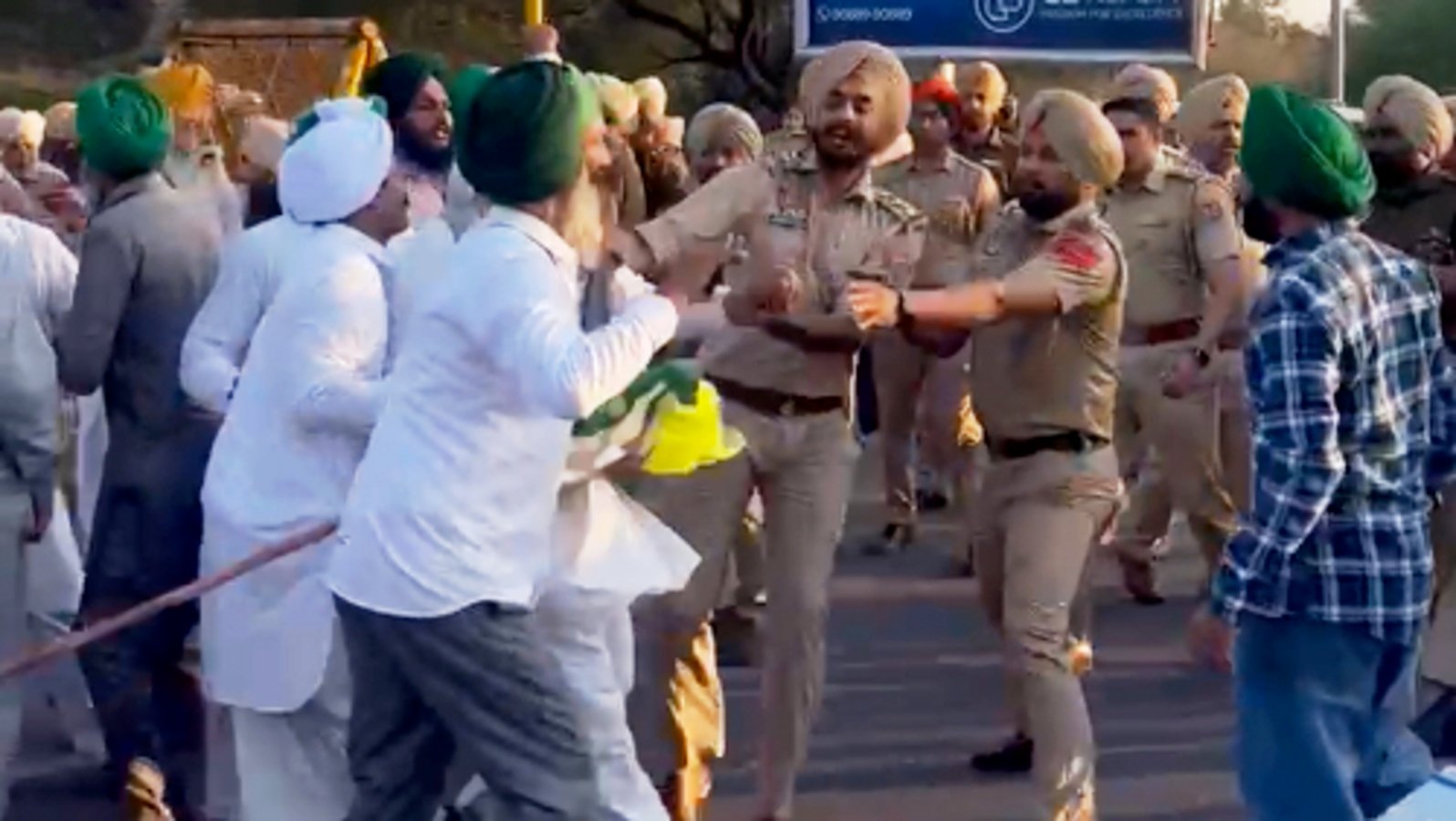
Her remarks came after Punjab Police removed protesting farmers from the border and detained several farmer leaders, including Jagjit Singh Dallewal and Sarvan Singh Pandher.

Published

on

The Congress on Thursday criticized Punjab Chief Minister Bhagwant Mann and the Aam Aadmi Party (AAP) government for their handling of the farmers’ protest at the Punjab-Haryana Shambhu border, accusing them of “backstabbing” the farmers.

Congress leader Supriya Shrinate said, “AAP showed its true character yesterday. We should not forget that Arvind Kejriwal’s Delhi government was the first state government to pass the three black farm laws. It is unbelievable that a party born out of a movement would resort to ending the farmers’ movement in this manner. Punjab will definitely take revenge for this backstabbing.”

Her remarks came after Punjab Police removed protesting farmers from the border and detained several farmer leaders, including Jagjit Singh Dallewal and Sarvan Singh Pandher.

Pratap Singh Bajwa, Leader of the Opposition in the Punjab Assembly, echoed similar sentiments, calling AAP and the Bharatiya Janata Party (BJP) “two sides of the same coin.” He alleged that the crackdown on farmers was politically motivated to ensure the victory of AAP’s candidate in the Ludhiana West bye-election, which could pave the way for Arvind Kejriwal to become a Rajya Sabha member.

“This was expected from Punjab CM Bhagwant Mann. Why did they betray the farmers? On one hand, they called the farmers for a meeting, and then they detained them. BJP and AAP are two sides of the same coin. The Haryana government has also started evacuating the borders. They want to ensure that their candidate wins the Ludhiana West bye-election so that Kejriwal can enter the Rajya Sabha,” Bajwa said.

The farmers, united under the banners of the All India Kisan Sabha and Bharatiya Kisan Union, had been protesting at the Shambhu border, demanding various concessions from the government. On Wednesday, Punjab Police dismantled temporary structures at the protest site and detained several farmer leaders, sparking outrage among the farming community.

In response to the crackdown, farmers staged a protest march to the residence of Haryana Chief Minister Nayab Singh Saini in Karnal on Thursday.

Punjab Minister Harpal Singh Cheema defended the government’s actions, stating that the borders needed to be reopened for the sake of Punjab’s economy and youth. He urged farmers to protest in Delhi or elsewhere, as their demands are directed at the Central government.

“The AAP government and the people of Punjab stood with the farmers when they protested against the three black farm laws. The demands of the farmers are against the Central government. It has been more than a year, and the Shambhu and Khanauri borders are closed. Traders and the youth of Punjab are very upset. When traders can do business, the youth will get employment and stay away from drugs,” Cheema told ANI.

“Today’s action has been taken because we want the youth of Punjab to get employment. We want to open Shambhu and Khanauri borders. The demands of the farmers are against the Central government, and they should stage a protest in Delhi or somewhere else but should not block the roads of Punjab,” he added.

India News

Give all tickets to Muslim women, Amit Shah says, attacking Akhilesh Yadav on sub-quota demand

A sharp exchange between Amit Shah and Akhilesh Yadav in Parliament over sub-quota for Muslim women highlights key divisions on women’s reservation implementation.

Published

on

A heated exchange broke out in Parliament during discussions on the women’s reservation framework, with Union Home Minister Amit Shah and Samajwadi Party chief Akhilesh Yadav locking horns over the demand for a sub-quota for Muslim women.

The debate unfolded as the government pushed forward key legislative measures to implement 33% reservation for women in the Lok Sabha and state assemblies.

Akhilesh Yadav argued that the proposed reservation must ensure representation for women from marginalised communities, including Other Backward Classes (OBCs) and Muslim women. He said that without such provisions, large sections could remain excluded from political participation.

He also questioned the timing of the bill, alleging that the Centre was avoiding a caste census. According to him, a census would lead to renewed demands for caste-based reservations, which the government is reluctant to address.

Government rejects religion-based quota

Responding to the demand, Amit Shah made it clear that reservation based on religion is not permitted under the Constitution.

He stated that any proposal to provide quota to Muslims on religious grounds would be unconstitutional, firmly rejecting the idea of a separate sub-quota for Muslim women within the broader reservation framework.

The government has maintained that the existing framework already includes provisions for Scheduled Castes (SC) and Scheduled Tribes (ST) women within the overall reservation structure.

Wider political divide over implementation

The issue of sub-categorisation within the women’s quota has emerged as a major flashpoint, even as most opposition parties broadly support the idea of women’s reservation.

Samajwadi Party leaders reiterated that their support for the bill depends on inclusion of OBC and minority women, while the government continues to defend its constitutional position.

The debate is part of a broader discussion during the special Parliament session, where multiple bills linked to delimitation and implementation of the women’s quota are being taken up.

Continue Reading

India News

No state will lose a seat, Centre assures as delimitation debate takes centre stage in Parliament

Parliament’s special session begins with key focus on implementing women’s reservation and delimitation, setting the stage for major electoral changes.

Published

on

Parliament

A special session of Parliament commenced on Thursday, with the Centre set to take up crucial legislation related to women’s reservation and delimitation of constituencies. The session, scheduled over three days, is expected to witness intense debate as the government pushes forward its legislative agenda.

At the centre of discussions is the proposal to operationalise the women’s reservation law, which seeks to allocate 33 percent of seats in the Lok Sabha and state assemblies to women. The law, passed earlier, requires enabling provisions before it can be implemented.

The rollout of the reservation is closely tied to the delimitation exercise — a process that redraws parliamentary constituencies based on updated population data. The implementation is expected only after the next census and delimitation process are completed.

The government is aiming to put in place the framework so that the reservation can be enforced in future elections, likely around 2029.

Delimitation and numbers at play

Delimitation is a key aspect of the proposed changes, as it will determine how seats are redistributed and which constituencies are reserved. The exercise is expected to reflect population shifts and may also involve an increase in the total number of Lok Sabha seats.

This linkage has made the issue politically sensitive, with several opposition parties backing women’s reservation in principle but raising concerns over how and when delimitation will be carried out.

Political reactions and expected debate

The session is likely to see sharp exchanges between the government and opposition. While there is broad agreement on increasing women’s representation, disagreements remain over the timing, process, and potential political implications of the delimitation exercise.

Some leaders have argued that delimitation could significantly alter the balance of representation among states, making it a contentious issue beyond the women’s quota itself.

The government, however, has framed the move as a step toward strengthening women’s participation in governance and ensuring more inclusive policymaking.

Continue Reading

India News

Delimitation and women’s quota bills set to be tabled in Parliament today, key numbers explained

The Centre will table key bills on women’s reservation and delimitation, proposing a major expansion of Lok Sabha and changes in seat allocation based on updated census data.

Published

on

Lok Sabha

The Centre is set to introduce a set of crucial bills in Parliament aimed at implementing women’s reservation and redrawing electoral constituencies, marking a major shift in India’s political framework.

According to details accessed from official drafts, three separate legislations are expected to be tabled during the ongoing session. These include a constitutional amendment to operationalise 33% reservation for women, a delimitation bill to redraw constituencies, and changes to laws governing Union Territories.

The move is seen as a coordinated effort to align women’s reservation with a fresh delimitation exercise based on updated population data.

How the numbers may change

One of the most significant proposals is the expansion of the Lok Sabha. The draft legislation suggests increasing the maximum strength of the House to around 815 members, with up to 35 seats allocated to Union Territories.

Currently, the Lok Sabha has 543 elected members. The increase is aimed at ensuring proportional representation after decades of population changes across states.

The proposed delimitation exercise would rely on the latest available census figures, likely the 2011 Census, replacing the long-standing reliance on 1971 data.

Women’s reservation linked to delimitation

The proposed framework makes it clear that the 33% reservation for women in Parliament and state assemblies will only be implemented after the delimitation process is completed.

The reservation is expected to apply across general, Scheduled Caste, and Scheduled Tribe seats, with constituencies being rotated periodically to ensure broader representation.

The reform is likely to come into effect ahead of the 2029 general elections, depending on the completion of the delimitation exercise.

Why delimitation is central to the plan

Delimitation has remained frozen for decades, leading to imbalances in representation due to population growth, migration, and urbanisation.

The new bill proposes setting up a Delimitation Commission, which would be tasked with redrawing constituency boundaries and reallocating seats based on updated population data.

This process is expected to significantly alter the political map of the country and could trigger debates over regional representation.

Continue Reading

Trending

© Copyright 2022 APNLIVE.com