India News
How India Became the World Leader in Trump Projects

[vc_row][vc_column][vc_column_text]-By Blake Schmidt
Three years after his deal-making tour, India has become the only developing nation where the US president’s personal construction business in booming
In western India, a pair of shiny black Trump buildings with gold insignia tower over the city of Pune. In nearby Mumbai, a 75-story Trump skyscraper will be one of the tallest in the megacity. In a swanky suburb of Delhi, two Trump partners have big plans. And in Kolkata, a new Trump tower is under way.
Three years after Donald Trump arrived on his private jet for a deal-making tour, India has become the only major developing country where his business is roaring. It has the most construction projects with Trump licensing deals of any country outside of the U.S.
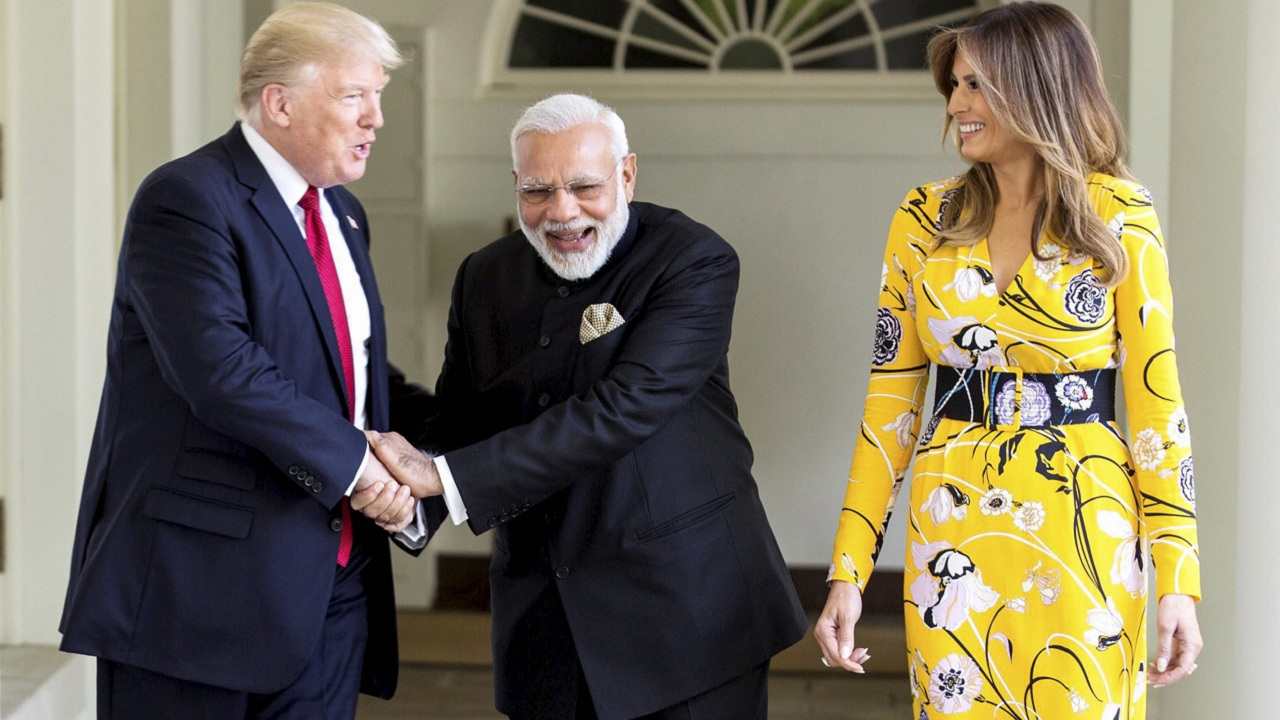
After his election, Trump abandoned a number of international projects and promised not to engage in new foreign deals that could trigger conflicts of interest. With the Indian deals struck earlier, his company is barreling ahead. While in office, Trump has been building a strong bond with Prime Minister Narendra Modi—as his company builds ties with some partners who have faced legal troubles.
Modi was one of the first to visit Trump after he took office and invited daughter Ivanka to lead a delegation to a business summit in November. All of this has raised fresh questions about whether Trump Organization’s deals with politically-connected foreign tycoons could put his interests ahead of the nation’s and entail special treatment by foreign authorities.
India is a key U.S. ally in Asia and its rivalry with both Pakistan and China fosters many areas where Trump and Modi need each other—nuclear weapons, anti-terrorism, Afghanistan and trade, among others. So far, Trump doesn’t seem to have spared India in policies ranging from visas for technology workers to the Paris climate accord. Still, the risk that he might let his business interests outweigh national needs—or that Modi might cut him a break on taxes or permits in exchange for policy tweaks—remains a big concern for government ethics experts in the U.S. A spokesman for Modi did not respond to repeated requests for comment.
Asked about potential conflicts in India, the Trump Organization said it’s “very proud of the success we have achieved in that market with five active properties under various stages of development.” The White House referred questions to the Trump Organization.
Trump’s Indian partners Atul and Sagar Chordia celebrated the U.S. victory by flying immediately to New York to congratulate the president-elect, increasing congressional calls for Trump to divest his businesses. He opted instead to hold onto his assets and hand management to his two older sons.
Whatever concerns have been raised in the U.S. regarding the blending of business and policy, Trump’s election seems only to have increased the value of his brand in India, though some voices in the Indian press have begun to question the effects of politics and well-publicized conflicts of interests on his brand. Here, political ties have long been the fastest route to get approvals for big projects. Only Afghanistan is more burdensome when it comes to dealing with construction permits, according to a ranking of 186 nations in the World Bank’s 2017 Doing Business report.
In fact, the link between construction and politics is so tight in India that research by political scientists Milan Vaishnav and Devesh Kapur shows that cement consumption declines in the lead-up to state assembly elections because firms redirect cash from construction to campaigns.
“No one in India would think twice about him being engaged in politics on the one hand and real estate on the other,” said Vaishnav, senior fellow at the Carnegie Endowment for International Peace. “It’s an open secret that to be successful in Indian real estate, you have to be well connected in politics.”
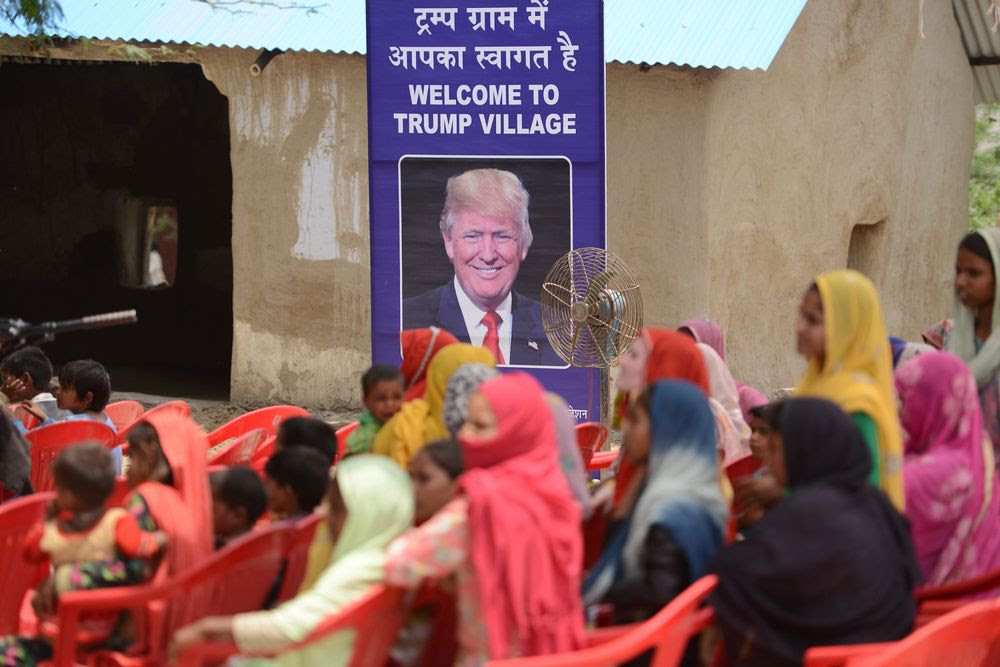
Residents of Marora, a village about 100 km from Delhi, have tried renaming the place “Trump Village.” Photographer: Money Sharma/AFP/ via Getty Images
In a more surreal display of Trump’s allure in India, a small village, encouraged by a charity group, renamed itself Trump Village and put up a Trump billboard to help get much-needed toilets. A local commissioner lashed out at the stunt and ordered the billboard removed. Bindeshwar Pathak, an activist who led the effort, expects the name will stick, however: “You can now say ‘I want to go to Trump Village’ and people will tell you how.”
One question facing Modi is to what extent his changes in real estate policy could impact the bottom line of Trump Organization or its partners. Last year, he ended a tax loophole often used by the rich to buy property in someone else’s name.
In his high-profile visit to Mumbai in August 2014, Donald Trump praised Modi for winning the country’s first single-party parliamentary majority in 30 years.
“India is a great place to invest, especially after the elections,” Trump told reporters. He held a banquet attended by 500 of Pune’s rich and powerful, in which TV cameramen pushed for position while a Bollywood star interviewed the American tycoon.
Trump spoke about his global ambitions to build towers in China and South America. As it happens, those projects have largely failed to materialize. His group scrapped deals in Brazil last year after being cited in a local corruption probe, in which the group hasn’t been charged with any crimes, and several projects in China and Russia have floundered.
Not so in Modi’s India, where an extended economic boom and the political influence of Trump’s allies have helped his business flourish.
In Pune on a recent afternoon, men in military uniform guarded the entrance of the Trump towers as auto rickshaws buzzed about on the street outside. The twin 23-story buildings stand out in the city’s unremarkable skyline. They were erected by Panchshil, the real estate business of the Chordia family. Patriarch Ishwardas Chordia, who hailed from a family of sugar traders, was college buddies with a powerful political broker, Sharad Pawar, whom Modi has lauded for his guidance in his early days in politics, and whose family members have shared business interests with the Chordias.
When Chairman Atul Chordia, his brother and an associate visited Trump days after the election, Trump praised Modi. The Chordias had been negotiating a second deal, which Trump scrapped along with other projects days before his inauguration. Chordia declined to comment.
In nearby Mumbai, Abhishek Lodha is trying to secure approvals for the last few floors of the Trump Tower Mumbai. The managing director of Lodha Group said in an interview at the firm’s office that he negotiated the tower deal over six months prior to Trump’s election, which included a visit to Trump Tower in New York for meetings with Donald Jr. and Ivanka. Once in Mumbai, Trump the elder made a few tweaks to the project: bigger kitchens, air-conditioning in the lobbies and kitchens, and he picked out the façade design.
Lodha is no political novice. His father is the deputy boss in Maharashtra state for Modi’s Bharatiya Janata party. After the government revised rules to allow transfer of development rights to the city of Mumbai in November, Lodha was the first to take advantage and surrendered some mill land. The group gained rights to more floor space in the city but hasn’t said how it will use it.
Almost 900 miles to the north in the Delhi suburb of Gurgaon, Pankaj Bansal is one of two Trump partners in a city where a Dubai-style boom of sky-rises emerged almost overnight out of farmland. Bansal, who traveled with Prime Minister Narendra Modi in business delegations to Russia and Japan, agreed to meet at M3M’s Golf Estate, though declined to comment on his Trump tie-up.
The entrance to the resort is flanked by shanties of workers. Bansal collects cars and likes to sky dive, and his company sells dreams to those fancying themselves as “the gentry”—a promotional video by his Polo Suites project offers a chance to “breathe the air of nobility, and live your life king-sized, to walk like gods amongst men.”
Gurgaon’s market is tough at the moment, but Bansal said he expects the family-run company to weather India’s economic slowdown by delivering on projects as competitors face crises. Two managing directors of Unitech Limited, for example, are fighting allegations that they duped customers after they were arrested in April over a delayed project. Unitech, which is not a Trump partner, did not respond to requests for comment.
“People who are delivering are doing okay,” said Bansal. “People who aren’t are bleeding blood.”
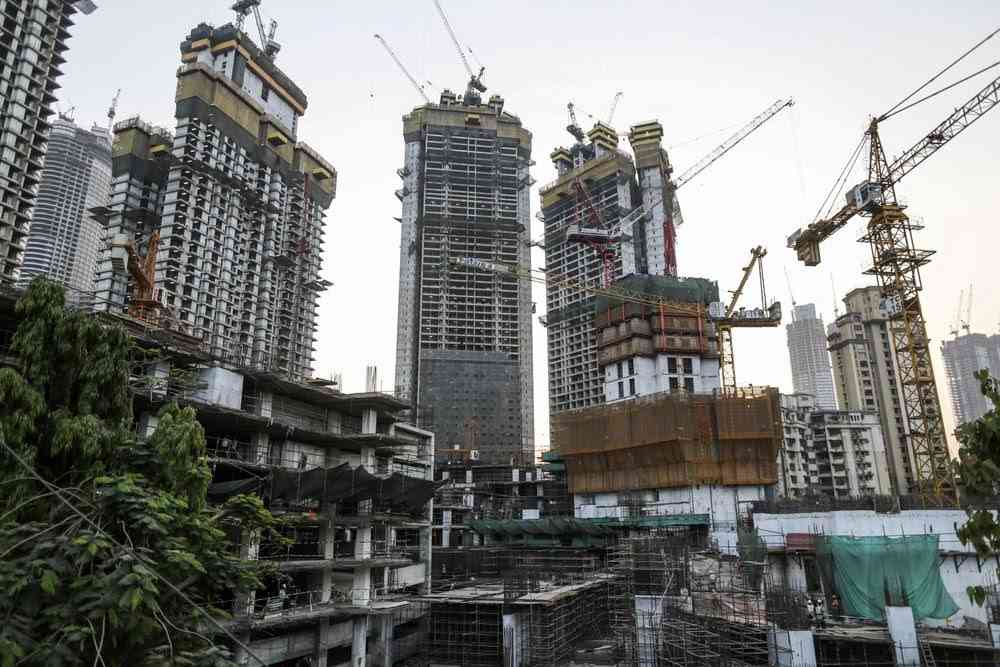
Lodha’s The Park complex, home to Mumbai’s Trump Tower. Photographer: Dhiraj Singh/Bloomberg
The name—M3M—tells something about the company’s self-image. It stands for Magnificence in the Trinity of Men, Materials and Money. The group has been facing some legal troubles of its own. It has denied allegations in a police report in March that an executive bribed forestry officials to clear 2,200 trees at a development site. The company says the allegations are completely false.
The company was entangled for years in a tax investigation into the suspected use of fronts in land purchases, a practice which is banned in India. M3M’s chairman offered to pay millions in advance tax when investigators raided group offices and seized funds and valuables in 2007, though court documents show the funds were later recouped after no incriminating evidence was found. The company said an appeal by the income tax department was dismissed in its favor in 2015.
Trump’s other partner in Gurgaon, IREO, also had its offices searched by tax investigation in 2010. The group said in an emailed response that it complied with tax authorities and provided all of its relevant shareholding details. No charges were filed. The executive who announced the Trump deal for the private equity real estate firm is the brother-in-law of Sudhanshu Mittal, a ruling party leader, though the company said he is not associated in any ownership or management capacity.
Harsh Patodia, chairman for Unimark Group, who has an arrangement with the Trump Organization in Kolkata, declined to comment by phone. Tribeca Developers, whose founder Kalpesh Mehta is a Trump representative in India who visited Trump Tower in November with the Chordias, also declined requests for comment.
During his 2014 visit, Trump knew how to flatter his audience.
“I don’t consider this an emerging market, I consider this an amazing market,” he said in an interview with NDTV, citing real estate prices that are cheap by his standards, though out of reach for most Indians. “India was very divisive at one point and people were afraid to invest and I think people have great confidence in the new prime minister.”
Trump’s courting of India is already paying off: his personal financial disclosures, which released details of his income in ranges, show India deals bringing in between $1.6 million and $11 million in royalties since 2014.
(This article is from a syndicated feed provided by Bloomberg)[/vc_column_text][/vc_column][/vc_row]









India News
Journalist files police complaint against Rahul Gandhi over push allegation
Journalist Richa Parashar has filed a criminal complaint against Rahul Gandhi and others, alleging that she was pushed while covering the Opposition’s march to the Supreme Court. The Congress has denied the allegation.

India News
Delhi court orders release of CJP founder Abhijeet Dipke
A Delhi court on Saturday ordered the conditional release of Cockroach Janta Party founder Abhijeet Dipke, who was detained and subsequently arrested ahead of a planned protest march at Connaught Place.
India News
Anirudh Ravichander to marry Kavya Maran in November, reception on November 21
Anirudh Ravichander and Kavya Maran are set to marry in November, with their Chennai wedding reception scheduled for November 21.


Anirudh Ravichander to marry Kavya Maran in November, reception on November 21

Journalist files police complaint against Rahul Gandhi over push allegation

Delhi court orders release of CJP founder Abhijeet Dipke
Journalist files police complaint against Rahul Gandhi over push allegation
Delhi court orders release of CJP founder Abhijeet Dipke
Anirudh Ravichander to marry Kavya Maran in November, reception on November 21

ED summons Pinarayi Vijayan in money laundering case

LK Advani, 98, hospitalised in Delhi with chest infection

Afghan Men Try To Hang With The Jet Engine Of The Aircraft in Kabul- Afghanistan News – Kabul News
Trending Top 10 News: 10000 Crore Fine on Flipkart, Apple to Launch Unique Feature, Hdfc Bank Job Ad

Trending Top 10 News: Nokia 6310, Apple sales, Bachpan ka Pyar Video Kid, Dainik Bhaskar IT Raid

Trending Top 10 News: Canada bans Indian flights, Rain in Delhi NCR, AIMIM Twitter hacked, Raj Kundra case