English हिन्दी
Connect with us

India News

Doctors predict health risks in using cow dung for Covid cure

In Hinduism, the cow is a sacred symbol of life and the earth, and for centuries Hindus have used cow dung to clean their homes and for prayer rituals, believing it has therapeutic and antiseptic properties.

Published

on

cow dung

Doctors in India warned the people who are using cow dung as a medicine against the Covid-19 and said that the practice has risks of spreading other diseases as there is no scientific evidence for its effectiveness.

The national president of Indian Medical Association J A Jayalal said that there is no concrete scientific evidence that cow dung or urine work to boost immunity against Covid-19, it is based entirely on belief. He said there are also health risks involved in smearing or consuming these products other diseases can spread from the animal to humans.

In Hinduism, the cow is a sacred symbol of life and the earth, and for centuries Hindus have used cow dung to clean their homes and for prayer rituals, believing it has therapeutic and antiseptic properties.
India has been reported 22.66 million cases and 246,116 deaths so far while the experts predicted that the actual numbers could be 5 to 10 times higher. The people across the country are struggling to find hospital beds, oxygen, or medicines, leaving many to die for lack of treatment.

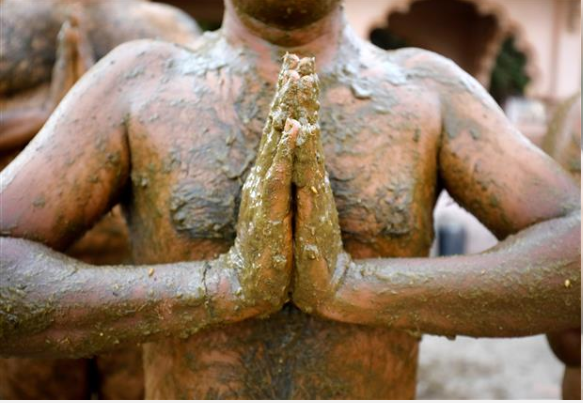
In Gujarat, some believers have been following a routine to go to Gaushala once a week to cover their bodies in cow dung and urine with a hope to boost immunity to fight against the coronavirus. People walk after applying cow dung on their bodies during cow dung therapy, believing it will boost their immunity at the Shree Swaminarayan Gurukul Vishwavidya Pratishthanam Gaushala located at the outskirts of Ahmedabad.

Uddhav Bhatia, a frontline worker, touches a cow after applying cow dung on his body during cow dung therapy to boost his immunity which will help to fight against the Covid-19. He has since been a regular at the Shree Swaminarayan Gurukul Vishwavidya Pratishthanam, a school run by Hindu monks that lies just across the road from the Indian headquarters of Zydus Cadila, which is developing its own Covid-19 vaccine.

Read Also: Uttar Pradesh government begins house-to-house tracking for Covid-19 cases

There are also concerns the practice could contribute to the spread of the virus as it involved people gathering in groups. Madhucharan Das, in charge of another cow shelter in Ahmedabad, said they were limiting the number of participants.

Doctors and scientists in India and across the world have repeatedly warned against practising alternative treatments for Covid-19, saying they can lead to a false sense of security and complicate health problems.

India News

AI errors in voter list digitisation causing hardship during SIR, Mamata writes to EC chief

Mamata Banerjee has written to the chief election commissioner alleging that AI-driven digitisation errors in electoral rolls are causing hardship, harassment and distress to genuine voters during the SIR process in West Bengal.

Published

on

mamta banerjee

West Bengal Chief Minister Mamata Banerjee has once again written to Chief Election Commissioner Gyanesh Kumar, alleging that errors arising from AI-driven digitisation of the 2002 electoral rolls are causing widespread hardship to genuine voters during the ongoing Special Intensive Revision (SIR) exercise in the state.

In her fifth letter since the SIR process began, Banerjee claimed that the use of artificial intelligence tools to digitise older voter lists led to serious inaccuracies in electors’ personal details. According to her, these errors have resulted in large-scale data mismatches, with many genuine voters being wrongly flagged as having “logical discrepancies”.

The chief minister accused the Election Commission of disregarding statutory processes that had been followed over the past two decades. She said voters were now being forced to re-establish their identity despite corrections having been made earlier through quasi-judicial hearings.

Calling the approach arbitrary and illogical, Banerjee alleged that it went against the constitutional spirit by effectively disowning the commission’s own past actions and mechanisms. She further claimed that voters submitting documents during the SIR exercise were not being given proper acknowledgements, terming the procedure “fundamentally flawed”.

Raising concerns over the nature of hearings, Banerjee said the SIR process had become largely mechanical and overly dependent on technical data, lacking sensitivity, human judgment and compassion. She argued that such an approach undermines democratic values and the constitutional framework.

Highlighting the human impact of the exercise, the chief minister claimed that the revision process had already seen 77 deaths, four suicide attempts and 17 cases of hospitalisation. She attributed these incidents to fear, intimidation and excessive workload caused by what she described as an unplanned exercise by the Election Commission.

Banerjee also criticised the treatment of several eminent citizens, alleging that they were subjected to harassment during the process. She further expressed concern over the handling of cases involving women voters, particularly those who had changed their surnames after marriage or shifted to their matrimonial homes.

According to her, women electors were being questioned and summoned to prove their identity, reflecting a lack of social sensitivity and amounting to an insult to women and genuine voters. She questioned whether a constitutional authority should treat half of the electorate in such a manner.

Urging immediate corrective steps, Banerjee called on the Election Commission to address the issues arising from the SIR exercise to end what she described as harassment and agony for both citizens and officials, and to safeguard democratic rights.

Continue Reading

India News

Communist Party of China delegation visits BJP headquarters in Delhi

A delegation from the Communist Party of China, led by Vice Minister Sun Haiyan, visited the BJP headquarters in Delhi and held discussions on inter-party communication.

Published

on

China delegation visits BJP office

A delegation from the Communist Party of China (CPC), led by Sun Haiyan, Vice Minister of the International Department of the CPC Central Committee (IDCPC), visited the Bharatiya Janata Party (BJP) headquarters in Delhi on Monday.

During the visit, the Chinese delegation held discussions with a BJP team headed by party general secretary Arun Singh. The talks focused on ways to advance inter-party communication and engagement between the BJP and the CPC.

Sharing details of the meeting, BJP foreign affairs department in-charge Vijay Chauthaiwale said the interaction involved an in-depth exchange on strengthening party-to-party dialogue. He confirmed the visit in a post on social media, stating that the CPC delegation was received at the BJP head office as part of ongoing inter-party interactions.

The Chinese Ambassador to India, Xu Feihong, was also present during the meeting, accompanying the CPC delegation.

According to Chauthaiwale, the visit was led by Sun Haiyan in her capacity as Vice Minister of the IDCPC, underscoring the importance attached to party-level exchanges between the two sides.

Continue Reading

India News

Only Marathi leadership will run BMC, says Fadnavis ahead of civic polls

Devendra Fadnavis says BMC will remain under Marathi leadership, dismissing opposition claims of threats to the Marathi community ahead of civic polls.

Published

on

Devendra Fadnavis

With elections to major civic bodies approaching, Maharashtra Chief Minister Devendra Fadnavis on Monday asserted that the Brihanmumbai Municipal Corporation (BMC) would continue to be led by a Marathi leader, rejecting opposition claims that the interests of the “Marathi manush” were under threat.

Addressing the political narrative around Marathi identity, Fadnavis said that it was not the Marathi community whose existence was at risk, but certain political forces attempting to create fear ahead of the polls. He stressed that Maharashtra belongs to all Marathi people and not to any single political group.

“I want to reiterate that only a Marathi person will be at the helm of affairs in the BMC. Only Marathi will lead,” the chief minister said, pushing back against allegations of marginalisation of the Marathi community.

Language policy row and cabinet decision

Responding to criticism over the language policy debate, Fadnavis said the recommendation to teach Hindi and English in schools was approved during the tenure of former chief minister Uddhav Thackeray. He clarified that the present government had merely constituted a committee to examine the implementation of that earlier cabinet decision.

According to Fadnavis, the report recommending the inclusion of Hindi and English was submitted in September 2021 and received cabinet approval in January 2022, with the decision being reaffirmed later. “We have only formed a committee to study the implementation of that decision, yet unnecessary controversy was created,” he said.

Opposition sharpens attack

Earlier, Shiv Sena (UBT) chief Uddhav Thackeray accused the state government of damaging Mumbai over the last three years and claimed that the work carried out by the undivided Shiv Sena over 25 years was being undone.

The political rhetoric intensified further after Maharashtra Navnirman Sena (MNS) chief Raj Thackeray called for Marathi unity, warning that Maharashtra’s language, land and identity were under threat. Addressing party workers, he said any attempt to impose Hindi in the state would be opposed and described the upcoming BMC polls as a decisive election for the Marathi community.

The exchanges come ahead of elections to 29 municipal corporations across Maharashtra, including the BMC, Pune Municipal Corporation and Pimpri-Chinchwad Municipal Corporation. Polling is scheduled for January 15, with counting to take place on January 16.

Continue Reading

Trending

© Copyright 2022 APNLIVE.com