English हिन्दी
Connect with us

India News

Karunya Plus KN-408 Kerala lottery result announced: First winner gets Rs 80 lakh, check the full list of winners here | Here’s how to claim prize money

Kerala State Lottery Department has announced the lucky draw winners of the Karunya Plus KN-408 lottery ticket today at 3 pm. The next Karunya Plus draw will be held on February 24.

Published

on

Kerala engineer swallows bribe money after being caught red-handed by vigilance department, admitted to hospital

Kerala State Lottery Department has announced the lucky draw winners of the Karunya Plus KN-408 lottery ticket today at 3 pm at Gorky Bhavan, near Bakery Junction, in the state capital Thiruvananthapuram. The winner of the first prize will get Rs 80 lakh while the second and third prize winner will get Rs 10 lakh and Rs 1 lakh respectively.

You can check the result by clicking on the official website of the Kerala State Lottery Department- keralalotteryresult.net. Apart from these, the results are also published in the Kerala Government Gazette.

The winner of the first prize (Rs 80 lakh) is PD 948502

The winner of the second prize (Rs 10 lakh) is PM 654747

The winners of the third prize (Rs 1 lakh) are PA 222249 PB 959099 PC 747429 PD 926532 PE 693707 PF 707096 PG 899786 PH 443286 PJ 825753 PK 903520 PL 948491 PM 556459

The winners of the consolation prize (Rs 8,000) are PA 948502 PB 948502 PC 948502 PE 948502 PF 948502 PG 948502 PH 948502 PJ 948502 PK 948502 PL 948502 PM 948502

FOR THE TICKETS ENDING WITH THE FOLLOWING NUMBERS

The winners of fourth prize (Rs 5,000) are 0734 0830 1198 1294 2877 3673 3848 4622 4896 5068 5193 5250 6051 6935 7303 7997 9131 9270

The winners of fifth prize (Rs 1,000) are 0451 0735 1092 1139 1612 1642 1718 1889 2231 2427 3082 3407 3760 4160 4418 4487 4812 4905 5036 5817 6174 6224 6478 6571 6824 7008 7223 7596 9145 9196 9225 9349 9473 9646

The winners of sixth prize (Rs 500) are 0034 0046 0129 0307 0647 0892 1016 1068 1233 1424 1447 1456 1482 1750 1851 2162 2180 2215 2451 2560 2577 2631 2650 2656 2735 3124 3373 3380 3739 3814 3861 3880 3934 4134 4307 4333 4444 4559 4678 4988 5000 5519 5559 5592 5617 5644 5690 5727 5790 5805 6020 6287 6372 6432 6502 6631 6902 6934 7103 7120 7185 7195 7390 7669 7902 7963 8045 8319 8645 8660 8716 8790 8798 8888 9029 9040 9046 9627 9921 9923

The winners of seventh prize (Rs 100) are 0005 0024 0043 0053 0081 0131 0207 0391 0499 0730 0822 0844 0901 0952 1035 1058 1102 1143 1196 1466 1524 1735 1827 1862 1864 2049 2112 2298 2327 2350 2359 2360 2479 2639 2745 2758 2863 2901 3289 3302 3343 3432 3459 3528 3586 3590 3616 3977 4050 4087 4110 4170 4191 4196 4352 4430 4489 4521 4558 4562 4590 4657 4750 4757 4892 5062 5194 5198 5341 5626 5950 6007 6060 6145 6206 6290 6371 6379 6510 6556 6564 6570 6622 6685 6707 6761 6788 7034 7078 7121 7147 7244 7266 7599 7739 7760 7782 7783 7799 7801 7969 8023 8036 8196 8207 8330 8452 8589 8624 8805 8904 9006 9068 9135 9202 9260 9277 9377 9400 9424 9525 9533 9534 9596 9612 9756

The prize winners are advised to verify the winning numbers with the results published in the Kerala Government Gazette and surrender the winning tickets within 30 days.

Next Karunya Plus Lottery

The next Karunya Plus Draw will be held on February 24 at Gorky Bhavan, Near Bakery Junction, Thiruvananthapuram.

How to claim prize money?

Winners of the Karunya Plus KN-408 lucky draw must check the Kerala lottery results published in the Kerala Government Gazette to verify their winning tickets.

They must report to the Kerala lottery office in Thiruvananthapuram with their tickets and identification evidence within 30 days if they find their ticket number in the published gazette.

The verification process should be completed within 30 days following the announcement of the results.

Those who have won less than Rs 5,000 in a lottery can claim their reward money at any lottery shop in Kerala.

Those who have won more than Rs 5,000 must present their tickets to a bank or government lottery office with their identification papers in order to make a claim.

India News

BJP says Mamata Banerjee not fit for constitutional post over remarks on PM Modi

BJP has criticised West Bengal Chief Minister Mamata Banerjee over her remarks on Prime Minister Narendra Modi, triggering a political controversy ahead of elections.


Published

on

mamta banerjee speech

The Bharatiya Janata Party has criticised West Bengal Chief Minister Mamata Banerjee over her remarks against Prime Minister Narendra Modi, with a party leader saying such statements make her unfit to hold a constitutional post.

The controversy began after Mamata Banerjee, while addressing an Eid gathering in Kolkata, criticised the prime minister’s policies and accused him of targeting minorities. During her speech, she also accused the prime minister of calling certain people infiltrators and alleged that names were being deleted.

Reacting to the remarks, BJP leader Shishir Bajoria said that anyone who calls the prime minister an infiltrator does not have the right to occupy a constitutional position. He also alleged that the chief minister’s comments reflected fear of losing the upcoming election.

The BJP has been raising the issue of illegal infiltration from Bangladesh ahead of the West Bengal Assembly elections and has accused the Trinamool Congress government of allowing infiltration. The Trinamool Congress has rejected the allegations, stating that border security is controlled by central forces under the Union Home Ministry.

At the Eid event in Kolkata, Mamata Banerjee was joined by Trinamool Congress National General Secretary Abhishek Banerjee. The Trinamool leadership also criticised the Election Commission’s special intensive revision exercise, alleging that it targets certain communities.

Abhishek Banerjee said that while political narratives are being built around religion, the real issue is that the entire country is in danger and people should not view issues only through a religious lens.

The political exchange comes amid rising tensions between the BJP and the Trinamool Congress ahead of the state elections, with both parties accusing each other over issues related to infiltration, minority rights and voter lists.

Continue Reading

India News

Delhi sees coldest March day in 6 years as air quality improves sharply

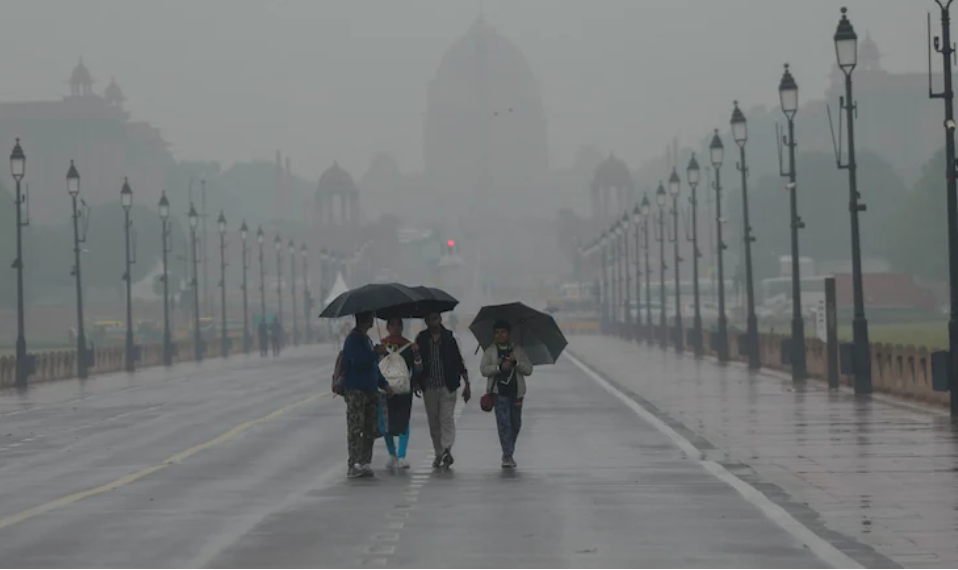
Delhi logs its coldest March day since 2020 as rainfall brings a sharp dip in temperature and significantly cleaner air.
Published

on

Delhi Records maximum temperature

After days of continuous rainfall and gusty winds, Delhi experienced an unusual weather shift, recording its coldest March day in six years along with significantly improved air quality.

The maximum temperature at Safdarjung dropped to 21.7 degrees Celsius, which is 9.6 degrees below normal. This marks the lowest daytime temperature for March since March 8, 2020, when it had settled at 21.2 degrees Celsius.

At the same time, the city witnessed a notable improvement in air quality. The Air Quality Index (AQI) was recorded at 93, placing it in the ‘satisfactory’ category. This is the first such instance in around five months (161 days), with the previous similar reading recorded on October 9, 2025, when the AQI stood at 99.

According to standards set by the Central Pollution Control Board, AQI levels between 51 and 100 fall under the ‘satisfactory’ category.

Temperatures remain below normal across monitoring stations

Other parts of the city also reported significantly lower daytime temperatures. Palam recorded a maximum of 21.2 degrees Celsius, while Lodhi Road registered 21.0 degrees Celsius. Ridge and Ayanagar reported 21.1 degrees Celsius and 21.5 degrees Celsius respectively, all well below seasonal averages.

Minimum temperatures, however, showed less variation. Safdarjung recorded 16 degrees Celsius, while Palam logged 14.7 degrees Celsius. Lodhi Road, Ridge, and Ayanagar recorded temperatures close to normal levels.

Rainfall contributes to weather shift

The city received 7 mm of rainfall during the day, taking the monthly total to 16.2 mm so far. This makes it the wettest March since 2023.

Rainfall was recorded across multiple stations, including Safdarjung, Palam, Lodhi Road, Ridge, and Ayanagar, along with areas like Mayur Vihar, Pusa, and Janakpuri.

Cumulative rainfall between Thursday morning and Friday morning ranged between 5.4 mm and 7.4 mm across key monitoring stations.

Weather likely to stabilise

The recent spell of rain is expected to ease, with forecasts indicating a partly cloudy sky on Saturday. Temperatures are likely to rise slightly, with the maximum expected around 27 degrees Celsius and minimum around 14 degrees Celsius.

Air quality is also expected to move back into the ‘moderate’ category over the next couple of days, according to the Air Quality Early Warning System.

Continue Reading

India News

Late-March western disturbance brings 1,000-km rain band across India, Pakistan and Afghanistan

An unusual western disturbance has created a 1,000-km rain band, bringing widespread storms, rainfall and hail across parts of India and neighbouring countries.

Published

on

Weather

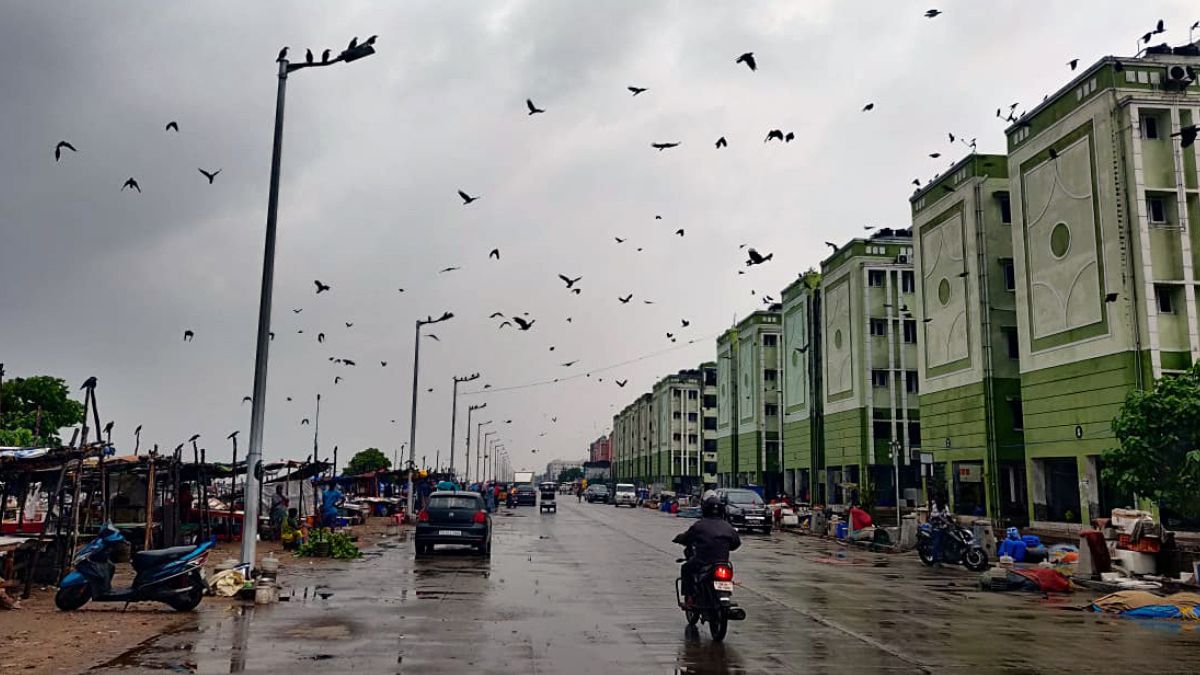
An unusual weather system is currently impacting large parts of India, Pakistan and Afghanistan, bringing widespread thunderstorms, gusty winds, rainfall and even hailstorms at a time when summer conditions typically begin to set in.

The ongoing event is being driven by an active western disturbance that has formed a nearly straight, linear low-pressure trough stretching about 1,000 kilometres—from Afghanistan, across Pakistan, and into India. This formation is considered atypical, as most western disturbances usually follow a curved path.

Western disturbances are generally extratropical systems originating near the Mediterranean region and are more common during winter months, when they bring snowfall and cold weather to northern India. However, this system stands out both for its timing in late March and its distinct structure.

Widespread weather activity across regions

The system is associated with an upper-air cyclonic circulation over northern Pakistan, which is leading to widespread thunderstorms and winds ranging between 40 and 80 kmph across northwest India. Isolated hailstorms and light-to-moderate rainfall or snowfall have also been reported.

Heavy to very heavy rainfall has already occurred in sub-Himalayan West Bengal and Sikkim, while southern states including Karnataka, Andhra Pradesh, Kerala and Tamil Nadu have received significant showers. Hailstorm activity has also been observed in multiple regions.

Meteorological conditions indicate that the western disturbance includes a trough in the middle and upper atmospheric levels. This is interacting with several low-level cyclonic circulations over regions such as north Madhya Pradesh, east Uttar Pradesh, west Rajasthan, Haryana, northeast Assam, coastal Andhra Pradesh, and parts of Tamil Nadu and Kerala, intensifying weather activity.

System likely to weaken, another disturbance ahead

The current disturbance is expected to remain active over the Western Himalayas and adjoining plains through Friday, after which its intensity is likely to decrease.

However, forecasts suggest that another weaker western disturbance may approach the region around March 22, potentially bringing further weather changes.

Moisture sources behind the system

The primary moisture feeding this system originates from evaporation over multiple water bodies, including the Mediterranean Sea, Caspian Sea, Black Sea, and the Persian Gulf.

As the system moves eastward, it gathers additional moisture from the Arabian Sea. This moisture is further enhanced due to orographic lifting along the Himalayas. Simultaneously, existing troughs and cyclonic features over regions such as Gujarat and the Mannar area are contributing to increased low-level convergence, leading to intensified rainfall and storm activity.

Delhi-NCR sees cooler conditions and rainfall

In Delhi-NCR, light-to-moderate rainfall accompanied by thunderstorms and winds of 30–50 kmph is expected to continue until Friday. Daytime temperatures are likely to remain between 25 and 28 degrees Celsius, which is below the seasonal average.

Why late-March disturbances are uncommon

Climatologically, western disturbances are most frequent between December and February, with India typically experiencing four to six such systems per month during winter.

By late March, their frequency usually declines sharply as the jet stream weakens and shifts northward. Historically, only one or two such systems occur during this period each year.

However, recent trends suggest a gradual extension of the western disturbance season into April. Experts attribute this to changes in atmospheric patterns, including stronger subtropical jet streams and broader climate variability.

Continue Reading

Trending

© Copyright 2022 APNLIVE.com