English हिन्दी
Connect with us

India News

Navy inducts Made in India anti-submarine warship INS Kiltan

Published

on

Navy inducts Made in India anti-submarine warship INS Kiltan
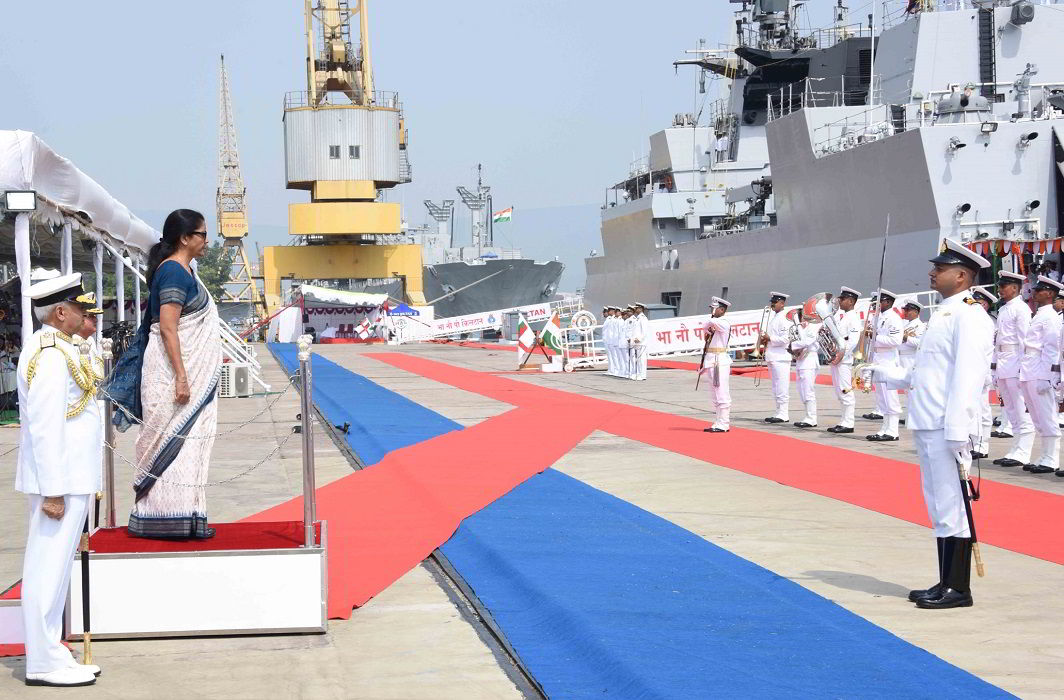
The ship hosts a predominantly indigenous cutting-edge weapons and sensors suite which includes heavyweight torpedoes, ASW rockets, 76 mm calibre Medium Range gun and two multi-barrel 30 mm guns.

Defence Minister Nirmala Sitharaman on Monday commissioned the indigenously-built anti-submarine warship INS Kiltan into the Indian Navy in a ceremony held at the naval dockyard in Visakhapatnam.

INS Kiltan, which is the third of the four indigenously built Anti-Submarine Warfare (ASW) stealth corvettes, has a team of 13 officers and 178 sailors led by commanding officer Naushad Ali Khan. It was designed by the navy and built by Garden Reach Shipbuilders and Engineers in Kolkata.

According to a official release, INS Kiltan is the first major warship to have a superstructure of carbon composite material. This, the release said, helps improve stealth features and lower top weight and maintenance costs.

Top officials of the Indian Navy including chief Admiral Sunil Lanba, Flag Officer Commander-in-chief of Eastern Naval Command HS Bisht also attended the event.

Addressing the audience on the occassion, Sitharaman said INS Kiltan strengthens the defence system and will be a shining armour of the ‘Make in India’ programme as it is totally built in the country.

The ship derives its name from one of the islands in Aminidivi group of Lakshadweep and Minicoy islands. It also boasts of the legacy of the Petya Class ship of the same name Kiltan (P79). The USSR built ship had participated as Task Force Commander in the “Operation Trident” during the 1971 Indo-Pak war.

The ship hosts a predominantly indigenous cutting-edge weapons and sensors suite which includes heavyweight torpedoes, ASW rockets, 76 mm calibre Medium Range gun and two multi-barrel 30 mm guns as close-in-weapon system (CIWS) with dedicated fire control systems, missile decoy rockets (Chaff), advanced Electronic Support Measure system, most advanced bow-mounted sonar and air surveillance radar Revathi, the official release said.

India News

Congress, BJP attack Bhagwant Mann over remarks on Punjab blasts

Congress and BJP have jointly criticised Punjab CM Bhagwant Mann after he linked recent blasts near defence sites to political motives, triggering a controversy.

Published

on

Bhagwant Mann

A political row has erupted in Punjab after Chief Minister Bhagwant Mann linked recent blast incidents to political motives, drawing sharp criticism from both the Congress and the Bharatiya Janata Party (BJP).

The controversy follows two low-intensity explosions reported within a short span of time — one near the Border Security Force (BSF) headquarters in Jalandhar and another close to an army cantonment area in Amritsar. The incidents raised concerns over security, particularly given the sensitive nature of the locations.

In response, Mann suggested that the blasts could be part of a larger political strategy. His remarks triggered a strong backlash, with opposition parties accusing him of politicising a serious security issue.

Leaders from the Congress criticised the Chief Minister’s statement, calling it inappropriate and alleging that such comments undermine the gravity of the situation. They stressed that matters related to national security should be handled with caution and responsibility.

The BJP also joined the criticism, questioning the basis of Mann’s claims and urging the state government to focus on investigation and law enforcement instead of making political allegations.

The developments have led to an unusual moment where both Congress and BJP appear aligned in their criticism of the Aam Aadmi Party-led government in the state.

Meanwhile, the blasts themselves have intensified concerns over safety in border regions, with authorities continuing their investigation into the incidents. No casualties were reported, but the proximity to defence establishments has made the issue particularly sensitive.

The episode has further escalated political tensions in the state, with security and accountability emerging as key points of debate.

Continue Reading

India News

Himanta Biswa Sarma resigns as Assam chief minister, oath ceremony likely after May 11

Himanta Biswa Sarma resigns as Assam Chief Minister after BJP-led NDA’s victory. He will continue as caretaker CM until the new government is sworn in after May 11.

Published

on

Himanta sharma

Assam Chief Minister Himanta Biswa Sarma resigned from his post on Wednesday, paving the way for the formation of a new government after the BJP-led NDA secured a decisive victory in the 2026 Assembly elections.

Sarma submitted his resignation to Governor Lakshman Prasad Acharya at Lok Bhawan in Guwahati. The Governor accepted the resignation and asked him to continue as the caretaker Chief Minister until the new government takes charge.

The resignation comes after the NDA’s strong electoral performance, where the alliance won a clear majority in the 126-member Assembly, ensuring its return to power for another term.

Oath ceremony expected after May 11

Speaking to reporters after submitting his resignation, Sarma said the swearing-in ceremony for the new government is likely to be held after May 11.

He indicated that Prime Minister Narendra Modi has been invited to attend the ceremony but is unavailable until May 11, which has influenced the tentative schedule.

Decision on next chief minister soon

Sources suggest that central observers, including senior BJP leaders, are expected to arrive shortly to oversee the selection of the legislature party leader. The newly elected MLAs will then decide on the next Chief Minister.

Despite the formal resignation, party sources indicate that Sarma is likely to continue in the role for another term, given the BJP’s strong mandate in the state.

The move marks the beginning of the government formation process in Assam following the election results declared earlier this week.

Continue Reading

India News

Rahul Gandhi and Vijay alliance took shape through backchannel talks, early signals from Congress leaders

Congress outreach and political calculations led to Rahul Gandhi and Vijay coming together after the Tamil Nadu 2026 election results.

Published

on

The coming together of Rahul Gandhi and actor-politician Vijay in Tamil Nadu after the 2026 Assembly elections was not sudden, but the result of behind-the-scenes political manoeuvring and early signals within the Congress.

According to media reports, some leaders in the Tamil Nadu Congress had already sensed the scale of Vijay’s surge during the campaign, anticipating what was later described as a “wave” in favour of his party.

After the results, where Vijay’s Tamilaga Vettri Kazhagam (TVK) emerged as the single largest party but fell short of a majority, communication channels between the Congress leadership and Vijay quickly became active.

A key moment in this evolving political equation was a phone call from Rahul Gandhi to Vijay, congratulating him on the party’s strong performance. The conversation was seen as more than a courtesy, signalling the possibility of cooperation at a time when government formation required additional support.

Reports indicate that discussions within Congress weighed the political benefits of supporting Vijay, especially given the shifting dynamics in the state where traditional dominance by major Dravidian parties has been challenged.

With TVK needing allies to cross the majority mark, Congress emerged as a potential partner, leading to a broader political realignment in the state. This development also triggered tensions within opposition alliances, highlighting the strategic importance of the decision.

The evolving partnership reflects a mix of electoral pragmatism and changing voter sentiment, particularly the growing influence of younger voters, which leaders acknowledged as a key factor in the election outcome.

Continue Reading

Trending

© Copyright 2022 APNLIVE.com