English हिन्दी
Connect with us

India News

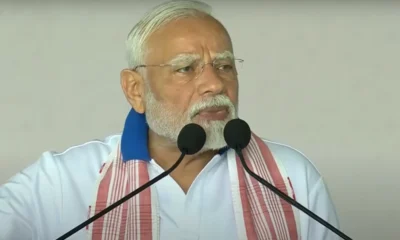
PM Modi says talks with Pakistan will only be on terror and PoK

In his 8 PM speech, PM Modi confirmed the success of Operation Sindoor, saluted India’s armed forces, and warned Pakistan over its support for terrorism following the brutal Pahalgam attack.

Published

on

PM Modi speech on gst 2.0

Prime Minister Narendra Modi on Monday said terror will wipe out Pakistan itself for its continued support to terrorist activities inside India. He said after Operation Sindoor, India will continue to take decisive steps to protect its people from any threat, hinting at more strikes if there was a spike in terror.

In his first televised address after the India-Pakistan ceasefire, Modi said India will talk to Pakistan only on limiting its support to terror and on Pakistan-occupied Kashmir. This is a reference to Trump, who had evinced interest in solving all issues, including Kashmir. The government doesn’t want third-party involvement and sees it as a bilateral issue for India and Pakistan to discuss.

Assuring the people, Modi said terror and talks cannot happen together, nor can terror go along with trade or terror along with water in an apparent rebuff to US President Donald Trump, who has been speaking of India and Pakistan getting back to trading with the US.

In a firm, emotionally charged speech, he said India decisively responded to the Pahalgam terror attack with Operation Sindoor, saying the country has “turned the homes of terrorists into ruins”.

Modi saluted the Indian armed forces, scientists, and security personnel, crediting their bravery and precision for the operation’s success. “Operation Sindoor is not just a name,” he said, “it is a reflection of the emotions of crores of Indians and a pledge for justice.”

Referring to the April 22 terrorist attack in Pahalgam, where 26 people were brutally killed, Modi called it deliberate targeting of innocent tourists. “The cruelty shown by terrorists, asking people’s religion and killing them in front of their children, was an attack not only on humanity but on India’s harmony,” the Prime Minister said.

Terror’s epicentres destroyed in Pakistan and PoK

Modi confirmed that on the night of May 6 and early May 7, Indian forces launched targeted strikes on terror hubs across Pakistan and PoK, including key facilities of Lashkar-e-Taiba and Jaish-e-Mohammed. These included terror camps, training centers, and command infrastructure. “More than 100 hardcore terrorists were eliminated — the same who had roamed free in Pakistan for two to three decades,” he announced.

The strikes also destroyed Bahawalpur-based facilities, which Modi described as a “global university of terrorism,” linking them to past international attacks, including 9/11 and London bombings.

Pakistan retaliated, India exposed them

Following the Indian strikes, Pakistan retaliated by targeting Indian civilian zones, including schools, temples, and homes. However, Modi said Pakistan’s efforts failed miserably. “India’s air defence system crushed their drones and missiles mid-air,” he said, adding, “Pakistan’s pride in its airbase crumbled before India’s accuracy.”

He noted that in just the first three days, Pakistan had been so severely hit that it began seeking international intervention. On May 10, Pakistan’s military approached India’s DGMO to propose a halt to further escalation.

“By then, we had already reduced their terror infrastructure to rubble. Their terror bases had become their own ruins,” Modi said.

He concluded by reaffirming that India will consider peace, but only after destroying the backbone of terror. “We have avenged the sindoor wiped off our sisters’ foreheads,” he declared.

Prime Minister Modi continued his address by highlighting how the world has now seen the true face of Pakistan, especially after high-ranking Pakistani officials were seen publicly attending the funerals of terrorists killed in Operation Sindoor. “This is undeniable proof of state-sponsored terrorism,” he said, asserting that India will continue to take decisive steps to protect its people from any threat.

Modi underlined that India had repeatedly outmatched Pakistan on the battlefield, but this time, Operation Sindoor introduced a new dimension—one that showcased India’s prowess in new-age warfare. “We have demonstrated the power of Made-in-India weapons systems. Their performance has proven that the time has come for India to lead in 21st-century warfare technology,” he added.

He urged citizens to remain united, calling India’s unity its greatest strength. “This may not be an age of world wars, but it cannot be an age of terrorism either. Zero tolerance for terrorism is the guarantee of a better world,” he said.

Taking a firm stand, PM Modi warned that Pakistan’s patronage of terror will eventually destroy it from within. “If Pakistan wants to survive, it must eliminate terrorism from its soil. There is no other path,” he declared.

He reiterated India’s clear policy—“Terror and talks cannot go together. Terror and trade cannot coexist. Blood and water cannot flow together.”

Addressing the global community, the Prime Minister said, “If there is ever to be a dialogue with Pakistan, it will be only on terrorism and only on Pakistan-Occupied Kashmir.”

Modi concluded his address by invoking the spirit of Buddha Purnima, calling for a future guided by peace, strength, and prosperity. “Lord Buddha showed us the way of peace, and even that path passes through strength,” he said. “For every Indian to live in peace and fulfill the dream of a developed India, it is essential for the nation to be strong — and when required, to use that strength.”

“I once again salute our armed forces and all security personnel for their valour in achieving the goals of Operation Sindoor,” he declared. “This valour, this courage, this sacrifice — I dedicate it to every mother of India, every sister, and every daughter of the nation.”

With a resounding tribute, Modi ended his speech, “Bharat Mata ki Jai! Bharat Mata ki Jai! Bharat Mata ki Jai!

India News

Amit Shah counters delimitation concerns, says southern states to gain Lok Sabha seats

Amit Shah assures Parliament that southern states will gain Lok Sabha seats after delimitation, countering opposition criticism during the women’s reservation debate.

Published

on

Amit Shah

Union Home Minister Amit Shah on Thursday addressed concerns over the proposed delimitation exercise, asserting in the Lok Sabha that southern states will not lose representation but instead see an increase in their number of seats.

His remarks came during a heated debate linked to the implementation of women’s reservation, where opposition parties have raised fears that population-based delimitation could reduce the political weight of southern states.

Shah rejected these claims, calling them misleading, and said the proposed framework ensures fairness while expanding the overall strength of the Lok Sabha.

Seat count to rise with expansion of Lok Sabha

The government has indicated that the total number of Lok Sabha seats could increase significantly as part of the delimitation process. In this expanded House, the combined representation of southern states is expected to rise from 129 seats at present to around 195 seats.

Shah emphasised that no state will lose seats in absolute terms, and the exercise is designed to reflect population changes while maintaining balance across regions.

State-wise projections shared in Parliament

During his address, Shah also provided indicative figures for individual southern states, suggesting notable increases in representation. According to the projections:

  • Tamil Nadu could see its seats rise substantially
  • Kerala, Telangana, and Andhra Pradesh are also expected to gain additional seats
  • Karnataka’s representation may increase as well

These figures were presented to counter the argument that delimitation would disproportionately favour northern states.

Political debate intensifies over linkage with women’s quota

The delimitation exercise has been closely linked to the rollout of women’s reservation, which proposes one-third seats for women in Parliament and state assemblies.

Opposition leaders have questioned this linkage, arguing that tying reservation to delimitation could delay its implementation and raise federal concerns. Some leaders have also warned that the move could impact national unity if apprehensions among states are not addressed.

The government, however, maintains that the reforms are necessary to ensure equitable representation and to align the electoral system with demographic realities.

Centre dismisses ‘false narrative’ on southern states

Shah reiterated that concerns about southern states losing influence are unfounded. He said the delimitation process will increase representation across regions and described the criticism as a “false narrative” aimed at creating confusion.

The issue is expected to remain a key flashpoint as Parliament continues discussions on the women’s reservation framework and related legislative changes.

Continue Reading

India News

PM Modi assures no discrimination in women’s quota, delimitation debate intensifies in Parliament

PM Narendra Modi has assured that women’s reservation will be implemented without discrimination, amid a heated debate over delimitation in Parliament.

Published

on

PM modi

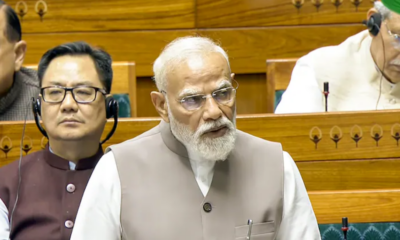
Prime Minister Narendra Modi has assured that there will be no discrimination in the implementation of women’s reservation, as Parliament witnessed a sharp debate over the proposed linkage between the quota and delimitation exercise.

During the ongoing special session, the government reiterated its commitment to ensuring fair representation while addressing concerns raised by opposition parties regarding the timing and structure of the legislation.

The proposed framework aims to reserve 33 percent of seats for women in the Lok Sabha and state assemblies. However, its implementation is tied to a fresh delimitation exercise, which is expected after the next census.

Opposition questions timing and intent

Opposition leaders have raised concerns that linking the women’s quota to delimitation could delay its implementation. They argue that the process of redrawing constituencies may push the actual rollout further into the future.

The issue has triggered a broader political confrontation, with multiple parties questioning whether the move could alter representation across states.

Some critics have also alleged that the delimitation exercise could disproportionately benefit certain regions based on population, a charge the government has rejected.

Government reiterates commitment to fair implementation

Responding to these concerns, the Centre has maintained that the reforms are necessary to ensure accurate and updated representation based on population data.

Leaders from the ruling side have repeatedly emphasized that the process will be carried out transparently and without bias. The assurance that there will be “no discrimination” is aimed at addressing fears among states and opposition parties.

The debate marks a key moment in Parliament, with both sides engaging in intense exchanges over one of the most significant electoral reforms in recent years.

Continue Reading

India News

Give all tickets to Muslim women, Amit Shah says, attacking Akhilesh Yadav on sub-quota demand

A sharp exchange between Amit Shah and Akhilesh Yadav in Parliament over sub-quota for Muslim women highlights key divisions on women’s reservation implementation.

Published

on

A heated exchange broke out in Parliament during discussions on the women’s reservation framework, with Union Home Minister Amit Shah and Samajwadi Party chief Akhilesh Yadav locking horns over the demand for a sub-quota for Muslim women.

The debate unfolded as the government pushed forward key legislative measures to implement 33% reservation for women in the Lok Sabha and state assemblies.

Akhilesh Yadav argued that the proposed reservation must ensure representation for women from marginalised communities, including Other Backward Classes (OBCs) and Muslim women. He said that without such provisions, large sections could remain excluded from political participation.

He also questioned the timing of the bill, alleging that the Centre was avoiding a caste census. According to him, a census would lead to renewed demands for caste-based reservations, which the government is reluctant to address.

Government rejects religion-based quota

Responding to the demand, Amit Shah made it clear that reservation based on religion is not permitted under the Constitution.

He stated that any proposal to provide quota to Muslims on religious grounds would be unconstitutional, firmly rejecting the idea of a separate sub-quota for Muslim women within the broader reservation framework.

The government has maintained that the existing framework already includes provisions for Scheduled Castes (SC) and Scheduled Tribes (ST) women within the overall reservation structure.

Wider political divide over implementation

The issue of sub-categorisation within the women’s quota has emerged as a major flashpoint, even as most opposition parties broadly support the idea of women’s reservation.

Samajwadi Party leaders reiterated that their support for the bill depends on inclusion of OBC and minority women, while the government continues to defend its constitutional position.

The debate is part of a broader discussion during the special Parliament session, where multiple bills linked to delimitation and implementation of the women’s quota are being taken up.

Continue Reading

Trending

© Copyright 2022 APNLIVE.com