English हिन्दी
Connect with us

India News

President Murmu, PM Modi, Mallikarjun Kharge, others congratulate Manu Bhaker on winning Bronze in Paris Olympics

PM Modi called it an incredible achievement.

Published

on

President Droupadi Murmu, Prime Minister Narendra Modi, and Congress chief Mallikarjun Kharge on Sunday extended their wishes to Indian shooter Manu Bhaker for winning Bronze in the Paris Olympics 2024.

In a post on X, President Murmu congratulated Manu Bhaker for opening India’s medal tally with her Bronze medal in the 10-metre air pistol shooting event at the Paris Olympics. She is the first Indian woman to win an Olympic medal in a shooting competition, Murmu added. India is proud of Manu Bhaker and her feat is going to inspire many sportspersons, especially women, the President said. She wished Manu to scale greater heights of accomplishment in the future.

The Prime Minister, taking to X, congratulated her for winning India’s first medal at the Paris Olympics 2024. “Congrats on the Bronze”, PM said. This success is even more special as she became the 1st woman to win a medal in shooting for India. PM Modi called it an incredible achievement.
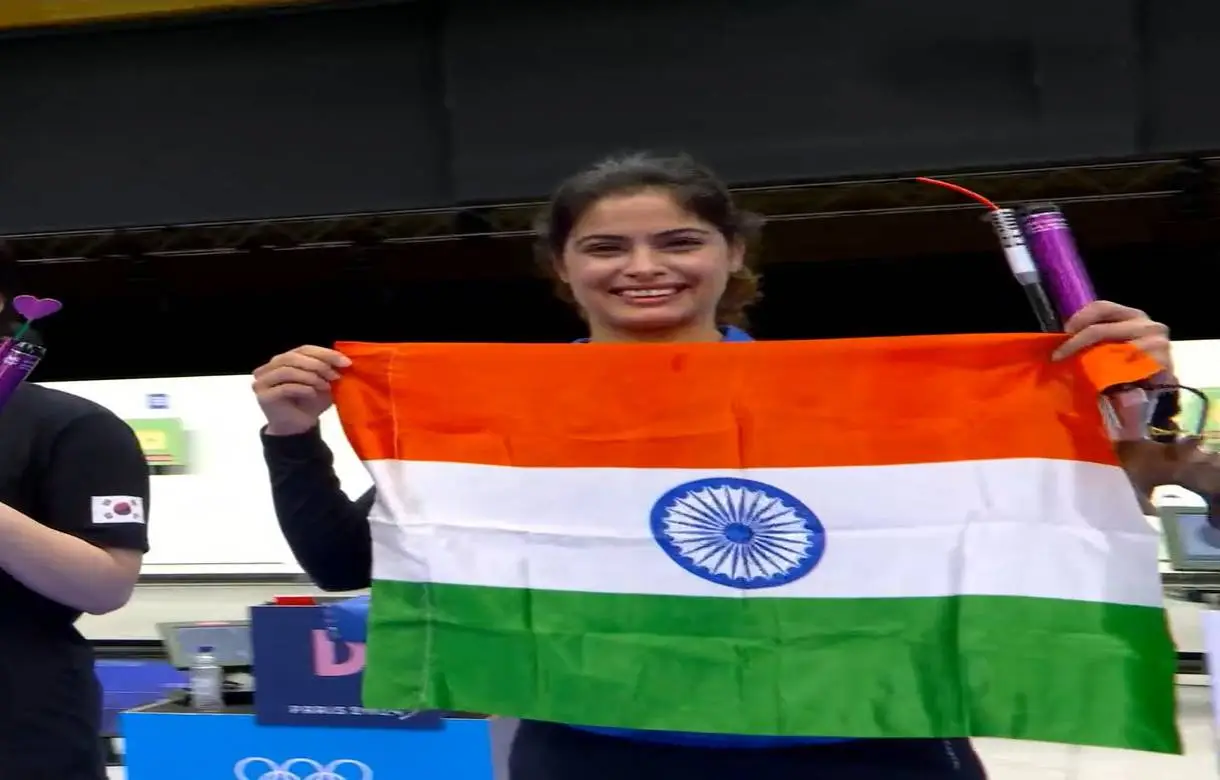
Congress president Mallikarjun Kharge congratulated Manu Bhaker on winning Bronze medal for India at the Paris Olympics 2024. Taking to X, he wrote, “India has begun its Olympics run with a well-deserved medal. Our congratulations to Manu Bhaker on clinching the bronze medal for India in the women’s 10m pistol event at the Paris 2024. Your achievement is a testament to your exceptional skill and perseverance. We are extremely proud of you! May this momentous occasion inspire countless young athletes to strive for excellence.”

Leader of Opposition in Lok Sabha Rahu Gandhi too congratulated Manu Bhaker for her win at the Paris Olympics 2024. In a post on X, Gandhi wrote, “Proud to see India clinch its first medal in the Paris Olympic Games 2024! Congratulations to Manu Bhaker for the Bronze – first Indian female shooter to win an Olympic medal. Our daughters have given us a wonderful start. Many more to come.”

Haryana Chief Minister Nayab Singh Saini, in a post on X, extended his wishes to Manu Bhaker for winning Bronze and wrote in Hindi, “Finally the dream has come true which the whole country was expecting from Haryana’s strong daughter Manu Bhaker. The pride of the country, women shooter Manu Bhaker has shown her strength in Paris.”

Saini said Bhaker won the Bronze medal for the country in the 10-meter women’s air pistol event in the Paris Olympics. Today, 22-year-old Manu Bhaker has made India and Haryana proud. He said, “Today, every Haryanvi’s chest has swelled with pride. Many congratulations to the strong and courageous daughter of Haryana.”

The Punjab Chief Minister Bhagwant Mann also extended his wishes to Manu Bhaker for winning a Bronze medal at the Paris Olympics 2024. Taking to X, he said in Punjabi, Manu Bhakar, the daughter of India, made the name of the country bright today by winning the Bronze medal in the 10m air pistol shooting competition at the Paris Olympics.

India News

Thackeray cousins reunite for Mumbai civic polls, announce Shiv Sena UBT–MNS alliance

Uddhav and Raj Thackeray have reunited after two decades, announcing a Shiv Sena–MNS alliance for the upcoming BMC elections with a focus on Marathi identity.

Published

on

Shiv sena ubt mns alliance

The long political estrangement between Uddhav Thackeray and Raj Thackeray has ended, with the cousins formally announcing an alliance for the upcoming Brihanmumbai Municipal Corporation (BMC) elections. The joint decision marks a significant shift in Mumbai’s civic politics, placing Marathi identity at the centre of the campaign.

At a joint press conference, Raj Thackeray declared that the Shiv Sena and Maharashtra Navnirman Sena (MNS) would contest the local body elections together. He asserted that Mumbai would get a Marathi mayor, adding that the mayor would come from the Shiv Sena–MNS alliance. Uddhav Thackeray, seated alongside him, echoed the confidence, stating that Mumbai would remain with them “come what may”.

Focus on unity and Marathi identity

Uddhav Thackeray underlined the importance of unity, invoking the slogan “batenge toh katenge” to warn against division. Raj Thackeray said the alliance would work to ensure that Marathi people get what they want, reinforcing the emphasis on regional identity that once defined the politics shaped by Shiv Sena founder Bal Thackeray.

The cousins, who have come together after nearly two decades, also appealed to leaders and workers unhappy with the Shiv Sena faction aligned with the BJP to join their front. The message was aimed at consolidating forces opposed to the ruling coalition in the state.

Seat-sharing and poll preparations

Elections to the BMC are due within a month, with voting scheduled for January 15. Political parties have already begun preparations for a high-intensity campaign to gain control of the country’s richest municipal body.

Uddhav Thackeray said that seat-sharing arrangements for Mumbai, Nashik and other municipal bodies have been finalised, though details were not disclosed. Sources indicated that the Shiv Sena faction led by Uddhav Thackeray could contest around 145–150 seats, while the MNS may field candidates in 65–70 seats. The remaining seats are expected to be contested by allies, including a faction of the NCP.

Strategic reunion against rivals

The alliance shifts the political narrative from disputes over the “real Sena” to a united front led by the Thackeray family, signalling continuity with Bal Thackeray’s legacy. Party leaders described the reunion as a moment of significance for Marathi voters and Maharashtra.

The combination brings together Uddhav Thackeray’s support among traditional Sena loyalists and Raj Thackeray’s appeal among younger voters, positioning the alliance as a key challenger in the civic polls. Raj Thackeray’s return to the fold is also expected to consolidate the Marathi vote bank that had earlier moved towards the MNS, impacting rival formations in Mumbai.

Continue Reading

India News

Nitin Gadkari flags Delhi air pollution, says two-day stay causes infection

Union minister Nitin Gadkari says spending two days in Delhi leads to infection, flags fossil fuel use as a major cause of pollution and calls for alternative energy solutions.

Published

on

Union Minister Nitin Gadkari

Delhi’s worsening air quality has drawn sharp criticism from within the ruling BJP, with Union minister Nitin Gadkari saying that even a brief stay in the national capital affects his health.

Speaking at a public event in Delhi, Gadkari remarked that spending just two days in the city results in an infection, raising questions over why the capital continues to struggle with severe pollution levels. His comments come at a time when the Air Quality Index has remained in the ‘very poor’ and ‘severe’ categories for weeks.

The Union minister, who handles the road transport and highways portfolio, acknowledged that the transport sector plays a major role in pollution. He said around 40 per cent of pollution is linked to fossil fuel usage and pointed out that India spends nearly Rs 22 lakh crore on importing fossil fuels, which also contributes to environmental damage.

Gadkari pushes for alternative fuels and exports

Gadkari stressed that promoting alternative fuel and biofuel technologies should be seen as a form of true nationalism. He argued that reducing imports and increasing exports would strengthen the country economically while also addressing pollution. According to him, resistance to eco-friendly technologies remains a major hurdle despite their long-term benefits.

Remarks on communal issues and secularism

During the same address, Gadkari said it was incorrect to label every Muslim as a terrorist, emphasising that there are varying degrees of extremism. He cited former President A P J Abdul Kalam as a national icon and underlined the importance of education, especially among marginalised sections.

He further claimed that Hindu-Muslim tensions in the country are a result of vote bank politics pursued by the Congress. Defining secularism as “justice for all”, Gadkari said policies driven by electoral considerations had created divisions. He asserted that Indian culture is neither communal nor casteist and described Hindutva as tolerant and inclusive.

Reiterating views earlier expressed by former prime minister Atal Bihari Vajpayee, Gadkari said India was, is, and will remain a secular country, rooted in its cultural traditions that advocate welfare for all.

Political reactions over pollution issue

The BJP-led governments at the Centre and in Delhi have faced criticism over their handling of air pollution. Congress leader Imran Masood responded to Gadkari’s remarks by saying that the minister had at least acknowledged the seriousness of the problem. He added that pollution cannot be attributed only to vehicles, noting that similar vehicles operate outside Delhi as well.

Continue Reading

India News

Over 24 lakh voters dropped from Kerala draft electoral roll after special revision

The Election Commission has removed over 24 lakh names from Kerala’s draft voter lists after verification during the Special Intensive Revision process.

Published

on

kerala voters delete

Over 24.08 lakh electors have been removed from the draft voter lists in Kerala following the completion of the Special Intensive Revision (SIR) exercise, with the Election Commission publishing the updated draft electoral roll on Tuesday.

As per official data, Kerala has a total of 2,78,50,855 registered electors. Of these, 2,54,42,352 electors submitted their Enumeration Forms during the revision process, which concluded on December 18.

The poll body said the deletions were carried out after verification and were linked to multiple factors, including electors shifting to other states or Union Territories, voters found to be non-existent, individuals who did not submit enumeration forms within the stipulated time, and those who chose not to continue their registration.

Break-up of deleted names

According to the Election Commission, the deleted entries include 6,49,885 names of deceased voters, accounting for 2.33 per cent of the electorate. Another 14,61,769 voters, or 5.25 per cent, were removed after being found shifted or absent, while 1,36,029 voters, around 0.49 per cent, were deleted for being enrolled at multiple locations.

Claims and objections window open

Although the enumeration phase has ended, eligible citizens can still seek corrections. The Commission has opened a claims and objections period from December 23 to January 22, 2026, allowing applications for inclusion of eligible voters or removal of ineligible names from the rolls.

The final electoral roll for Kerala is scheduled to be published on February 21, 2026.

Awareness drives and field-level efforts

The Election Commission said extensive awareness campaigns were conducted across the state to ensure maximum participation. Senior election officials held regular meetings with political parties at the state, district and assembly constituency levels to explain the revision process and share progress updates.

Booth Level Officers (BLOs) carried out house-to-house visits to all electors listed as of October 27, distributing Enumeration Forms and making at least three follow-up visits for collection. Booth Level Agents were permitted to submit up to 50 forms per day to strengthen coordination at the grassroots level.

To support field staff, BLOs were assisted by Anganwadi workers, students from NCC, NSS and election literacy clubs, volunteers, revenue officials and social work students. The poll body said more than 93 per cent mapping of collected forms was achieved through repeated training sessions, video tutorials and doubt-clearing programmes.

Special initiatives during SIR

During the exercise, the Chief Electoral Officer of Kerala launched motivational and outreach initiatives aimed at supporting election staff managing the heavy workload of digitising voter data. District-level programmes were also rolled out to recognise and motivate BLOs and supervisors completing digitisation targets.

In areas with weak network connectivity, a community-based digitisation model was adopted, where BLOs collectively digitised forms from locations with better internet access. Special urban camps were organised across all wards of urban local bodies to ensure comprehensive coverage of city voters.

Continue Reading

Trending

© Copyright 2022 APNLIVE.com