English हिन्दी
Connect with us

India News

Provide Petitioners All Documents Related To Judge Loya death case: SC

Published

on

Provide Petitioners All Documents Related To Judge Loya death case: SC

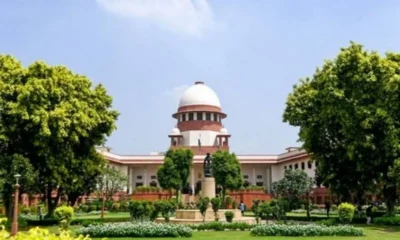
The Supreme Court on Tuesday, January 16, directed the Maharashtra government to share all documents, including those marked ‘secret’, linked to the death of CBI judge BH Loya with the public interest litigation (PIL) petitioners.

“It is a matter which they [petitioners] should know everything,” Justice Arun Mishra, heading the Bench with Justice Mohan M. Shantanagoudar, orally observed in a crowded courtroom.

Judge Loya was hearing the Sohrabuddin Sheikh police encounter case when he passed away. The case assumed political significance because one of the accused is BJP president Amit Shah.

The Supreme Court bench of Justices Arun Mishra and Mohan M Shantanagoudar was on Tuesday (January 16) given the investigation report on the unusual death of CBI Judge BH Loya by the Maharashtra government in a sealed envelope. When the bench asked for documents from the other side that was also given in a sealed envelope.

The government’s documents came with the rider that ‘secret’ portions of the documents cannot be disclosed to the petitioner.

The hearing of the case has been postponed for a week, though no particular date has been set.

On the issue of the report given by the Maharashtra government it has been said that of all the documents only the inappropriate ones have been given. It has also been said that the confidential papers should not be made public.

The court asked senior advocate Harish Salve, appearing on behalf of the Government of Maharashtra, “what is in this report that it cannot be given to the petitioner?” Salve said that after the court reads the reports the confidential data should be separated from the rest and not given to the petitioner. The rest can be given.

The court observed that the sensitive portions can be marked and also be given to the petitioner.

Incidentally, Loya’s 21-year-old son Anuj had recently held a press conference and said that there was nothing unusual about his father’s death and that it was “of natural causes.”

Anuj had blamed his earlier suspicions on “emotional turmoil”, adding that his family was not making allegations against anyone. Asked whether he had ever harboured suspicions over the special CBI judge’s death, he said: “I was in emotional turmoil, right now I am in emotional turmoil.”

Asked about the doubts raised by his family members about the inconsistencies in what they had been told about Loya’s death, Anuj had said, “They had some suspicions because of emotional turmoil at that period. So right now even they are clear with it and even they don’t have any issues.”

Judge Loya’s sister and Anuj’s aunt Anuradha Biyani, however, when asked whether she agreed with Anuj’s characterisation of her views, told an NDTV reporter: “I have nothing to say.” She had earlier told The Caravan that her brother had told her that Justice Mohit Shah had offered him a bribe of Rs 100 crore to give a favourable verdict in the Sohrabuddin case.

Anuj’s uncle and Judge Loya’s brother Shrinivas Loya was also reported as saying that he wanted an inquiry into the matter and that 21-year-old Anuj Loya was likely “under pressure” to make those claims.

The case is also important for it was in focus when the four senior judges of the top court held a press conference slamming Chief Justice Dipak Misra for his allegedly “arbitrary” rosters, selectively assigning cases to benches with junior judges.

India News

Satellite images reveal extensive construction of launch pads and bunkers near Chinese nuclear missile silos

Satellite images show that Beijing is constructing a vast web of over 80 launch pads, command bunkers, and electronic warfare facilities to protect its longest-range nuclear missiles in a remote desert complex.

Published

on

A vast military complex is rapidly taking shape in a remote Chinese desert, raising significant attention among security scholars. Freshly analyzed satellite images indicate that Beijing is building an expansive network of launch pads, bunkers, and communications nodes. This critical infrastructure is positioned near isolated nuclear silos that house the Chinese military’s longest-range missiles, which are already capable of reaching any city in the United States.

Media reports indicate that the scale of this newly discovered construction points to a sweeping expansion of hardened infrastructure. The entire network is specifically designed to protect and operate China’s land-based nuclear forces. This massive buildup signals a major upgrade in efforts to secure a resilient second-strike capability, highlighting the intensifying nuclear competition with Western powers amidst rising regional tensions.

Protecting second strike capabilities

According to assessments by security analysts, the imagery reveals more than 80 launch pads. These pads are intended for potential use by an expanding fleet of mobile missile launchers as well as air-defense batteries. Furthermore, the newly built facilities appear configured to serve command operations, satellite communications, and electronic warfare functions.

Security experts note that this infrastructure is being deployed on a grand scale, stretching across thousands of square kilometers of desert landscape beyond the primary silo fields. Depending on the exact operational capabilities of these sites, the development represents a highly considerable enhancement and diversification of the nation’s strategic nuclear deterrent.

The primary objective behind safeguarding these desert silos aligns with the stated goal of maintaining a credible nuclear deterrent. This military policy remains grounded in the absolute capacity to retaliate effectively if the nation is struck first.

Continue Reading

India News

DK Shivakumar expected to take oath as Karnataka chief minister on June 3

Senior leader DK Shivakumar is set to take office as the new chief minister of Karnataka on June 3, following top-level leadership transitions within the state government.

Published

on

Senior Congress leader DK Shivakumar is highly likely to take the oath of office as the next chief minister of Karnataka on June 3, according to government sources. The upcoming ceremony marks a major leadership transition in the southern state following recent political developments.

Transition of power

The development follows days of high-level consultations within the party’s central leadership to ensure a smooth transition of power in the state assembly. Media reports indicate that preparations for the oath-taking ceremony have begun, with the event expected to see attendance from top political leaders, party workers, and ministers.

State government officials and party insiders have indicated that the formal schedule and cabinet composition are being finalized ahead of the scheduled date. Further official announcements regarding the swearing-in ceremony are expected to be released soon by the state administration.

Continue Reading

India News

Maharashtra MLC Polls: MVA finalizes 15 seats, tussle remains over two key constituencies

The Maha Vikas Aghadi has ironed out differences across 15 Maharashtra Legislative Council seats, leaving Nashik and Nanded as the final points of contention between Congress and Shiv Sena (UBT).

Published

on

The Maha Vikas Aghadi (MVA) coalition, which includes Congress, Shiv Sena (Uddhav Balasaheb Thackeray), and the Nationalist Congress Party (Sharadchandra Pawar), has successfully reached a seat-sharing understanding for 15 out of 17 seats in the upcoming Maharashtra Legislative Council elections. While a major breakthrough has been achieved, the alliance is currently witnessing a stalemate over Nashik and Nanded, as multiple constituent partners assert their presence in these regions.

According to sources, the distribution plan was designed to prevent internal rifts by respecting the geographic and organizational strongholds of each party.

Congress secures maximum share of seats

Under the initial draft layout, Congress has come out as the largest stakeholder with seven seats in its quota. The party has been assigned constituencies across northern Maharashtra, western Maharashtra, and Vidarbha, where its ground-level network remains sturdy.

The locations likely allocated to Congress feature Solapur, Chandrapur, Yavatmal, Bhandara, Dharashiv, Amravati, and Ahilyanagar. To gear up for the electoral challenge, state party president Harshvardhan Sapkal has already designated senior leaders to observe and coordinate at the constituency level.

Five seats assigned to Uddhav Thackeray faction

The Uddhav Thackeray-led Shiv Sena (UBT) has been allotted five seats under the proposed arrangement, focusing its reach on the Konkan region and Marathwada. The seats projected for the party encompass Chhatrapati Sambhajinagar, Jalgaon, Hingoli, Raigad, and Parbhani.

Concurrently, the Sharad Pawar-led NCP faction is expected to field its candidates from three constituencies: Thane, Pune, and the joint Satara-Sangli seat. Even though Thane has been known as a core stronghold of the traditional Shiv Sena, evolving dynamics inside state politics led to this assignment during discussions.

Stalemate over two key constituencies

Despite finding common ground on most locations, Nashik and Nanded continue to be sources of disagreement. Media reports show that both Congress and Shiv Sena (UBT) want the Nashik seat, pointing to their local machinery. On the other hand, Nanded has traditionally stayed a bastion for Congress, but shifting political landscapes have led to claims from alliance partners too.

Leaders from the opposition have stressed that their core objective is to challenge the ruling Mahayuti coalition and prevent votes from splitting through friendly contests. Senior members are expected to hold more rounds of talks over the coming days to untangle the deadlock.

Ruling alliance formula takes shape

Sources close to the matter suggest that the ruling Mahayuti coalition has also neared completion of its election blueprint. Under their anticipated plan, the Ajit Pawar-led NCP faction might contest Pune and Raigad, whereas the Eknath Shinde-led Shiv Sena is tipped to take over Nashik, Thane, Parbhani, and Yavatmal. The remaining council seats are expected to be contested by the BJP.

Political experts are keeping a sharp watch on prospective inner rebellion inside the ruling camp, especially in regions like Nashik and Chhatrapati Sambhajinagar, where disgruntled figures might look to explore options alongside independent candidates.

Continue Reading

Trending

© Copyright 2022 APNLIVE.com