English हिन्दी
Connect with us

India News

Horror in Uttar Pradesh! Seven-year-old girl found dead in Kanpur, liver, lungs extracted for black magic

The police said two men allegedly kidnapped their seven-year-old neighbourhood girl from Kanpur’s Ghatampur area on Saturday, extracted her liver and lungs and presented them to the youth’s uncle and aunt to perform an occult ritual so that the couple could have children.

Published

on

Dead man

In a horrific incident, a seven-year-old girl was found dead in Uttar Pradesh’s Kanpur on Sunday with her liver extracted. The police have suspected that the accused also tried to rape her.

The police said two men allegedly kidnapped their seven-year-old neighbourhood girl from Kanpur’s Ghatampur area on Saturday, extracted her liver and lungs and presented them to the youth’s uncle and aunt to perform an occult ritual so that the couple could have children. The drunk men first tried to rape her and then killed her, the police added.
The police said a childless couple in the victim’s village paid Rs 1,000 to two men who were neighbours of the child to perform an occult ritual as they could not have children.

The police have said some other body parts could also have been extracted.

The child’s body was found in a village on Sunday morning.

The police have arrested all four accused.

Brajesh Srivastava, a senior police officer, said several teams were deployed to crack the case. The girl’s neighbours, Ankul and Beeran, were picked up based on suspicion. On questioning, they confessed. They said Ankur’s uncle Parshuram paid them some money to do this. The two men were drunk and tried to misbehave with her. After this, they cut her open, took out her liver and gave it to Parshuram, the officer added.

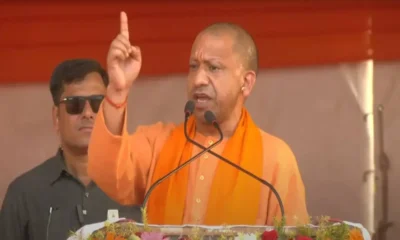
Uttar Pradesh Chief Minister Yogi Adityanath has directed the police administration to take stringent action against the accused. He said the case will be heard in a fast-track court. He also directed the police officials to extend financial help of Rs 5 lakh to the victim’s family.

Read Also: India’s daily coronavirus count falls below 30,000 for the first time in four months

India News

Mamata Banerjee slams poll body over officials’ transfer, calls move unprecedented

Mamata Banerjee has criticised the Election Commission for transferring senior officials ahead of West Bengal elections, alleging bias and procedural overreach.

Published

on

Mamata Banerjee

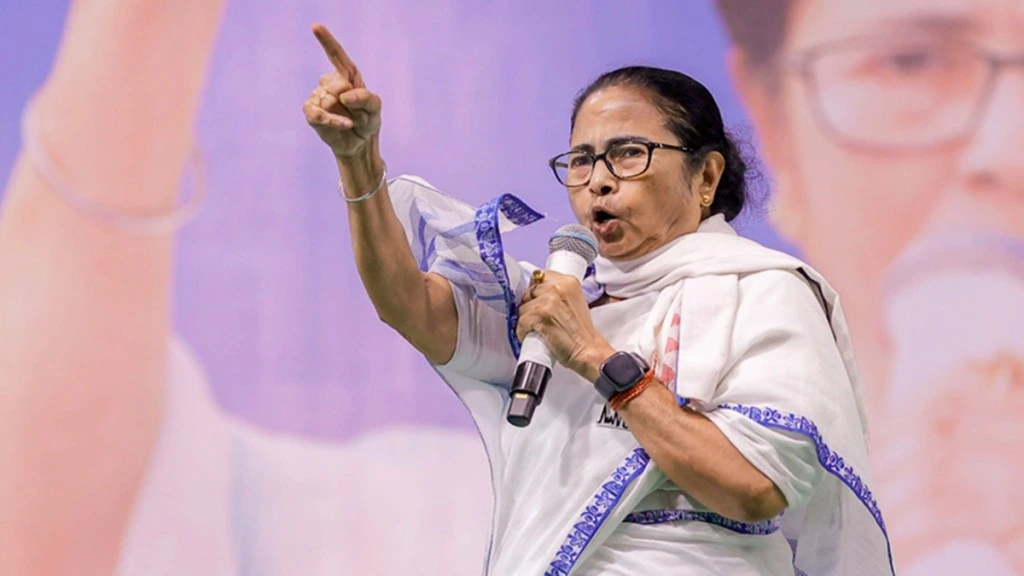
West Bengal Chief Minister Mamata Banerjee has sharply criticised the Election Commission of India over the transfer of senior state officials ahead of the assembly elections, alleging bias and procedural overreach.

In a strongly worded letter to Chief Election Commissioner Gyanesh Kumar, Banerjee expressed “deep shock” at the poll panel’s functioning, stating that it had “crossed all boundaries of decency and constitutional propriety.”

Concerns over transfers and alleged bias

The chief minister objected to what she described as “unilateral” transfers of key officials, including the chief secretary, home secretary, director general of police, and several district-level officers. According to her, these decisions were taken without citing any violations of electoral rules or the Model Code of Conduct.

Banerjee further alleged that the Commission had shown “apparent bias” since the beginning of the Special Intensive Revision of electoral rolls, claiming that repeated concerns raised by the state government had been ignored.

She also questioned the timing of the transfers, noting that district election officers were shifted during an ongoing revision process, which she suggested could affect administrative continuity and pending cases.

Supreme Court reference and governance concerns

Referring to her government’s move to approach the Supreme Court of India, Banerjee said the court had acknowledged the concerns and issued directions that are currently being implemented.

The chief minister warned that the removal of senior officials at short notice could disrupt governance, law and order, and disaster preparedness, particularly during the storm-prone months of March and April.

She also criticised the deployment of state police officers as observers in other poll-bound regions, calling it “arbitrary” and a “misuse of authority.”

Warning on federal structure and democracy

Describing the decisions as “biased, hasty and unilateral,” Banerjee said such actions undermine cooperative federalism and could create conditions resembling “indirect central rule.”

She urged the Commission to reconsider its decisions, warning that such steps are “deeply concerning” for a healthy democratic process.

Elections to the 294-member West Bengal assembly are scheduled to be held in two phases on April 23 and April 29, with counting set for May 4.

Continue Reading

India News

AIADMK-BJP seat-sharing talks to be finalised soon, says Edappadi K Palaniswami after Amit Shah meet

AIADMK chief Edappadi K Palaniswami says seat-sharing talks with BJP are in final stages and will conclude within days ahead of Tamil Nadu 2026 elections.
Published

on

Amit shah

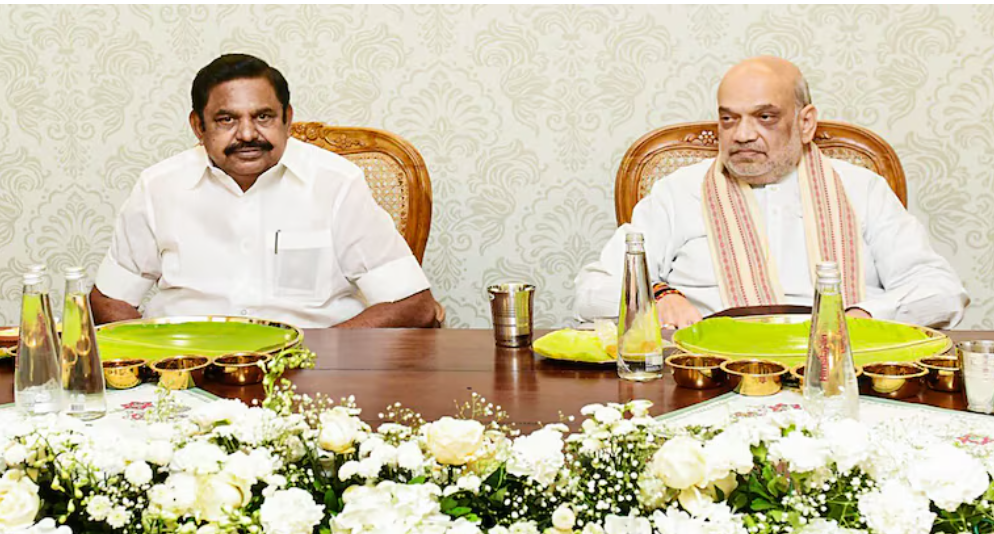
Signalling momentum ahead of the 2026 Tamil Nadu Assembly elections, Edappadi K Palaniswami on Friday said seat-sharing talks with the Bharatiya Janata Party would be finalised within four days following his meeting with Union Home Minister Amit Shah in Delhi.

Palaniswami, who serves as the general secretary of the All India Anna Dravida Munnetra Kazhagam, expressed confidence that negotiations would be concluded smoothly based on a “give-and-take” formula focused on winnability. He also took a swipe at the ruling Dravida Munnetra Kazhagam, suggesting delays in its own alliance discussions.

Union Minister Piyush Goyal is expected to visit Chennai soon, further accelerating alliance-building efforts. The AIADMK is also preparing to release its election manifesto within a week.

Likely seat-sharing formula emerges

While Palaniswami did not reveal specific numbers, sources indicate the AIADMK is aiming to contest around 165 seats. The remaining seats could be distributed among allies, including the BJP, Pattali Makkal Katchi, Amma Makkal Munnetra Kazhagam led by T T V Dhinakaran, and the Tamil Maanila Congress.

In the 2021 Assembly elections, the BJP and PMK had contested 20 and 23 seats respectively, securing four and five wins. The revised formula suggests a recalibration of alliance strengths ahead of the high-stakes 2026 polls.

‘Delhi visits necessary for coordination’

Responding to criticism over his frequent visits to the national capital, Palaniswami defended his outreach to BJP leadership. He said such meetings were necessary given the busy schedules of senior leaders like Amit Shah, who are handling elections across multiple states.

“I have come to meet Amit Shah twice, as he is busy with elections in five states,” he said, underlining the need for coordination at the national level.

No alliance with Vijay’s TVK

Dismissing speculation about new alliances, Palaniswami ruled out any talks with actor-turned-politician Vijay and his party, Tamilaga Vettri Kazhagam.

“Neither we nor TVK held talks,” he stated, indicating that the electoral contest would largely remain between the AIADMK-led and DMK-led fronts.

Criticism of DMK and internal damage control

Targeting the DMK government, Palaniswami alleged a deterioration in law and order, pointing to rising crimes against women and corruption. He also accused the government of failing to implement key welfare schemes.

At the same time, he sought to contain recent controversies involving AIADMK leaders, stating that former ministers who made objectionable remarks had acknowledged their mistakes and apologised.

High stakes for AIADMK and Palaniswami

The 2026 Assembly election is being seen as a crucial test for both the AIADMK and Palaniswami. Since the death of former Chief Minister J Jayalalithaa, the party has faced a series of electoral setbacks, including the 2019 and 2024 Lok Sabha elections and the 2021 Assembly polls.

The AIADMK had previously allied with the BJP in 2019 and 2021, a partnership often viewed as challenging in Tamil Nadu’s political landscape. In the 2024 Lok Sabha elections, both parties contested separately but failed to secure victories.

For Palaniswami, the upcoming election represents a critical opportunity to establish his leadership and revive the party’s political standing.

Continue Reading

India News

Deve Gowda hits back at Kharge’s married PM jibe, calls congress tie-up abusive relationship

HD Deve Gowda rebuts Mallikarjun Kharge’s remarks, saying JD(S) did not desert Congress and was forced to exit an “abusive” alliance.
Published

on

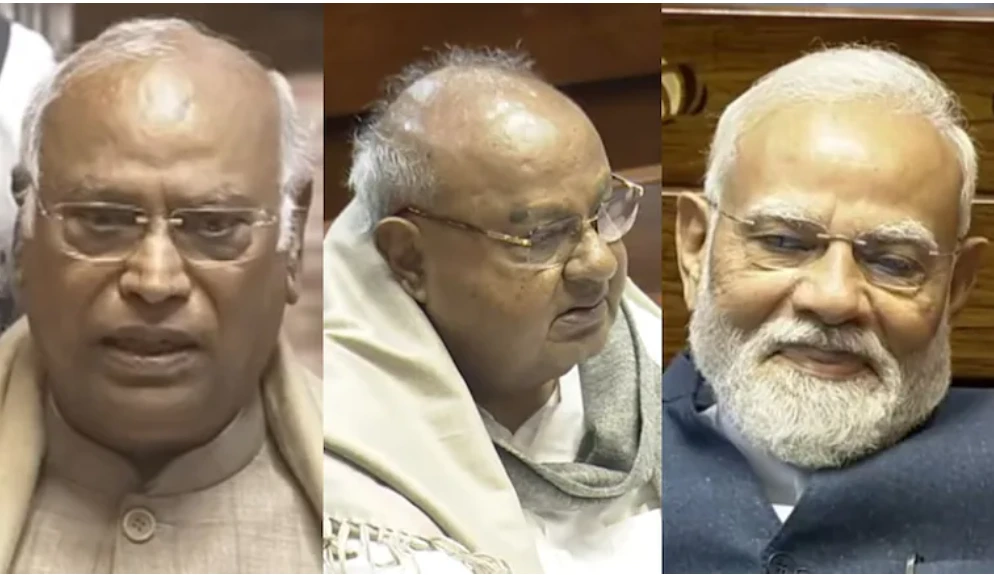
Former Prime Minister H. D. Deve Gowda has responded sharply to remarks made by Congress president Mallikarjun Kharge in the Rajya Sabha, rejecting the suggestion that he chose to align with Prime Minister Narendra Modi over the Congress.

War of words in rajya sabha

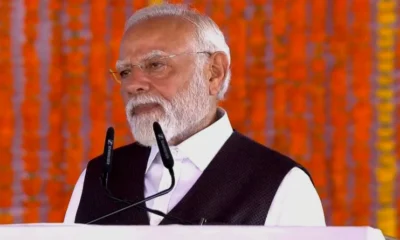
During his farewell speech in the Upper House, Kharge made a light-hearted remark about Deve Gowda’s political journey, saying he had “dated” the Congress but ultimately “married” Modi. The comment drew laughter across the House, including from the Prime Minister, who was present at the time.

Kharge also noted his long association with Deve Gowda, saying he had known him for over five decades but was unsure why the Janata Dal (Secular) leader shifted alliances.

Deve gowda’s ‘forced marriage’ reply

In a statement issued later, Deve Gowda said he was not present in the House when the comment was made as he had left for Bengaluru for Ugadi celebrations. Responding in similar metaphorical language, he said his association with the Congress was a “forced marriage” that eventually turned into an “abusive relationship.”

He asserted that his party did not leave the Congress alliance, but was instead compelled to move on after being sidelined.

Reference to 2018 karnataka alliance

Deve Gowda also revisited the 2018 Karnataka political developments, stating that the Congress leadership, including Ghulam Nabi Azad, had proposed his son H. D. Kumaraswamy as Chief Minister. He claimed he had instead suggested Kharge’s name, in the presence of leaders like Siddaramaiah.

Despite this, Kumaraswamy eventually took charge as Chief Minister after the Congress-JD(S) alliance formed the government.

Alliance collapse and aftermath

The coalition government collapsed in 2019 after multiple MLAs from both parties defected, leading to the fall of the government. Deve Gowda alleged that the Congress failed to act against those responsible for triggering the defections.

He maintained that the breakdown of the alliance left JD(S) with no option but to seek a “more stable” political partnership later.

Political context

Deve Gowda briefly served as Prime Minister following the 1996 Lok Sabha elections, heading a United Front government supported by the Congress. His party later allied with the Congress in Karnataka in 2018 before parting ways after the coalition government’s collapse.

Continue Reading

Trending

© Copyright 2022 APNLIVE.com