English हिन्दी
Connect with us

India News

Smriti Irani, Sarbananda Sonowal, Bhupender Yadav in new members of cabinet panel on political affairs

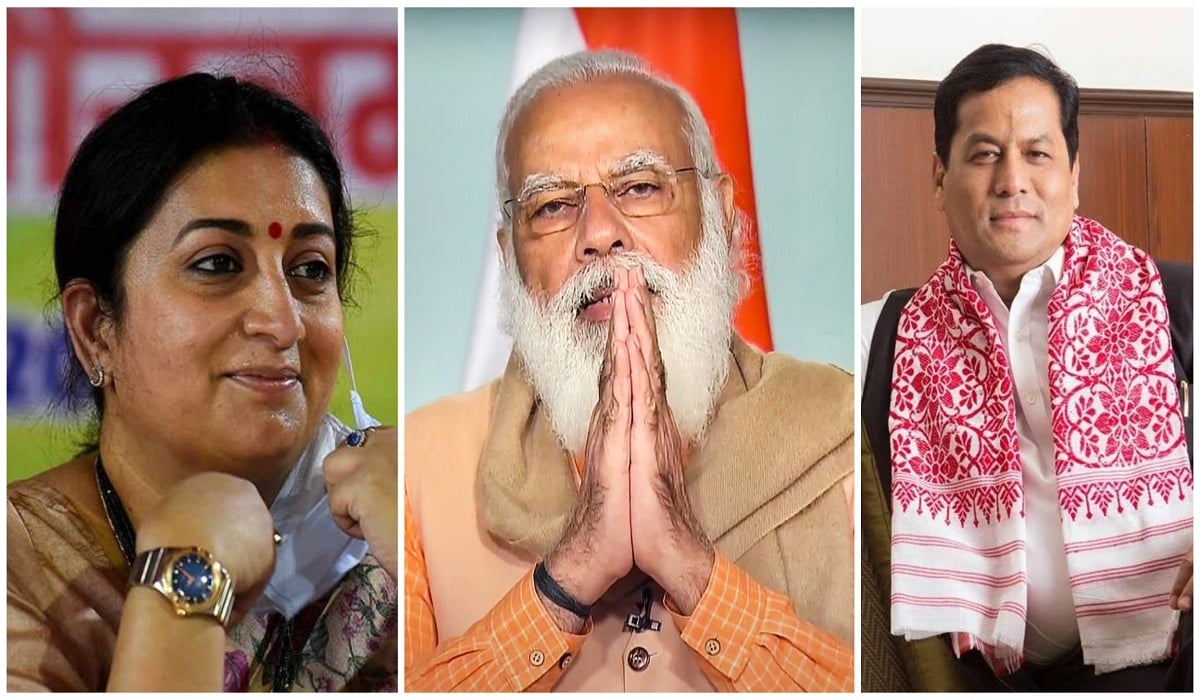
After a major reshuffle in the Modi cabinet, the government has now reconstituted the powerful cabinet committees. Ministers like Smriti Irani, Bhupender Yadav, and Sarbananda Sonowal are appointed as the new members of the Cabinet Committee on Political Affair.

Published

on

Narendra Modi

After a major reshuffle in the Modi cabinet, the government has now reconstituted the powerful cabinet committees. Ministers like Smriti Irani, Bhupender Yadav, and Sarbananda Sonowal are appointed as the new members of the Cabinet Committee on Political Affair.

According to a notification issued by the Cabinet Secretariat, Union Ministers Arjun Munda, Virendra Kumar, Kiren Rijiju, and Anurag Thakur have been included in the new Cabinet Committee on Parliamentary Affair.

However, members of the Cabinet Committee on Security are Prime Minister Narendra Modi, Home Minister Amit Shah, Defence Minister Rajnath Singh, Finance Minister Nirmala Sitharaman, and External Affairs Minister Subrahmanyam Jaishankar.

The two-member Appointments Committee of the Cabinet comprises the PM Mosi and Home Minister Amit Shah.

However, the reshuffled Cabinet Committee on Political Affairs comprises the prime minister, and Union ministers Rajnath Singh, Amit Shah, Nitin Gadkari, Nirmala Sitharaman, Narendra Singh Tomar, Smriti Irani, Piyush Goyal, Pralhad Joshi, Sarbananda Sonowal, Giriraj Singh, Mansukh Mandaviya, and Bhupender Yadav.

Irani, Sonowal, Giriraj Singh, Mandaviya, and Yadav are the additions while former ministers Ravi Shankar Prasad and Harsh Vardhan are no longer part of it following their exclusion from the ministry.

The Cabinet Committee on Economic Affairs has nine members which include PM Modi, Rajnath Singh, Amit Shah, Nitin Gadkari, Nirmala Sitharaman, Narendra Singh Tomar, S Jaishankar, Piyush Goyal, and Dharmendra Pradhan, according to the notification.

Earlier, former ministers D V Sadananda Gowda and Ravi Shankar Prasad were also part of this committee.

The members of the Cabinet Committee on Parliamentary Affairs are Amit Shah, Rajnath Singh, Nirmala Sitharaman, Arjun Munda, Narendra Singh Tomar, Pralhad Joshi, Kiren Rijiju, Virendra Kumar, and Anurag Thakur.

Union Ministers of State for Parliamentary Affairs Arjun Ram Meghwal and V Muraleedharan are special invitees to the committee.

Earlier, Ravi Shankar Prasad and Prakash Javadekar were also part of it.

The reshuffled Cabinet Committee on Investment and Growth comprises PM Modi, Amit Shah, Rajnath Singh, Nirmala Sitharaman, Nitin Gadkari, Piyush Goyal, Jyotiraditya Scindia, Narayan Rane, and Ashwini Vaishnaw.

Rane, Scindia, and Vaishnaw are the new members.

The members of the Cabinet Committee on Employment and Skill Development are PM Modi, Rajnath Singh, Amit Shah, Nirmala Sitharaman, Narendra Singh Tomar, Piyush Goyal, Dharmendra Pradhan, Ashwini Vaishnaw, Hardeep Singh Puri, and Bhupender Yadav.

The special invitees to this committee are Nitin Gadkari, RCP Singh, and G Kishan Reddy.

Ashwini Vaishnaw and Bhupender Yadav are the new members while RCP Singh and G Kishan Reddy are new special invitees.

Read Also: India’s 1983 World Cup hero Yashpal Sharma dies of cardiac arrest

Earlier, former union ministers Ramesh Pokhriyal Nishank and Santosh Kumar Gangwar and union minister Mahendra Nath Pandey were members of this committee while Smriti Irani and Prahalad Singh Patel were special invitees.

In other India news, India’s 1983 World Cup hero Yashpal Sharma died on Tuesday in New Delhi

India News

Maharashtra civic body polls held today with focus on Mumbai and Pune

Published

on

Voting is underway today for civic body elections across Maharashtra, covering 29 municipal corporations, with Mumbai and Pune emerging as the main political battlegrounds. The polls, being held after a long delay, are widely seen as a crucial test of political strength and identity ahead of larger state and national contests.

Polling began at 7.30 am for a total of 2,869 seats across 893 wards in the 29 civic bodies. The elections are taking place years after the scheduled term of most municipal corporations ended between 2020 and 2023. Voting will continue until 5.30 pm, while counting of votes is scheduled to begin at 10 am on January 16.

BMC election draws maximum attention

The Brihanmumbai Municipal Corporation (BMC), India’s richest civic body, remains the centre of attention. Unlike other corporations, the BMC follows a single-member ward system, meaning each voter casts only one vote. In the remaining 28 civic bodies, wards have three to five seats, requiring voters to cast multiple votes.

The BMC poll is particularly significant for the Thackeray brothers, Uddhav and Raj, who have come together in its backdrop after two decades. The election is seen as an opportunity for them to reassert their claim as political heirs of Bal Thackeray and revive their influence in Mumbai, a city long governed by the undivided Shiv Sena.

Test of Marathi identity politics

The elections are also being closely watched as a test of the “Marathi Manoos” plank. Rooted in the Samyukta Maharashtra movement of the 1950s and shaped politically by Bal Thackeray, the Marathi identity has remained a defining feature of Mumbai’s politics and a core theme for the Thackeray-led parties, particularly the Maharashtra Navnirman Sena.

BJP-Shinde alliance and NCP in fray

For Chief Minister Eknath Shinde, who split the Shiv Sena in 2022, the civic polls offer a chance to regain lost ground and reinforce his claim as Bal Thackeray’s political successor. His alliance partner, the BJP, is contesting 137 of the BMC’s 227 seats, while the Shinde-led Sena is contesting the remaining 90. The BJP, which won 82 seats in the last BMC election in 2019, is aiming to significantly improve its tally.

Meanwhile, Ajit Pawar’s faction of the Nationalist Congress Party is contesting the polls independently after differences with the BJP over leadership issues. The party is hoping to regain influence, especially in Pune, where the undivided NCP had controlled the civic body for a decade between 2007 and 2017.

With high political stakes, delayed polls and shifting alliances, today’s civic elections are expected to offer clear signals about Maharashtra’s evolving political landscape.

Continue Reading

India News

Karnataka to convene joint legislature session over MGNREGA repeal

The Karnataka government will convene a joint session of the legislature from January 22 to discuss the Centre’s repeal of MGNREGA, triggering sharp criticism from the opposition.

Published

on

karnataka assembly

The Karnataka cabinet on Wednesday decided to convene a joint session of the state legislature from January 22 to January 31, with the Centre’s decision to repeal the Mahatma Gandhi National Rural Employment Guarantee Act (MGNREGA) set to be the key focus.

The Congress-led government had earlier planned a two-day special session to discuss the repeal of MGNREGA, which has been replaced by the Viksit Bharat Guarantee for Rozgar and Ajeevika Mission (Gramin) (VB-G RAM G). However, State Law and Parliamentary Affairs Minister H K Patil said the plan was altered due to constitutional provisions.

Briefing reporters, Patil said the government was compelled to convene a joint session instead of a special session because of a technical requirement. Citing Article 176 of the Constitution, he explained that the Governor must address the first session of the state legislature every year.

“As a result of this technical reason, we are advancing the session. Instead of a special session, it will be a joint session,” Patil said, adding that holidays during the session would be announced by the Speaker.

He stressed that the state government would not remain silent if people’s rights were “snatched away” and said the objective of the session was to create public awareness and exert pressure on the Centre to restore MGNREGA.

Opposition questions intent of the session

Leader of Opposition in the Karnataka Assembly R Ashoka strongly criticised the decision, alleging that the joint session was convened with a “malafide intention” and amounted to a “sheer waste of money”.

Addressing a press conference, Ashoka said legislative sessions were meant for law-making and discussions on governance issues, questioning the purpose of holding a session on a matter decided by the Centre.

“What is this session convened for? Is it to utter gibberish in the House? There is no use of this session,” he said, adding that any resolution passed by the Assembly would have no practical value and would be ignored.

Continue Reading

India News

Centre urges Indians to leave Iran amid worsening security situation

India has advised its citizens to leave Iran and avoid travelling to the country as nationwide protests intensify and the security situation continues to deteriorate.

Published

on

unrest in iran

India on Wednesday asked all its nationals currently in Iran to leave the country using available commercial means, citing a sharp deterioration in the security situation amid widespread anti-government protests and a heavy crackdown by authorities.

The government has also issued a strong advisory urging Indians to avoid travelling to Iran until further notice.

Advisory issued for Indian nationals in Iran

In a fresh advisory, the Indian Embassy in Iran said Indian citizens, including students, pilgrims, businesspersons and tourists, should leave Iran by available modes of transport, including commercial flights.

The embassy further advised Indian nationals and persons of Indian origin to exercise extreme caution, avoid areas witnessing protests or demonstrations, stay in regular contact with the embassy, and closely monitor local developments through official channels and local media.

Separately, the Ministry of External Affairs reiterated its warning, strongly advising Indians against travelling to Iran in view of the evolving situation. Earlier this month, the ministry had already asked citizens to avoid non-essential travel and urged those residing in Iran to remain cautious.

Protests spread nationwide

The unrest in Iran began late last month in Tehran after the Iranian currency, the rial, fell to record lows. What started as protests over economic hardship has since expanded into a broader movement demanding political change.

The demonstrations have now spread across all 31 provinces of the country, with the overall situation deteriorating significantly in recent days.

According to reports cited by media, the death toll from the nationwide protests has crossed 2,500, reflecting the scale and intensity of the ongoing crackdown.

Rising regional tensions

The developments in Iran have also contributed to heightened tensions in West Asia. The situation escalated further after the US president warned Tehran against the use of force on demonstrators and hinted at possible military action.

In a message addressed to protesters, the US president said that “help is on the way,” adding to the growing international pressure surrounding the crisis.

Continue Reading

Trending

© Copyright 2022 APNLIVE.com