English हिन्दी
Connect with us

India News

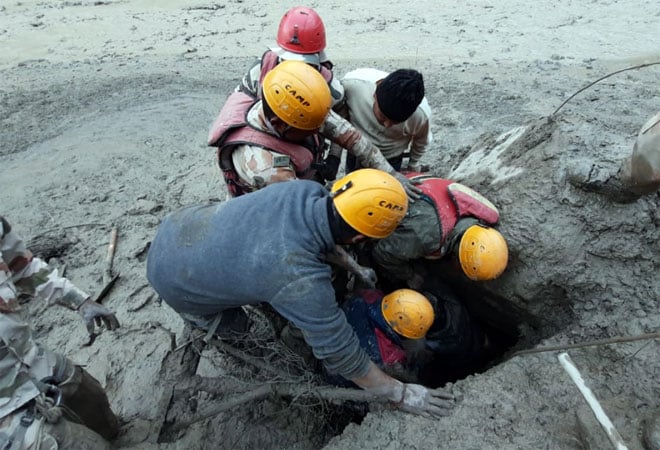
Uttarakhand glacier burst: 14 people dead in Chamoli district, 200 missing

A glacier break and flood in Uttarakhand’s Chamoli district on Sunday killed 14 people and over 170 are still missing. Among 170 missing people – 148 are employed at the NTPC plant and 22 at Rishiganga.

Published

on

Uttarakhand

A glacier break and flood in Uttarakhand’s Chamoli district on Sunday killed 14 people and over 170 are still missing. Among 170 missing people – 148 are employed at the NTPC plant and 22 at Rishiganga. Reports said around thirty others are trapped in a tunnel, and rescue teams worked through the night to save their lives. The glacier burst triggered an avalanche and a deluge in the Alaknanda river system that washed away hydroelectric stations and five bridges. The bridges that were washed away by the flood connected narrow roads with 13 villages in the hills.

The burst glacier swept away roads and forced authorities to evacuate villages. National and state disaster response teams and teams from Indo-Tibetan Border Police (ITBP) have been deployed in the region. An ITBP team rescued twelve people trapped in an under-construction tunnel. Mud and debris in the tunnel is posing a major challenge for the rescuers.

Rescue teams are continuing rescue operations on the second day at Joshimath in Chamoli district. 12 people were rescued from one tunnel yesterday. The second tunnel is being cleared with the help of JCB machines to rescue people.

Also Read: PM Modi says Mamata Banerjee gets angry when people raise slogan Bharat Mata ki Jai but not when people speak against India

As per reports, an early survey of the damage caused by the glacier burst and flood to the Tapovan Vishnugad hydropower plant shows the dam has been completely washed off.

Prime Minister Narendra Modi on Sunday tweeted that he is constantly monitoring the unfortunate situation in Uttarakhand. He said he has been in touch with senior authorities and getting updates on NDRF deployment, rescue and relief operations.

Uttarakhand Chief Minister Trivendra Singh Rawat has announced a compensation of Rs 4 lakh each to the families of those who lost their lives in the disaster. An extra Rs 2 lakh will be given from the Prime Minister’s National Relief Fund, with Rs 50,000 for those with serious injuries.

Also Read: Sasikala returns to Chennai, with AIADMK flag atop her car

The glacier disaster is a grim reminder of the monsoon floods in Uttarakhand in 2013, which killed 6,000 people and led to calls for a review of development projects in the state.

India News

Union Budget 2026 live updates: Nirmala Sitharaman set to present her 9th Budget

Finance Minister Nirmala Sitharaman is set to present the Union Budget 2026 in Parliament today. Follow this space for live updates, key announcements and policy signals.

Published

on

Finance Minister Nirmala Sitharaman arrives to present Union Budget 2026

Finance Minister Nirmala Sitharaman will shortly present the Union Budget 2026 in the Lok Sabha, marking her ninth consecutive Budget. The annual financial statement is expected to outline the government’s policy priorities, reform agenda and spending plans for the coming year. Stay tuned for live updates, key announcements and immediate reactions as the Budget speech unfolds.

Continue Reading

India News

Nirmala Sitharaman to present ninth Union Budget with reforms in focus

Nirmala Sitharaman will present her ninth consecutive Union Budget today, with expectations centred on reforms, growth priorities, rural development and capital expenditure.

Published

on

Union budget 2026

Finance Minister Nirmala Sitharaman will present her ninth consecutive Union Budget today, marking another key moment in India’s economic policy calendar. The Budget is expected to lay out measures aimed at sustaining growth in what remains the world’s fastest-growing major economy.

For fiscal 2027, policy priorities are likely to include defence, infrastructure, capital expenditure, power and faster growth in affordable housing, according to expectations ahead of the presentation.

Shift in Budget speech structure

This year’s Union Budget is expected to break with a long-standing tradition in the structure of the finance minister’s speech. Until now, most major policy announcements were typically made in Part A, while Part B focused on taxation. This time, Part B is expected to be used to present a broader vision for India’s economic future.

The finance minister is also expected to outline short-term priorities as well as longer-term goals, positioning India’s economic strategy as the country moves deeper into the 21st century, with emphasis on domestic strengths and global ambitions.

Market backdrop ahead of Budget

Ahead of the Budget presentation, equity markets opened lower. Gold and silver futures also declined sharply on the Multi Commodity Exchange, extending the impact of a severe two-day global sell-off.

India’s economy has so far remained resilient despite punitive tariffs imposed by the United States under President Donald Trump. Growth is forecast at 7.4 per cent for the year ending March 31, supported by government spending on infrastructure and tax measures that boosted consumption.

Focus on rural development and jobs

Rural development and agriculture are expected to be among the top priorities in Union Budget 2026. The finance minister may announce higher allocations for programmes aimed at expanding employment opportunities in rural areas.

The Rural Development Ministry has sought a sharp increase in funding for the new employment guarantee scheme, ‘Viksit Bharat – G Ram G’ or VB-G Ram G, proposing a budget of Rs 1.51 lakh crore, a 72 per cent rise. In comparison, the Mahatma Gandhi National Rural Employment Guarantee Scheme received Rs 86,000 crore in the previous Budget.

Fiscal deficit and capital expenditure

The budgeted fiscal deficit for fiscal 2026 is estimated at 4.4 per cent of gross domestic product. With the government having achieved a consolidation path that brought the deficit below 4.5 per cent, markets will closely watch signals on further debt-to-GDP reduction.

Capital expenditure for the current fiscal year has been budgeted at Rs 11.2 lakh crore. The government is expected to continue prioritising capex, with a possible increase of 10 to 15 per cent, as private sector investment remains cautious.

Investment reforms and global challenges

Further policy changes aimed at attracting domestic and foreign investment are also expected. These may include steps to make it easier for foreign companies to invest in defence firms that already hold licences.

The Union Budget 2026 comes at a time of mixed signals globally. While domestic demand remains steady and inflation has eased from recent highs, uncertainties linked to geopolitics, commodity price volatility and uneven monetary policy easing by major central banks continue to pose challenges.

Continue Reading

India News

Union budget 2026 to be presented on Sunday with special trading session

The Union Budget 2026 will be presented on a Sunday for the first time in over two decades, with NSE and BSE announcing special trading sessions for the day.

Published

on

Nirmala Sitharaman

For the first time in more than two decades, the Union Budget will be presented on a Sunday. Finance Minister Nirmala Sitharaman is scheduled to table the Union Budget for 2026 in the Lok Sabha on February 1 at 11 am, even as the day is usually observed as a holiday for government offices and financial markets.

February 1 falls on a Sunday this year, raising questions about market operations and investor response. To ensure uninterrupted trading and immediate market reaction to budget announcements, stock exchanges have announced special arrangements for the day.

Markets to remain open on budget day

Both the National Stock Exchange and the Bombay Stock Exchange have confirmed that markets will remain open on February 1. The NSE has announced a special trading session, with the pre-open market scheduled from 9 am to 9:08 am, followed by normal trading hours from 9:15 am to 3:30 pm.

The BSE has also declared the day a special trading day, with regular market hours applicable. Trading is expected to continue across equity, derivatives, and futures and options segments.

What the Sunday budget means for investors

A weekend budget presentation is seen as offering certain advantages for market participants. With trading active on the same day, investors will be able to respond to policy announcements immediately rather than waiting for the next working day.

The Sunday timing also gives investors, analysts, and financial institutions additional time to go through detailed proposals, including tax changes, fiscal deficit targets, and sector-wise allocations. The extended window for analysis may help reduce sharp, headline-driven reactions and encourage more informed decision-making.

With fewer competing developments on a non-working day, budget announcements are also expected to receive more focused attention from markets and stakeholders.

Parliamentary schedule and key milestones

The Economic Survey is expected to be tabled on January 29, ahead of the budget presentation. The Budget Session of Parliament began on January 28 with the President’s address to a joint sitting of the Lok Sabha and Rajya Sabha.

The upcoming budget will mark Nirmala Sitharaman’s ninth consecutive Union Budget. It will also be India’s 80th budget since Independence. Since 2017, Union Budgets have been presented at 11 am on February 1, following a timing change introduced during the tenure of former finance minister Arun Jaitley.

Continue Reading

Trending

© Copyright 2022 APNLIVE.com