English हिन्दी
Connect with us

Latest Politics News

Nitish Wins Vote: Trust doubtful

Published

on

Nitish Kumar won the trust vote

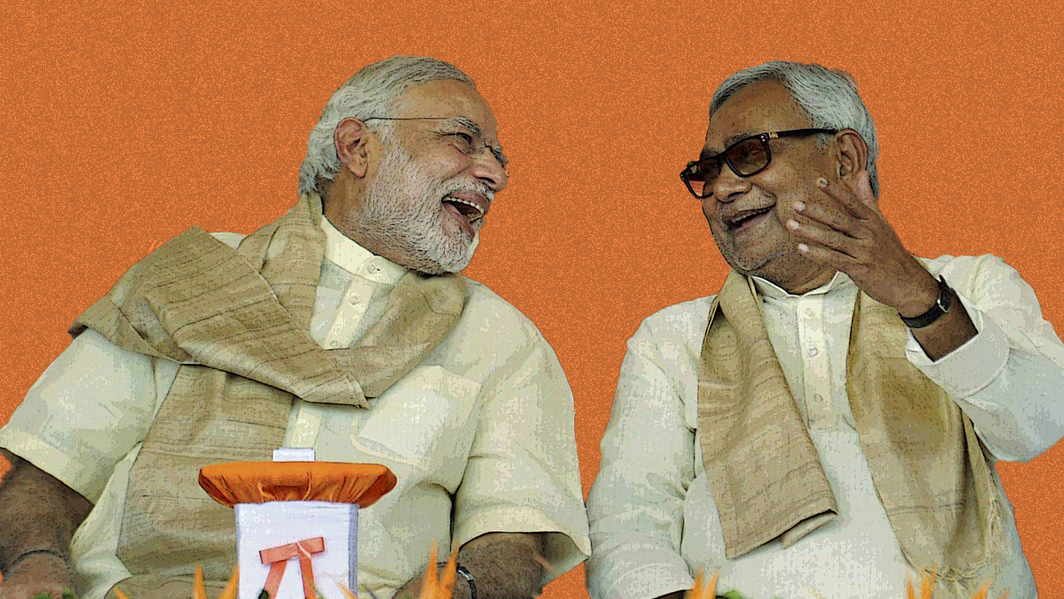
[vc_row][vc_column][vc_column_text]Winning the trust vote with a comfortable margin, Nitish Kumar started his second term as chief minister in the same State Assembly on Friday. This is the fifth time the 66-year-old has become CM in his 40 years of life in active politics.

The newly sworn-in CM won the trust vote on Friday in the Bihar Assembly with 131 votes in favour of the JD(U)-BJP alliance; 108 MLAs voted against the motion. The NDA had earlier submitted a list of 132 MLAs to the governor. These include 71 of JD(U), BJP 53, RLSP 2, LJP 2, HAM 1 and 3 Independents. In the rival camp, the RJD has 80 MLAs, the Congress 27 and the CPI-ML has three.

Four legislators did not vote, two on technical grounds and one calling sick. Two of the four independent legislators voted for Kumar in the House of 243.

There was no cross-voting, the Speaker Vijay Kumar Choudhary’s rejection of RJD and Congress’ demand for a secret ballot ensuring that voting was strictly on party lines. A lobby division method was opted for. Legislators went of the House and came back one by one and signed a register indicating their vote, for or against the motion.

A political survivor who has managed to stay in office by tying up with whichever party seems to be carrying the day, somewhat like the other Bihar politician and Union Consumer Affairs Minister Ram Vilas Paswan, Kumar insisted while seeking the trust vote that he changed sides for “sewa” (service) and not “mewa” (fruits of power).

“To be in power devolves great responsibility to govern, not earn. Yeh sewa ka Avsar hai, na ki mewa ka (It is an opportunity to serve, not profit,” he said before seeking the trust vote.

Two days ago, he had dumped coalition partners, the RJD and Congress. “I faced lot of resistance trying to run the government in the best interest of people of Bihar and preserve the mahagathbandhan, but failed due to RJD’s attitude,” said Kumar.

He chose to quit over his deputy chief minister and RJD chief Lalu Prasad’s son Tejashwi Yadav neither resigning nor explaining to the people the corruption charges against him being investigated by the CBI.

Less than two years ago, Kumar had ignored several cases of corruption against Prasad. However, Kumar probably realised that Lalu Prasad was grooming his son for post of CM and his position at the top was doubtful in future in the alliance even as, for him, it was leading to diminishing returns for him. He used the excuse of allegations of corruption against Yadav’s son, Tejashwi Yadav, to break the Grand Alliance. Kumar’s decision was likely made keeping the 2020 Bihar Assembly elections in mind.

Former ally BJP, with which he ran a previous coalition government till 2013, immediately offered him support and he was sworn in again as CM with BJP leader Sushil Kumar Modi as his new deputy on Thursday. Governor Keshari Nath Tripathi ased him to prove his majority on the floor of the House within two days, a condition that was met today.

His action dealt a blow to the strength and unity of Opposition, while giving further boost to the image of BJP as a fast-acting, decisive party under the strong and popular leadership of Prime Minister Narendra Modi. The Congress came out as a floundering party with an incapable leadership.

Modi congratulated Kumar immediately after the trust vote. “I am happy that the CM did not give in and took a step”, Modi said, referring to the corruption charges. Taking a dig at Tejashwi, Modi said, “Today Tejashwi did not say a single word on corruption in the assembly. People of Bihar want to know how has he earned so much money at an age of 28 years?”

About Mahagathbandhan, he said, “If they had votes, they should have proven it in the Assembly. It has been proved that the JD(U)-BJP alliance has full majority. Unnatural alliance died naturally. Within months, the alliance has split.”

Sushil Kumar Modi, the deputy chief minister who replaced Tejashwi, said, “I thank the Congress and the RJD for not asking Tejashwi to resign. Had that happened, I would not have been on the right side.”

“If the RJD insists that the mandate was not followed, it should introspect, whether it was for the likes of Mohammad Shahabuddin and Rajballabh Yadav? It is better now, that the government is in right hands,” he said, referring to two controversial aides of Lalu Prasad.

“The new government will register fresh milestones in successful governance, which was lacking in the last regime due to RJD’s intransigence,” he added.

Before the vote, Opposition leader and former deputy chief minister, Tejashwi Yadav, made an emotional speech, dismissing corruption charges against him were cooked up.

“Is there any charge against me in the last 20 months of impropriety during my tenure in office?… If it was about corruption, the JD(U) should not have allied with my father, who was facing cases; yet it happened,” he said.

“There is just an FIR, not a proved case; so where was the question of my resignation?” he added referring to the controversy over his refusal to quit that led to Kumar pulling of the grand alliance. “The chief minister never ever asked for my resignation either,” he said.

“I am young. Only 28. It was my success, which unnerved the JD(U), which plotted for my removal,” he said, adding that Kumar was aware of his “honesty”, said Tejashwi.[/vc_column_text][/vc_column][/vc_row]

India News

PM Modi assures no discrimination in women’s quota, delimitation debate intensifies in Parliament

PM Narendra Modi has assured that women’s reservation will be implemented without discrimination, amid a heated debate over delimitation in Parliament.

Published

on

PM modi

Prime Minister Narendra Modi has assured that there will be no discrimination in the implementation of women’s reservation, as Parliament witnessed a sharp debate over the proposed linkage between the quota and delimitation exercise.

During the ongoing special session, the government reiterated its commitment to ensuring fair representation while addressing concerns raised by opposition parties regarding the timing and structure of the legislation.

The proposed framework aims to reserve 33 percent of seats for women in the Lok Sabha and state assemblies. However, its implementation is tied to a fresh delimitation exercise, which is expected after the next census.

Opposition questions timing and intent

Opposition leaders have raised concerns that linking the women’s quota to delimitation could delay its implementation. They argue that the process of redrawing constituencies may push the actual rollout further into the future.

The issue has triggered a broader political confrontation, with multiple parties questioning whether the move could alter representation across states.

Some critics have also alleged that the delimitation exercise could disproportionately benefit certain regions based on population, a charge the government has rejected.

Government reiterates commitment to fair implementation

Responding to these concerns, the Centre has maintained that the reforms are necessary to ensure accurate and updated representation based on population data.

Leaders from the ruling side have repeatedly emphasized that the process will be carried out transparently and without bias. The assurance that there will be “no discrimination” is aimed at addressing fears among states and opposition parties.

The debate marks a key moment in Parliament, with both sides engaging in intense exchanges over one of the most significant electoral reforms in recent years.

Continue Reading

India News

Give all tickets to Muslim women, Amit Shah says, attacking Akhilesh Yadav on sub-quota demand

A sharp exchange between Amit Shah and Akhilesh Yadav in Parliament over sub-quota for Muslim women highlights key divisions on women’s reservation implementation.

Published

on

A heated exchange broke out in Parliament during discussions on the women’s reservation framework, with Union Home Minister Amit Shah and Samajwadi Party chief Akhilesh Yadav locking horns over the demand for a sub-quota for Muslim women.

The debate unfolded as the government pushed forward key legislative measures to implement 33% reservation for women in the Lok Sabha and state assemblies.

Akhilesh Yadav argued that the proposed reservation must ensure representation for women from marginalised communities, including Other Backward Classes (OBCs) and Muslim women. He said that without such provisions, large sections could remain excluded from political participation.

He also questioned the timing of the bill, alleging that the Centre was avoiding a caste census. According to him, a census would lead to renewed demands for caste-based reservations, which the government is reluctant to address.

Government rejects religion-based quota

Responding to the demand, Amit Shah made it clear that reservation based on religion is not permitted under the Constitution.

He stated that any proposal to provide quota to Muslims on religious grounds would be unconstitutional, firmly rejecting the idea of a separate sub-quota for Muslim women within the broader reservation framework.

The government has maintained that the existing framework already includes provisions for Scheduled Castes (SC) and Scheduled Tribes (ST) women within the overall reservation structure.

Wider political divide over implementation

The issue of sub-categorisation within the women’s quota has emerged as a major flashpoint, even as most opposition parties broadly support the idea of women’s reservation.

Samajwadi Party leaders reiterated that their support for the bill depends on inclusion of OBC and minority women, while the government continues to defend its constitutional position.

The debate is part of a broader discussion during the special Parliament session, where multiple bills linked to delimitation and implementation of the women’s quota are being taken up.

Continue Reading

India News

Raghav Chadha’s security withdrawn by Punjab amid AAP rift, Centre steps in with cover

Punjab withdraws Raghav Chadha’s security amid party tensions, Centre offers fresh protection.

Published

on

The Punjab government has withdrawn the Z+ category security cover provided to Raghav Chadha, amid an ongoing rift within the Aam Aadmi Party.

According to sources, the security personnel deployed by Punjab Police have been asked to report back, marking a significant development in the political dispute involving the Rajya Sabha MP.

The move comes shortly after Chadha was removed from his position as deputy leader of the party in the Rajya Sabha, signalling deepening differences between him and the party leadership.

Centre offers fresh security arrangement

Soon after the withdrawal, the Ministry of Home Affairs stepped in to provide security cover to Chadha.

Sources indicate that he will now receive Z-category security in Delhi and Punjab, while a Y-category cover may be provided in other parts of the country.

This shift ensures continued protection for the MP despite the withdrawal of state-provided security.

Fallout linked to political disagreement

The development is part of a broader fallout between Chadha and his party. He was recently replaced as deputy leader in the Rajya Sabha, with the party reportedly expressing dissatisfaction over his political approach and conduct in Parliament.

Chadha, however, has denied the allegations, calling them baseless and asserting that his focus has been on raising public issues rather than engaging in political confrontation.

Growing divide within party ranks

Once considered a close associate of Arvind Kejriwal and a prominent face of the party, Chadha’s recent removal from key roles and the withdrawal of his security underline a widening internal divide.

He is among the few leaders in the party who have recently found themselves at odds with the leadership, indicating shifting dynamics within the organisation.

Continue Reading

Trending

© Copyright 2022 APNLIVE.com