English हिन्दी
Connect with us

Latest Politics News

Opposition rallies behind Andhra CM Naidu as he sits on a day-long fast for spl status to his state

Published

on

Opposition rallies behind Andhra CM Naidu as he sits on a day-long fast for spl status to his state

Andhra Pradesh Chief Minister N Chandrababu Naidu today (Monday, Feb 11) began a day-long fast demanding that the Centre grant special status to the state and fulfil promises made before its bifurcation in 2014.

Naidu paid tributes to Mahatma Gandhi at Raj Ghat before heading to Andhra Pradesh Bhavan to observe the fast. A TDP delegation led by Naidu will submit a memorandum to President Ram Nath Kovind on Tuesday, said media reports.

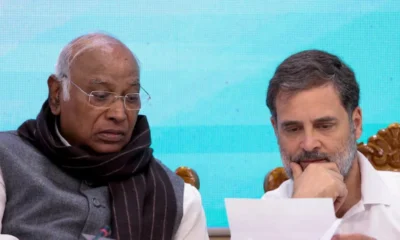
Naidu’s fast also became an occasion for a show of Opposition unity with a number of party leaders turning up to extend their support to the Telugu Desam Party (TDP) chief, said media reports. Congress President Rahul Gandhi arrived at N Chandrababu Naidu‘s one-day hunger strike against the Centre over special category status to Andhra Pradesh. National Conference’s Farooq Abdullah and NCP’s Majeed Memon are also present at the venue. Former Prime Minister Narendra Modi, Delhi Chief Minister Arvind Kejriwal and Trinamool Congress’ Derek O’Brien were also among those present.

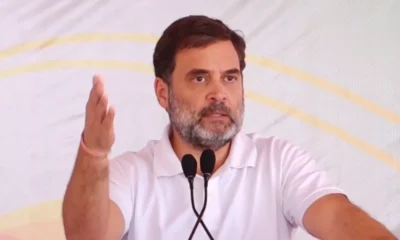
“I stand with the people of Andhra Pradesh. What kind of a PM is he? He did not fulfill the commitment made to the people of Andhra Pradesh. Mr Modi tells a lie wherever he goes. He has got no credibility left,” said Rahul Gandhi.

Accusing accused Prime Minister Narendra Modi of “facilitating loot”, Rahul Gandhi said, “Every defence deal has an anti-corruption clause. The Hindu has reported that the PM removed the anti-corruption clause. It is clear that the PM facilitated loot.”

The report in The Hindu stated that the PMO had waived key provisions of the anti-corruption clauses days before the defence agreement was signed. Quoting The Hindu report, the Congress, on its official Twitter handle, asked: “Who was the PMO trying to shield? Who was the PMO trying to benefit?”

Manmohan Singh, extending support to Andhra Pradesh Chief Minister N Chandrababu Naidu over the demand for special category status to the state, said, “I stand in support of Naidu, special category status promise must be implemented without any further delay,” adding that “demand for special status had support of all parties when it was discussed in Parliament.”

In February 2014, during his tenure as PM, Manmohan Singh had announced in the Rajya Sabha that special category status would be extended to the successor state of Andhra Pradesh comprising 10 districts, including four districts in Rayalaseema and three districts of coastal Andhra Pradesh, for a period of five years.

“Chandrababu Naidu ji, I would like to congratulate TDP. We started this fight four years back but there is a very important date – July 20, 2018 – when TDP brought in ‘No Confidence Motion’ in Lok Sabha. This scared Modi. After that on Jan 9, 2019 SP-BSP came together. After that, what happened on Jan 19?  On that day senior leaders of 22 political parties came on the same stage. Why am I mentioning these dates? Because after all of them, BJP got one new ally – CBI,” ANI quoted O’brien as saying.

Naidu has been trying to unite the opposition parties to take on the BJP in the general elections. Over the last three months, he has held a number of meetings with the opposition party leaders on forming an anti-BJP front.

In March last year, the TDP had pulled out of the NDA government over its refusal to grant a special status to Andhra Pradesh.

The party has been accusing the Narendra Modi government of not releasing enough funds for the Polavaram irrigation project, the Kadapa steel plant and Amravati, the under-construction ultra-modern state capital.

Earlier, as he began his fast, the TDP chief said the party was denied permission to stage a protest in Parliament premises. “So, we came here”.

“Today we came here all the way to protest against central government. Yesterday, PM visited Andhra Pradesh, Guntur one day before the dharna. What is the need, I am asking,” said Chandrababu Naidu.

He warned that Modi would be given a befitting answer if he made personal attacks against the people of his state. “On behalf of five crore people, I’m warning this government… I came here to remind you of the promises made in the AP Reorganisation Act,” Naidu said.

“I am warning you. Don’t make personal attacks against me and my people. It’s unwarranted. I am just doing my duty as the head of my state. We are only demanding what we were promised,” he said, adding if somebody “attacks our self respect, we will not tolerate it”.

On Sunday, responding to PM Modi’s charge that Naidu was only interested in promoting his son Lokesh  and not the state’s development, the TDPchief said the Prime Minister wouldn’t understand much as he didn’t even give due respect to his wife.

Stating that he was against personal attacks, but was compelled to do so, Naidu said, “Yes Lokesh is my son. …. You don’t have a family, no relations. I’m one who respects the family… wants to spend time with the family…. I am the father of Lokesh, grandfather of Devansh and husband of Bhuvaneshvari. And I’m proud of it,” Naidu said. “Does Modi have any respect for the family system? Has he ever spoken about his family?”

He then asked his audience: “Do you know he has a wife? They enacted the (instant) triple talaq law to protect women from being divorced by just the word being uttered three times. This is Yashodaben’s husband. Yes or no? He hasn’t even divorced her. He has just left her.”

Naidu said he wouldn’t have raised the issue had Modi not launched personal attacks: “I wouldn’t have spoken about this but you became personal. I have always respected women. I’m a big brother to all the women in the state.”

The chief minister was speaking at patta distribution ceremony in Vijayawada.

Modi, claiming that Naidu was always keen to portray his seniority, had said the former was his senior in defections, back-stabbing and opportunist politicking.

“Your CM often keeps saying he is quite a senior politician. Of course he is. A senior in changing colours last minute and forming alliances. Senior in back-stabbing his own father-in-law for power,” Modi told the gathering.

He also slammed the TDP chief for joining hands with the Congress, which he said was a betrayal of Naidu’s father-in-law and TDP founder, NT Rama Rao. “Naidu had said he would follow NTR’s footsteps, but is he really doing so. NTR had fought for a Congress-free India. Mukt-Congress has now become dost-Congress [friend of Congress] for Naidu.”

You might also be interested in:

India News

Sonia Gandhi calls weakening of MGNREGA a collective moral failure, targets Centre in op-ed

Sonia Gandhi has accused the Centre of weakening MGNREGA, calling it a collective moral failure with serious consequences for crores of working people.

Published

on

Sonia Gandhi

Congress Parliamentary Party chairperson Sonia Gandhi has sharply criticised the Central government over what she described as the steady dismantling of rights-based legislation, with a particular focus on the Mahatma Gandhi National Rural Employment Guarantee Act (MGNREGA).

In a recent opinion article published in a leading English daily, Sonia Gandhi argued that MGNREGA was envisioned as more than a welfare measure. She said the rural employment scheme gave legal backing to the constitutional right to work and was rooted in Mahatma Gandhi’s idea of Sarvodaya, or welfare for all.

Calling its weakening a serious failure, she wrote that the decline of MGNREGA represents a “collective moral failure” that will have lasting financial and human consequences for crores of working people across India. She stressed that safeguarding such rights-based frameworks is crucial at a time when, according to her, multiple protections are under strain.

Concerns raised over education, environment and land laws

Sonia Gandhi also flagged concerns beyond rural employment. Referring to education policy, she claimed that the Right to Education has been undermined following the National Education Policy 2020, alleging that it has led to the closure of around one lakh primary schools across the country.

On environmental and land-related legislation, she stated that the Forest Rights Act, 2006, was weakened through the Forest (Conservation) Rules, 2022. According to her, these changes removed the role of the gram sabha in decisions related to the diversion of forest land.

She further alleged that the Right to Fair Compensation and Transparency in Land Acquisition, Rehabilitation and Resettlement Act has been significantly diluted, while adding that the National Green Tribunal has seen its authority reduced over the years.

Warning on agriculture and food security laws

Touching upon agriculture reforms, Sonia Gandhi referred to the now-repealed three farm laws, claiming they were an attempt to deny farmers the right to a minimum support price. She also cautioned that the National Food Security Act, 2013, could face similar threats in the future.

Reiterating her central argument, she urged unity to protect statutory rights, stating that the erosion of such laws has implications that extend well beyond policy, affecting livelihoods and dignity on the ground.

Continue Reading

India News

Renaming MGNREGA removes core spirit of rural employment law, says Shashi Tharoor

Published

on

Shashi Tharoor

Congress MP Shashi Tharoor has strongly criticised the renaming of the Mahatma Gandhi National Rural Employment Guarantee Act (MGNREGA), saying the move strips the rural employment programme of its core essence. His remarks came after Parliament cleared the Viksit Bharat Guarantee for Rozgar and Ajeevika Mission (Gramin) Bill, also referred to as the VB-G RAM G Bill.

Speaking to media, Tharoor said the decision to remove Mahatma Gandhi’s name from the scheme “takes out the heart” of the rural employment programme that has been in place for years. He noted that the identity and philosophy associated with Mahatma Gandhi were central to the original law.

Tharoor also objected to the way the new name was framed, arguing that it unnecessarily combined multiple languages. He pointed out that the Constitution envisages the use of one language in legislation, while the Bill’s title mixes English and Hindi terms such as “Guarantee”, “Rozgar” and “Ajeevika”, along with the conjunction “and”.

‘Disrespect to both names’

The Congress leader said that inserting the word “Ram” while dropping Mahatma Gandhi’s name amounted to disrespecting both. Referring to Mahatma Gandhi’s ideas, Tharoor said that for Gandhi, the concepts of Gram Swaraj and Ram Rajya were inseparable, and removing his name from a rural employment law went against that vision.

He added that the name of Lord Ram could be used in many contexts, but questioned the rationale behind excluding Mahatma Gandhi from a programme closely linked to his philosophy of village self-rule.

Protests over passage of the Bill

The VB-G RAM G Bill was passed by the Lok Sabha on December 18 and cleared by the Rajya Sabha in the early hours of December 19 amid protests from Opposition members. Several MPs opposed the manner in which the legislation was pushed through, with scenes of sloganeering and tearing of papers in the House.

Outside Parliament, members of the Trinamool Congress staged a sit-in protest near Samvidhan Sadan against the passage of the Bill. Congress also announced nationwide protests earlier this week, accusing the government of weakening rights-based welfare schemes.

Despite opposition criticism, the government has maintained that the new law will strengthen rural employment and livelihood security. The Bill raises the guaranteed employment from 100 days to 125 days per rural household and outlines a 60:40 cost-sharing formula between the Centre and states, with a higher central share for northeastern, Himalayan states and certain Union Territories.

Continue Reading

India News

Rahul Gandhi attacks G RAM G bill, says move against villages and states

Rahul Gandhi has criticised the G RAM G bill cleared by Parliament, alleging it dilutes the rights-based structure of MGNREGA and centralises control over rural employment.

Published

on

Rahul Gandhi

Leader of the Opposition Rahul Gandhi has launched a sharp attack on the Modi government after Parliament cleared the Viksit Bharat Guarantee for Employment and Livelihood Mission (Rural) Bill, commonly referred to as the ‘G RAM G’ bill. He described the proposed law as “anti-state” and “anti-village”, arguing that it weakens the core spirit of the Mahatma Gandhi National Rural Employment Guarantee Act (MGNREGA).

The new legislation, which is positioned as an updated version of MGNREGA, was passed amid protests by opposition parties and is expected to replace the existing scheme once it receives presidential assent.

‘Bulldozed without scrutiny’, says Rahul Gandhi

Rahul Gandhi criticised the manner in which the bill was cleared, saying it was pushed through Parliament without adequate debate or examination. He pointed out that the opposition’s demand to refer the bill to a standing committee was rejected.

According to him, any law that fundamentally alters the rural employment framework and affects crores of workers should undergo detailed scrutiny, expert consultation and public hearings before approval.

Claim of dilution of rights-based guarantee

Targeting the central government, the Congress leader said the proposed law dismantles the rights-based and demand-driven nature of MGNREGA and replaces it with a rationed system controlled from Delhi. He argued that this shift undermines the autonomy of states and villages.

Rahul Gandhi alleged that the intent behind the move is to centralise power and weaken labour, particularly impacting rural communities such as Dalits, OBCs and Adivasis.

Defence of MGNREGA’s impact

Highlighting the role of MGNREGA, Gandhi said the scheme provided rural workers with bargaining power, reduced distress migration and improved wages and working conditions, while also contributing to rural infrastructure development.

He also recalled the role of MGNREGA during the Covid period, stating that it prevented crores of people from slipping into hunger and debt. According to him, any rationing of a jobs programme first affects women, landless workers and the poorest communities.

Opposition to name change and provisions

The Congress has also objected to the renaming of the scheme, accusing the government of attempting to erase the legacy associated with Mahatma Gandhi. Opposition MPs staged a dharna within the Parliament complex, questioning provisions of the bill that they claim dilute the “soul and spirit” of the original law enacted in 2005.

Under MGNREGA, the government guaranteed 100 days of work in rural areas along with an unemployment allowance if work was not provided. The ‘G RAM G’ bill proposes to raise the guaranteed workdays to 125, while retaining other provisions. However, critics have flagged concerns over employment being linked to pre-approved plans.

The bill was cleared after a midnight voice vote in the Rajya Sabha, following its passage in the Lok Sabha amid protests and walkouts. It will become law once approved by the President.

Continue Reading

Trending

© Copyright 2022 APNLIVE.com