English हिन्दी
Connect with us

Latest Politics News

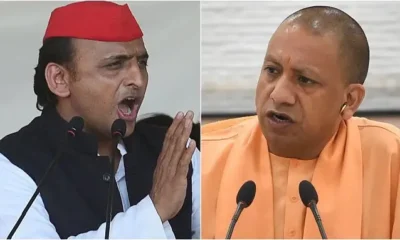
Akhilesh Yadav calls UP budget second last of BJP govt; slams CM Yogi for not having roadmap for state

“The government only talks about the amount it has paid so far but never discloses the outstanding dues. It also never tells farmers how much the price of sugarcane has increased,” he said.

Published

on

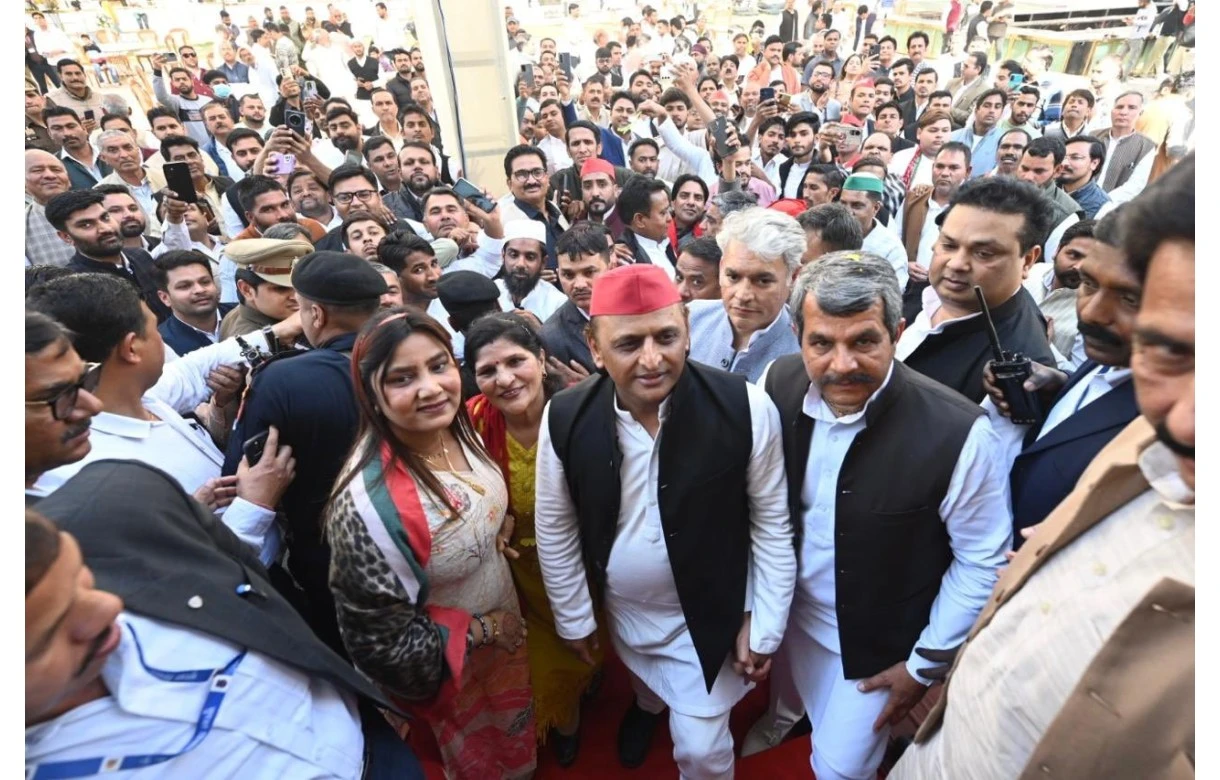
Samajwadi Party (SP) chief Akhilesh Yadav on Thursday launched a scathing attack on the Yogi Adityanath-led Uttar Pradesh government, dismissing its recently presented budget as the “second last budget” of the BJP in the state. Yadav criticized the budget for lacking vision and failing to address the needs of the people, claiming it was nothing more than an “empty drum” full of noise but devoid of substance.

“This is the ninth budget of this government, and it is their second last. After this, there will be one final budget, and then the people will get a chance to choose a new government,” Yadav said, expressing confidence in the BJP’s impending defeat in the next elections.

The former Chief Minister of Uttar Pradesh accused the BJP of presenting budgets without a clear roadmap for the state’s development. “The government has presented budgets without any vision on how to take the state forward. There is no clarity on how the needs of the common people will be addressed,” he stated.

Yadav also mocked the BJP’s repeated claims of presenting the “biggest budget,” pointing out that every new budget is naturally larger than the previous one. “Every time they present a budget, they say it’s the biggest one. This statement can be made by any government because every budget is bound to be bigger than the last,” he remarked.

Describing the budget as hollow, Yadav said, “This is not a budget; it’s an empty drum that makes a lot of noise but has nothing inside. The people feel like no real budget has been presented, just sermons, while they keep wondering when the actual budget will come.”

Yadav alleged that the budget had left various sections of society disillusioned. “Farmers’ hopes have dried up, women are even more worried about managing household expenses, the unemployed see nothing but darkness ahead, and traders are feeling the deepening impact of the economic slowdown,” he said.

He also took a dig at BJP ministers and MLAs, suggesting that despite their applause in the Assembly, they would soon face public anger over issues like inflation and unemployment. “Even BJP ministers and MLAs who were thumping desks in the Assembly are now anxious because they will have to face the anger of people in their constituencies,” he added.

Yadav highlighted the BJP’s failure to deliver on its election promises, particularly those related to farmers. “The BJP manifesto promised free electricity for farmers’ irrigation needs over the next five years. Nine budgets have passed, but has this promise been fulfilled? They also pledged to set up a Rs 25,000 crore agro-infrastructure mission in the name of Sardar Vallabhbhai Patel, but what happened to that?” he questioned.

He further criticized the government for not establishing a Rs 1,000 crore Bhama Shah Price Stabilization Fund for crops like potatoes, tomatoes, and onions, as promised. Yadav also accused the BJP of failing to ensure Minimum Support Price (MSP) for farmers and destroying mandis that were built to ensure fair prices for agricultural produce.

“They promised to provide MSP to farmers, but where is it? We had built mandis to ensure fair prices for farmers, and this government has destroyed them. Not a single new mandi has been built under BJP rule,” he claimed.

Yadav also pointed out the BJP’s unfulfilled promise to sugarcane farmers, who were assured that their dues would be paid within 14 days, with interest in case of delay. “The government only talks about the amount it has paid so far but never discloses the outstanding dues. It also never tells farmers how much the price of sugarcane has increased,” he said.

In a lighter vein, Yadav took a swipe at Chief Minister Yogi Adityanath’s use of Urdu words in his Assembly speech, despite the BJP’s opposition to the language. “Some people even oppose Urdu in Urdu itself,” he quipped, listing words like ‘badnaam,’ ‘bakhsha,’ ‘gunehgar,’ ‘haseen,’ and ‘duniya’ used by the CM.

Yadav concluded by asserting that the BJP’s budget had left people disillusioned and that the countdown for a new government had begun. “After nine budgets, the government still has no answers for the unemployed, struggling farmers, or common citizens. The countdown for a new government has begun,” he said, signalling the SP’s readiness to challenge the BJP in the upcoming elections.

India News

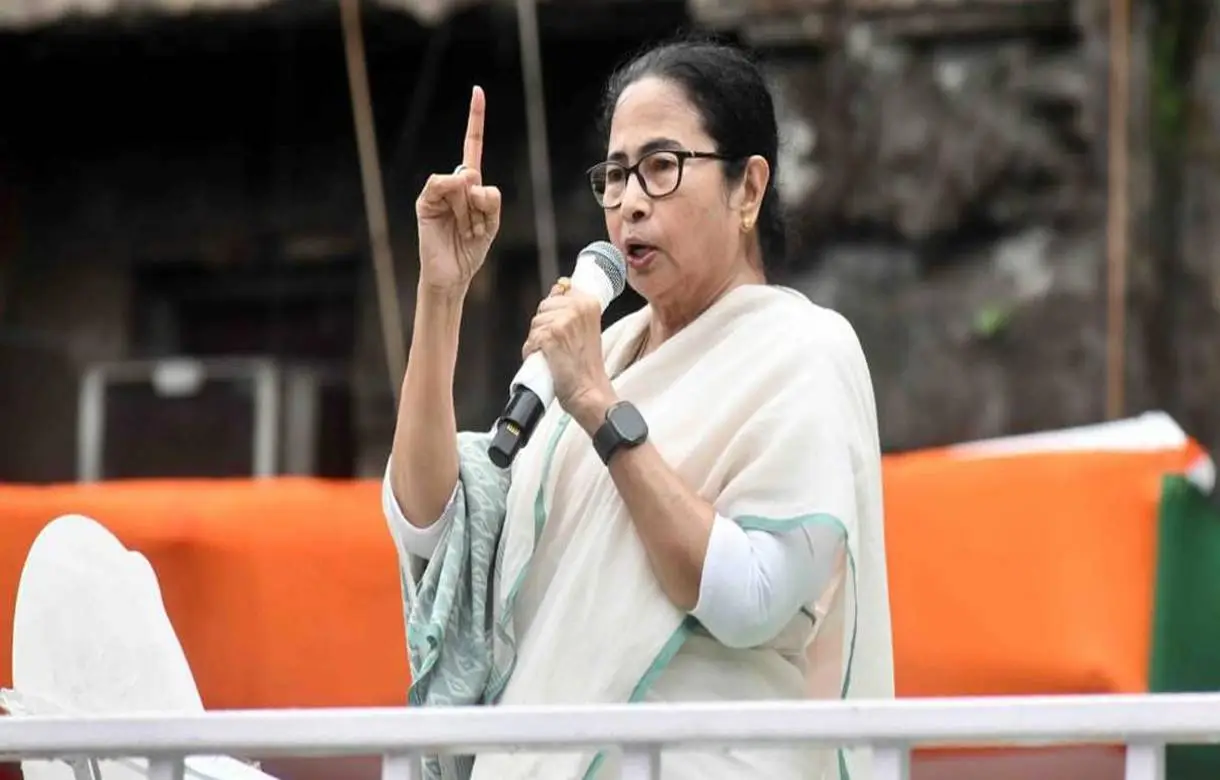
President Murmu questions tribal development in Bengal, Mamata Banerjee calls remarks political

President Droupadi Murmu raised concerns about tribal development in West Bengal and questioned the absence of state representatives during her north Bengal visit. Mamata Banerjee called the remarks political and said they were based on misinformation.

Published

on

mamta banerjee

President Droupadi Murmu on Saturday raised questions about the development of tribal communities in West Bengal and also expressed surprise over the absence of state government representatives during her visit to north Bengal.

Speaking at the International Santhal Conference, an event organised for the tribal community, the President wondered whether Chief Minister Mamata Banerjee was upset with her, as neither the chief minister nor any minister from the state cabinet was present to receive her.

Murmu also referred to the decision to shift the venue of the conference from Bidhannagar to Goshaipur. She questioned why the programme was not allowed at the earlier venue despite adequate space being available.

Addressing the gathering, the President said she did not know whether Banerjee was upset with her and remarked that she also considers herself a daughter of Bengal. She added that Banerjee was like a younger sister to her but the reason behind shifting the programme location remained unclear.

During her speech, Murmu also raised broader concerns about the condition of tribal communities in the region. She questioned whether development and facilities intended for Santhals and other tribal groups were actually reaching them.

According to the President, the Centre has worked over the past decade to strengthen tribal identity and accelerate development for tribal communities. However, she said it did not appear that the benefits were reaching people in the region.

Murmu also suggested that some individuals might have been prevented from attending the event and said it appeared that certain groups did not want the Santhal community to unite, progress, or gain access to education and strength.

The remarks triggered a political response, with Prime Minister Narendra Modi criticising the situation. Sharing a video of the President’s speech, he said the incident was shameful and expressed concern over what he described as an insult to the President and to Santhal culture.

The BJP also criticised the West Bengal government, alleging that the lack of preparation and protocol during the President’s visit reflected administrative failure and disrespect for constitutional offices.

Responding to the President’s remarks, Mamata Banerjee said the statements were political in nature. Speaking during a protest in Kolkata against the Special Intensive Revision of voter rolls, the chief minister urged the President to avoid making remarks that could affect the dignity of the office.

Banerjee said the President had spoken about only one community and not about others in the state. She also asked her party’s MPs to seek an appointment with Rashtrapati Bhavan to present details of the state government’s work for Scheduled Tribe and Scheduled Caste communities.

The Trinamool Congress also rejected the suggestion that there had been no development for tribal communities in the state. In a statement, the party said the President appeared to have been misinformed.

The party highlighted several welfare initiatives, including financial assistance under the Lakshmir Bhandar scheme. It said women from Scheduled Tribe communities now receive Rs 1,700 per month, amounting to Rs 20,400 annually.

The Trinamool Congress also referred to scholarships for tribal students, the establishment of schools and other development programmes aimed at improving conditions in tribal areas.

According to the party, these measures represent concrete initiatives designed to improve opportunities, dignity and development for Adivasi communities across West Bengal.

Continue Reading

India News

BJP likely to get chief minister in Bihar as Nitish Kumar plans Rajya Sabha move

Bihar may see a BJP chief minister for the first time as Nitish Kumar prepares to contest the Rajya Sabha elections. JD(U) is likely to receive 15 cabinet positions in the new government.
Published

on

BJP Leaders

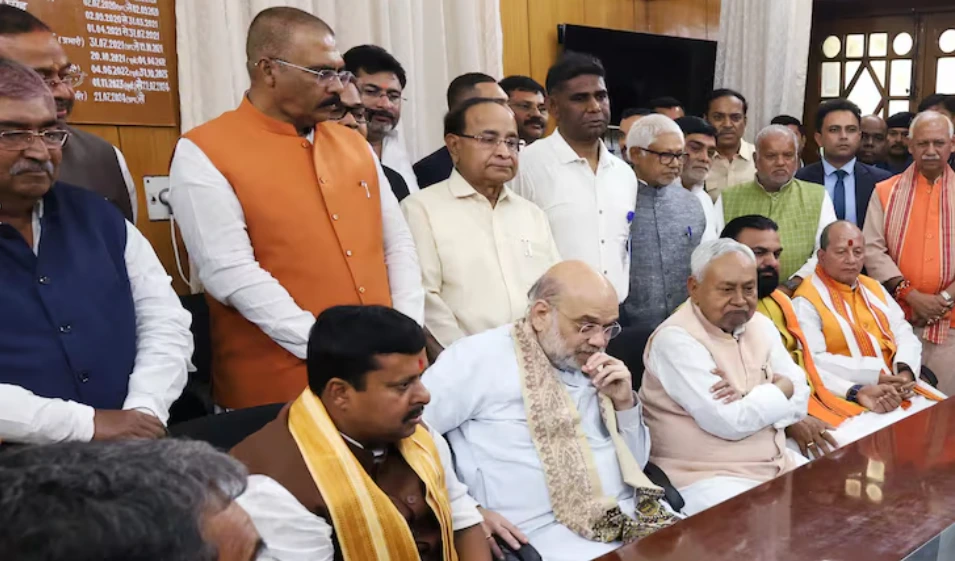
Bihar may soon witness a major political transition as a leader from the Bharatiya Janata Party is likely to become the state’s chief minister, following Nitish Kumar’s decision to step down and contest the Rajya Sabha elections, according to sources.

Nitish Kumar, who has served as Bihar’s chief minister for more than two decades and held the post a record ten times, filed his nomination papers for the Rajya Sabha on Thursday. His move comes only four months after he was sworn in for his tenth term as chief minister.

If the reported arrangement goes ahead, it would mark the first time that the BJP occupies the chief minister’s post in Bihar, a state where leadership has largely alternated between the Janata Dal United and the Rashtriya Janata Dal.

Possible cabinet structure being discussed

Sources indicated that the proposed government structure may include one deputy chief minister. Nitish Kumar’s son Nishant Kumar is likely to be given that role, which would mark his entry into electoral politics.

The Janata Dal United is expected to receive 15 ministerial positions in the new cabinet.

Apart from the JD(U), coalition partners may also get representation. Two ministers from the Lok Janshakti Party Ram Vilas, and one each from the Rashtriya Lok Morcha and the Hindustani Awam Morcha are likely to be included, sources said.

The Speaker of the Bihar Assembly is expected to remain from the BJP.

Nitish Kumar has also called a meeting of all JD(U) Members of Parliament and senior party leaders to discuss the developments.

Rajya Sabha elections scheduled for March 16

Announcing his decision to contest the Rajya Sabha elections, the 75 year old leader wrote on X that he intends to continue contributing to Bihar’s development.

“I seek to become a member of the Rajya Sabha in the elections being held this time. I want to assure you with complete honesty that my relationship with you will continue in the future as well, and my resolve to work together with you to build a developed Bihar will remain steadfast,” he said.

He added that the new government would have his full cooperation and guidance.

Along with Nitish Kumar, several leaders also filed their nominations for the Rajya Sabha elections. These include BJP leader Nitin Nabin, Union minister Ram Nath Thakur from the JD(U), Rashtriya Lok Morcha chief Upendra Kushwaha, and BJP state general secretary Shivesh Kumar.

Polling for the Rajya Sabha elections will be held on March 16 to fill 37 seats across 10 states. The counting of votes is scheduled to take place the same day at 5 pm.

Continue Reading

India News

Siddaramaiah presents record 17th Karnataka budget with Rs 4.48 lakh crore spending plan

Karnataka CM Siddaramaiah presented his record 17th budget, outlining a Rs4.48 lakh crore spending plan for 2026–27 with focus on infrastructure, welfare and technology.
Published

on

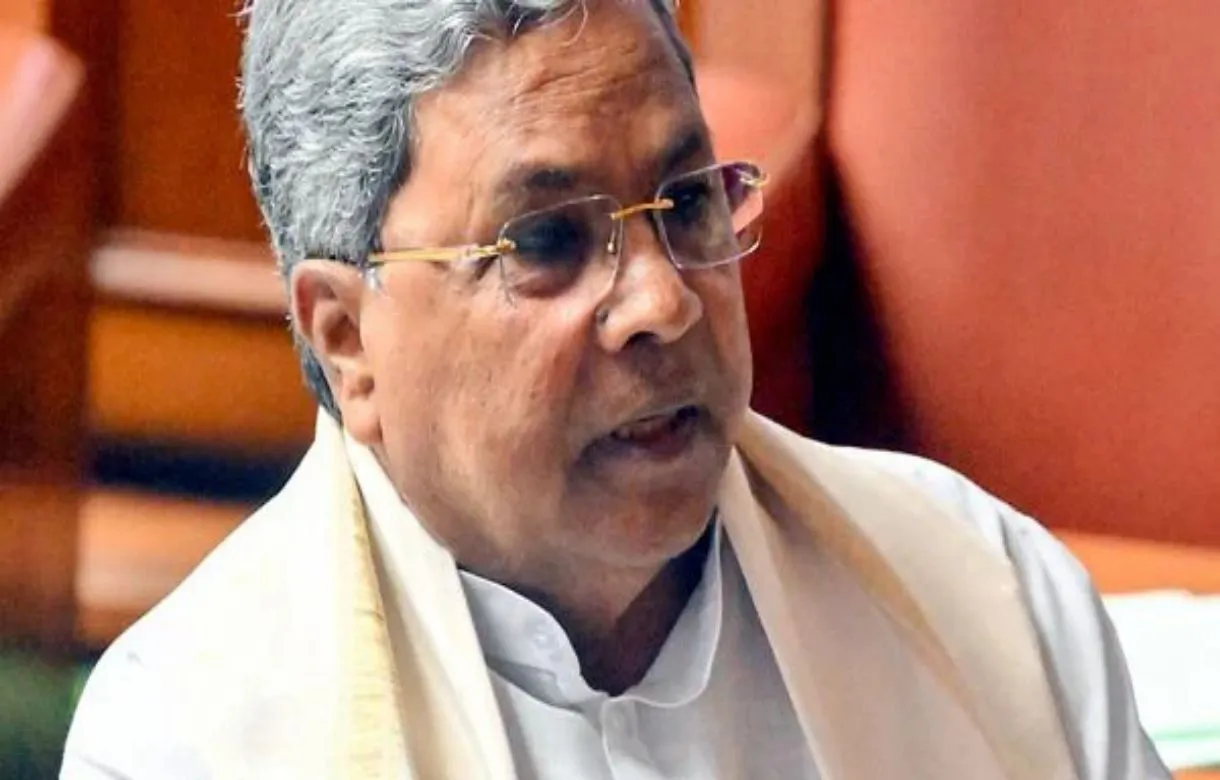
Chief Minister Siddaramaiah on Friday presented his 17th State Budget, the highest number delivered by any Karnataka chief minister, outlining a Rs 4.48 lakh crore spending plan for the financial year 2026–27.

The budget indicates that the state will continue to run a revenue deficit for the third consecutive year, even as the government focuses on welfare programmes, infrastructure development and technology investments.

According to the budget estimates, total revenue receipts are projected at Rs3,15,050 crore. This includes Rs 2,20,000 crore from the state’s own tax revenue, Rs16,000 crore from non-tax revenue, and Rs79,050 crore in transfers from the Government of India.

The government has also projected gross borrowings of Rs 1,32,000 crore and non-debt capital receipts of Rs190 crore, taking total receipts to Rs 4,47,240 crore for the fiscal year.

Meanwhile, overall expenditure is estimated at Rs 4,48,004 crore, divided into Rs 3,38,007 crore in revenue expenditure, Rs 74,682 crore in capital expenditure, and Rs 35,316 crore towards loan repayments.

The state has projected a revenue deficit of Rs 22,957 crore, while the fiscal deficit is estimated at Rs97,449 crore, which equals 2.95% of the Gross State Domestic Product (GSDP).

Total liabilities by the end of the year are expected to reach Rs 8,24,389 crore, accounting for 24.94% of the state’s GSDP. The government said both deficit levels remain within limits set under the Karnataka Fiscal Responsibility Act, indicating adherence to fiscal discipline.

Mekedatu project and student protection law

The government said a revised Detailed Project Report for the Mekedatu Dam Project will soon be submitted to the Centre along with a request for forest clearance. The project is intended to improve drinking water supply for Bengaluru but has faced opposition from Tamil Nadu in the past.

Another major announcement was the proposed Rohith Vemula Act, which aims to prevent caste-based discrimination and atrocities against students in government, private and deemed universities across the state.

Welfare and infrastructure focus

Under tribal welfare initiatives, the government will construct the Sri Maharshi Valmiki Administrative Soudha in Bengaluru’s Sumanahalli at an estimated cost of Rs 50 crore. The building will house offices of the Scheduled Tribes Welfare Department.

The budget also proposed the development of Waqf properties located in prime commercial areas through a Public-Private Partnership model, aiming to unlock their economic potential.

For urban infrastructure, Rs 1,255 crore has been allocated for ward-level road and infrastructure projects across five city corporations in Bengaluru.

The government also plans to develop 100 Miyawaki urban forests, which use dense plantations of native species to create green spaces in urban areas.

Push for technology and innovation

To encourage investment and improve ease of doing business, the state launched a unified investment portal developed with the support of Microsoft, providing more than 100 services across 30 departments for investors.

The Indian Institute of Science will host the Bangalore Robotics and AI Innovation Zone (BRAIN) under ARTPARK in collaboration with the Indian Space Research Organisation and Karnataka State Electronics Development Corporation Limited.

Additionally, a drone testing and performance evaluation facility will be established in Chikkaballapur to support the state’s growing drone technology ecosystem.

Mysuru to be developed as second IT hub

The government also announced plans to develop Mysuru as Karnataka’s second IT hub, aiming to reduce congestion in Bengaluru while promoting technology-driven growth in other regions of the state.

Continue Reading

Trending

© Copyright 2022 APNLIVE.com