English हिन्दी
Connect with us

Top Stories

Rajnath Singh approves Agnipath scheme, says employment will be increased through this

In order to boost employment in the country, Union Defence Minister Rajnath Singh on Tuesday approves the Agnipath scheme, aiming to provide the opportunity to the youth to work for shorter and longer tenures in the armed forces.

Published

on

Rajnath Singh Defence Minister

In order to boost employment in the country, Union Defence Minister Rajnath Singh on Tuesday approves the Agnipath scheme, aiming to provide the opportunity to the youth to work for shorter and longer tenures in the armed forces.
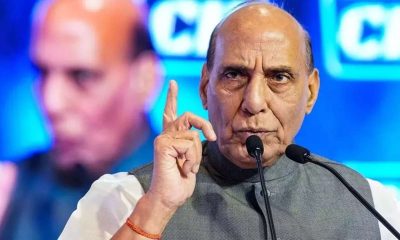
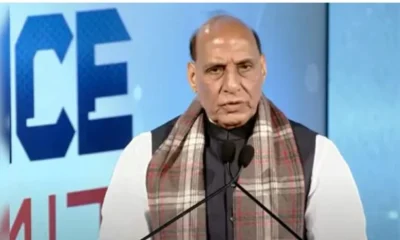
While speaking about the same during a press conference in Delhi on Tuesday, Singh said the Cabinet Committee on Security has taken a historic decision by approving the transformative scheme of Agnipath wherein the youngers in the country will be given an opportunity to get inducted into the Armed services.

During the conference, the Union Minister also pointed out the benefits of the scheme, where he said the initiative has been taken to will help the youth in the country train for new technologies, it will help them to improve their health levels, and increase employment opportunities with new skills in different sectors.

Read Also: PM Modi directs ministries to recruit 1 million people in mission mode in next 1.5 yrs, Varun Gandhi thanks PM in tweet, tweeple say happy days are coming

He further said that the entire nation, especially the younger generation needs to treat the armed forces with respect. Every child aspires to wear an army uniform at some point in their lifetime, Singh added.

Singh also told the media that with the help of the scheme, it will collectively contribute to the country’s GDP growth.

The decision of approving the Agnipath scheme comes after when Prime Minister Narendra Modi who had promised to provide 2 crores to the youth in 2014, asked the government officials on Tuesday to start recruiting people for 10 lakh jobs in the next 1.5 years in a mission mode.

Informing about the directions from PM Modi, the PMO’s Twitter also wrote that the PM Modi reviewed the status of Human Resources in all departments and ministries and instructed that recruitment of 10 lakh people will be done by the Government in a mission mode in the next 1.5 years.

Day after arrest, Siddhanth Kapoor released on bail in drugs case, why did Shakti Kapoor’s son not get same treatment as Shah Rukh Khan’s son Aryan Khan?

Delhi Weather Today: IMD predicts light rain in Delhi, maximum temperature to hit 43 degress

India News

MK Stalin announces major DMK organisational Changes in Tamil Nadu

MK Stalin has announced a major DMK organisational overhaul, introducing age and term limits and expanding party districts from 77 to 110.

Published

on

DMK chief MK Stalin has announced a major overhaul of the party’s organisational structure, months after the party lost the Tamil Nadu assembly election.

Acknowledging the defeat, Stalin said the party must openly recognise its mistakes. He also pointed to the functioning of party office-bearers as one of the factors behind the electoral loss.

“Although there are several reasons for our defeat, the functioning of our party office-bearers is also one of them,” Stalin said, stressing that the party must acknowledge its shortcomings and ensure better performance at every level.

Stalin also described the DMK as a “specialist” in making comebacks and said the party would return stronger.

Age and term limits for party posts

Among the major changes announced by Stalin are age and tenure limits for party positions.

Stalin said the changes would involve a significant restructuring of the DMK’s administrative system, with priority being given to new faces. He said the measures were intended to make the party sustainable for the next 100 years and help restore the trust of young people and women.

Under the new rules, branch secretaries must be aged 45 or below and can hold the position for a maximum of two terms.

District secretaries, meanwhile, must be below 70 years of age and can serve for a maximum of three terms.

DMK to increase party districts from 77 to 110

The DMK executive committee has approved increasing the number of party districts from 77 to 110.

The expansion will be implemented as part of the party’s 16th organisational elections. Revenue districts will generally be reorganised so that each party district covers two assembly constituencies.

Where only one constituency remains after the reorganisation, it will be attached to another suitable party district within the same revenue district as a third constituency.

Stalin has been authorised to determine and announce the constituencies that will form the 110 party districts.

New branch structure planned in urban areas

The DMK will also introduce a new branch-level structure in urban areas, along with the post of branch secretary.

The new system will initially be implemented in Chennai, Coimbatore, Madurai, Tiruchirappalli and Salem. It may subsequently be extended to other corporations.

Once the new party districts are announced, district executive committees will have to meet and establish the union, city, area, town, ward and branch-level units within 15 days.

The organisational changes come as the DMK seeks to restructure its party machinery and prepare for its political comeback following its assembly election defeat.

Continue Reading

India News

PM Modi says India’s political stability makes India a bright spot for growth

PM Modi said India’s political stability and policy continuity are helping make the country a bright spot of growth amid global concerns.

Published

on

Narendra Modi 12345

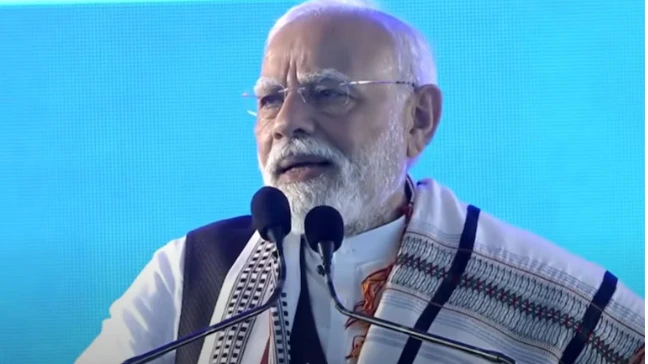
Prime Minister Narendra Modi on Friday said India has political stability and continuity in its policies, describing the country as a bright spot of growth and hope amid global concerns over economic growth.

Addressing the Economic Times World Leaders Forum, PM Modi said India is continuing to push reforms across sectors to maintain its growth momentum. He said reforms remain a key commitment of his government.

The Prime Minister said the NDA government has a clear roadmap for reforms, with a strong focus on governance. He also said the government is using incentives to encourage higher production.

PM Modi highlights shift in regulatory approach

PM Modi said his government is changing the country’s regulatory framework and moving away from what he described as a “prohibited-unless-permitted” approach.

He said the government believes there should be no regulation for an activity that has not been explicitly prohibited under law. According to him, the aim is to bring next-generation reforms at the policy and governance levels while improving ease of living.

He also contrasted the current Production Linked Incentive (PLI) model with what he described as a “Production Linked Punishment” approach followed by previous governments.

Focus on infrastructure and manufacturing

PM Modi cited changes in areas including the Indian Railways, Delhi Metro and Namo Rapid Rail as examples of reforms reflecting India’s changing needs.

He also said the government has changed the approach towards border infrastructure, which he described as a strength rather than a weakness.

The Prime Minister further highlighted India’s affordable data services and domestic mobile-phone manufacturing while discussing the country’s economic transformation.

India seen as a growth bright spot

PM Modi said the world is facing several concerns related to growth, including the weaponisation of resources, but India is being viewed as a bright spot of growth.

He said India’s political stability, policy continuity and reform efforts are helping sustain the country’s growth momentum.

Continue Reading

Latest world news

India calls US religious freedom body biased over RSS sanctions demand

India has criticised USCIRF as biased and lacking credibility after the US body urged sanctions against RSS members ahead of Mohan Bhagwat’s New York visit.

Published

on

India has criticised the United States Commission on International Religious Freedom (USCIRF) after the US body called for sanctions against members of the Rashtriya Swayamsevak Sangh (RSS) ahead of RSS chief Mohan Bhagwat’s scheduled visit to the United States.

External Affairs Ministry spokesperson Randhir Jaiswal described USCIRF as a “biased organisation” and said it lacked credibility.

“It is a biased organisation. I would say that we should keep away from such organisations as they have their own agenda and lack any credibility,” Jaiswal said.

He also accused the body of making “disparaging and inflammatory remarks” about India and said the USCIRF was unlikely to engage with the country’s “pluralistic framework” or acknowledge the harmonious coexistence of its diverse communities.

USCIRF seeks sanctions against RSS members

USCIRF chair Asif Mahmood opposed Mohan Bhagwat’s upcoming visit to the US and called on the American government to impose sanctions against the RSS. Bhagwat is scheduled to visit New York on August 29.

The US body also urged Washington not to extend diplomatic courtesies to RSS leaders. It described the RSS as an “umbrella organisation” and alleged that its sub-groups had “perpetrated attacks on religious minorities”.

USCIRF said the US government should instead focus on imposing sanctions on RSS members found responsible for freedom of religious belief violations.

USCIRF’s earlier criticism of India

In its annual report released in March, USCIRF criticised India over alleged violations of religious freedom and recommended targeted sanctions against individuals and entities, including the RSS and Research and Analysis Wing.

The commission also recommended designating India as a “country of particular concern”.

USCIRF is an independent, bipartisan US federal government agency that makes policy recommendations to the US President, Secretary of State and Congress and tracks their implementation.

Hindu advocacy group criticises USCIRF

US-based Hindu advocacy group HinduPACT also condemned USCIRF members’ public opposition to Bhagwat’s New York visit.

Ajay Shah, founder and chair of HinduPACT, accused the commission of having “disgraced its mandate” and alleged that its chair’s remarks reflected an anti-Hindu narrative.

Shah also criticised groups including CAIR, IAMC and HfHR, alleging that they had portrayed Hindu self-assertion as extremism.

Continue Reading

Trending

© Copyright 2022 APNLIVE.com