English हिन्दी
Connect with us

Top Stories

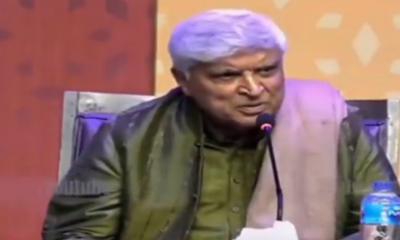
Javed Akhtar’s remarks on 26/11 terrorist at event in Pakistan goes viral, says terrorists still roam free | Watch

As per the reports, Javed Akhtar was speaking at a festival in Lahore which was organized to honor the late revolutionary poet Faiz Ahmed Faiz.

Published

on

Javed Akhtar

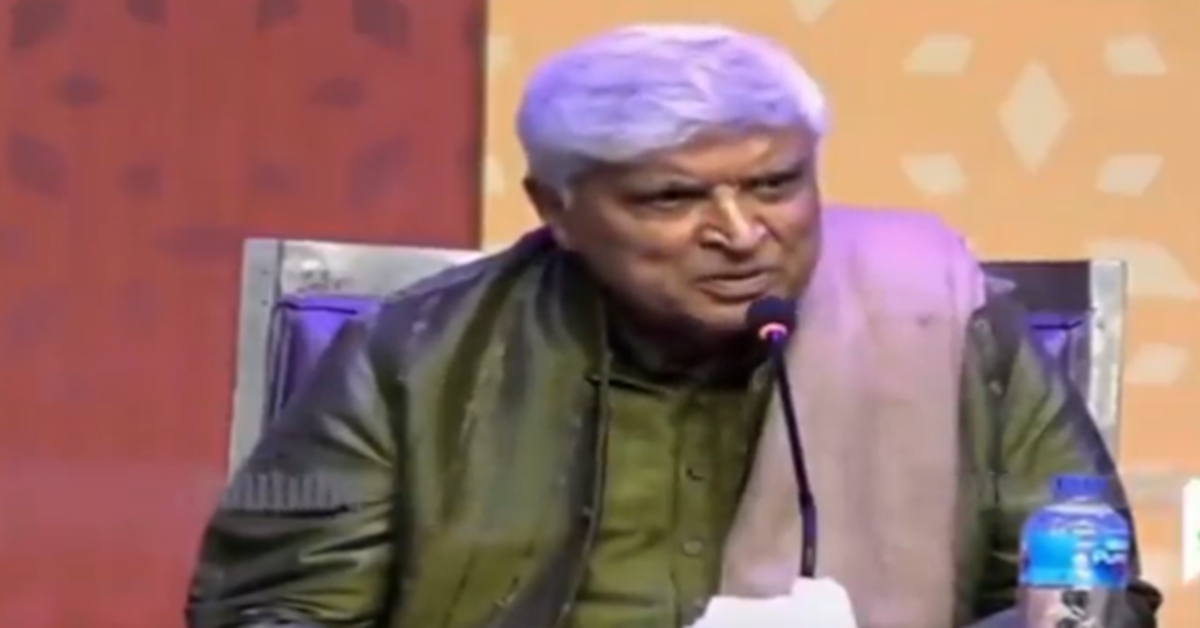
Renowned poet and writer Javed Akhtar while speaking at a festival in Pakistan’s Lahore last week talked about the 26/11 terrorist attack in India’s Mumbai and curtly questioned the country saying that the terrorists are still roaming free in the country. The video of the event has been making rounds as many users rushed in to laud Akhtar on his remarks.

As per the reports, Javed Akhtar was speaking at a festival in Lahore which was organized to honor the late revolutionary poet Faiz Ahmed Faiz. During the interaction at the event, Akhtar spoke on pacifying tensions between the two neighboring countries and also spoke about how Pakistan shouldn’t blame Indians for being angry and raked up the 26/11 attack in India.
Javed Akhtar was responding to the question that was asked by an audience member who had asked him when he returns to India, does he tell the people that the people of Pakistan greet him with garlands and love.

After hearing out the question, Akthar said that when Faiz Ahmed Faiz visited, he was received and treated like an important visitor in India. He further named Nusrat Fateh Ali Khan and Mehdi Hasan who were part of the various events in India.

Read Also: Haryana Muslim men killing: 3 of 5 accused were police informers in cow smuggling cases, claims report

Javed Akhtar further highlighted and said that however, the neighboring country never invited Lata Mangeshkar and other actors to perform. The renowned poet further urged the audience member to not turn hostility towards each other as it won’t solve the problem and the tensions between the two countries continue to prevail.

Akhtar in his interaction also added and said that he is from Mumbai and saw the attack in his city, implying at the 26/11 attack. The poet further said that the attackers did not come from Norway or Egypt and suggested that the terrorists are still roaming free in Pakistan.

He also said the anger in people against Pakistan is justifiable.

See video here:

https://twitter.com/ashoswai/status/1627943718060756998?s=20

The remarks by the renowned poet was lauded by many Indians who dubbed Akhtar’s comments as even a surgical strike. Even actor Kangana Ranaut chimed in to praise the renowned poet on how he dealt with the situation.

Ladakh sets Guinness record for world’s highest frozen lake half marathon at Pangong

Turkey and Syria witnesses another earthquake of 6.4 magnitude weeks after fatal quake

India News

Protests outside Bangladesh High Commission in Delhi over lynching of Hindu youth in Bangladesh

Protests broke out outside the Bangladesh High Commission in Delhi following the lynching of a Hindu youth in Bangladesh’s Mymensingh, with demonstrators demanding justice and accountability.

Published

on

Protests outside Bangladesh High Commission in Delhi over lynching of Hindu youth in Bangladesh

A large protest was held outside the Bangladesh High Commission in New Delhi following the lynching of a Hindu man, Dipu Chandra Das, in Bangladesh’s Mymensingh district. Several demonstrators gathered near the diplomatic mission, holding placards and raising slogans while demanding justice for the victim and accountability from Bangladeshi authorities.

The protest was led by Vishwa Hindu Parishad and Bajrang Dal, who alleged a pattern of violence against Hindus and vandalism of religious sites in Bangladesh. Protesters attempted to push through police barricades, leading to clashes with security personnel. To disperse the crowd and prevent escalation, police resorted to a lathi-charge.

Slogans such as “Bharat Mata Ki Jai”, “Yunus Sarkar hosh me aao” and “Hindu hatiya band karo” were raised as tensions mounted. According to reports, protesters managed to break through at least two layers of barricading before police regained control of the situation. Some demonstrators were detained as authorities worked to clear the area and restore order.

Several protesters were also seen burning effigies of Bangladesh’s interim chief Muhammad Yunus. One protester said that remaining silent would put others at risk, while another alleged attacks on Hindus in Bangladesh. Security agencies had already been on alert and deployed police and paramilitary forces in multiple layers around the High Commission to prevent any untoward incident.

Details of lynching incident in Bangladesh

Dipu Chandra Das, a 25-year-old garment factory worker, was lynched to death by a mob in Baluka area of Mymensingh on December 18 over allegations of blasphemy. His body was later set on fire, triggering widespread outrage and condemnation. At least 12 people have been arrested in connection with the killing.

Diplomatic response from Bangladesh

Earlier, Bangladesh summoned the Indian High Commissioner, expressing concern over protests and incidents targeting its diplomatic missions in India. The Bangladesh Foreign Ministry condemned acts of violence and intimidation against diplomatic establishments, stating that such incidents threaten the safety of diplomatic personnel and undermine principles of mutual respect.

The ministry urged India to conduct a thorough investigation, prevent recurrence of such incidents and ensure security of Bangladesh’s diplomatic missions. The incidents cited included vandalism at the Bangladesh Visa Centre in Siliguri on December 22 and the protest outside the High Commission in New Delhi on December 20.

India, however, dismissed allegations of inadequate security, stating that the protest in New Delhi was brief and posed no threat to the mission. The diplomatic row has its roots in the killing of the Hindu youth in Bangladesh, which has raised international concerns about the safety of minorities.

Continue Reading

India News

Rahul Gandhi alleges institutional bias, questions electoral system during Berlin address

Rahul Gandhi alleged that India’s institutions and electoral system have been weaponised to favour the BJP, remarks that sparked a strong political response.

Published

on

Rahul-Gandhi

Leader of the Opposition in the Lok Sabha, Rahul Gandhi, has said that India’s institutional framework is facing a serious challenge and has been used to favour the ruling BJP. Speaking during an interaction at the Hertie School in Berlin, Gandhi questioned the functioning of key institutions and the electoral machinery, remarks that triggered a sharp political response from the BJP.

Gandhi said the Congress believes there is a problem with the electoral system and alleged that several institutions have been captured. Referring to investigative agencies, he claimed that bodies such as the CBI and the ED have been used as political tools. According to him, cases filed by these agencies overwhelmingly target those opposing the BJP, while leaders from the ruling party face none.

He also pointed to what he described as a stark financial imbalance between the BJP and the opposition, claiming a funding ratio of 30:1. Gandhi said this disparity reflects how institutions are being used to consolidate political power.

Opposition strategy and INDIA alliance

The Congress leader said merely pointing out problems in elections is not enough and stressed the need for the opposition to build a system of resistance that can effectively counter the ruling party. He added that the challenge now goes beyond electoral contests and is about presenting an alternative vision for the country.

On the INDIA alliance, Gandhi said the unity among opposition parties is rooted in their rejection of the ideological position of the RSS. While acknowledging that tactical contests between alliance partners will continue, he said they remain united when it comes to opposing laws they disagree with and working together in Parliament.

BJP hits back at remarks abroad

Gandhi’s comments delivered overseas drew a strong reaction from the BJP. Party president and Union minister JP Nadda accused him of speaking against India while Parliament is in session and claimed that he was undermining the country’s image at a time when the Prime Minister is receiving global recognition.

BJP spokesperson Shehzad Poonawalla also criticised Gandhi, alleging that he routinely travels abroad to defame India. He accused the Congress leader of making misleading claims about the country’s institutions and economic activity while praising China.

Continue Reading

India News

Sonia Gandhi calls weakening of MGNREGA a collective moral failure, targets Centre in op-ed

Sonia Gandhi has accused the Centre of weakening MGNREGA, calling it a collective moral failure with serious consequences for crores of working people.

Published

on

Sonia Gandhi

Congress Parliamentary Party chairperson Sonia Gandhi has sharply criticised the Central government over what she described as the steady dismantling of rights-based legislation, with a particular focus on the Mahatma Gandhi National Rural Employment Guarantee Act (MGNREGA).

In a recent opinion article published in a leading English daily, Sonia Gandhi argued that MGNREGA was envisioned as more than a welfare measure. She said the rural employment scheme gave legal backing to the constitutional right to work and was rooted in Mahatma Gandhi’s idea of Sarvodaya, or welfare for all.

Calling its weakening a serious failure, she wrote that the decline of MGNREGA represents a “collective moral failure” that will have lasting financial and human consequences for crores of working people across India. She stressed that safeguarding such rights-based frameworks is crucial at a time when, according to her, multiple protections are under strain.

Concerns raised over education, environment and land laws

Sonia Gandhi also flagged concerns beyond rural employment. Referring to education policy, she claimed that the Right to Education has been undermined following the National Education Policy 2020, alleging that it has led to the closure of around one lakh primary schools across the country.

On environmental and land-related legislation, she stated that the Forest Rights Act, 2006, was weakened through the Forest (Conservation) Rules, 2022. According to her, these changes removed the role of the gram sabha in decisions related to the diversion of forest land.

She further alleged that the Right to Fair Compensation and Transparency in Land Acquisition, Rehabilitation and Resettlement Act has been significantly diluted, while adding that the National Green Tribunal has seen its authority reduced over the years.

Warning on agriculture and food security laws

Touching upon agriculture reforms, Sonia Gandhi referred to the now-repealed three farm laws, claiming they were an attempt to deny farmers the right to a minimum support price. She also cautioned that the National Food Security Act, 2013, could face similar threats in the future.

Reiterating her central argument, she urged unity to protect statutory rights, stating that the erosion of such laws has implications that extend well beyond policy, affecting livelihoods and dignity on the ground.

Continue Reading

Trending

© Copyright 2022 APNLIVE.com