
Latest world news
Indonesia quake toll touches 131, hundreds injured, 1.5 Lac homeless


The death toll of the Sunday earthquake on the Indonesian island of Lombok has raised to131 by Wednesday while 156,000 have been forced to leave their homes, the official figures said.
The 6.9-magnitude quake triggered panic among locals and tourists on Lombok Island just a week after another quake struck the holiday island and killed 17.
According to The Jakarta Post, around 1,477 people have been severely injured in the latest quake, with tens of thousands of homes damaged, and authorities have appealed for more medical personnel and basic supplies.
Sutopo Purwo Nugroho, the spokesman of the national disaster agency, said, “We estimate the death toll of 131 will keep rising.”
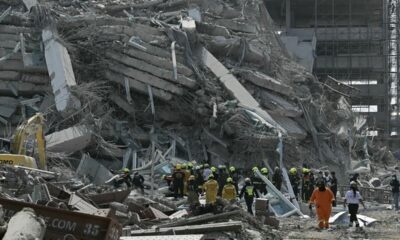
On Wednesday, rescue workers with heavy machinery resumed searching through the rubble of homes, schools and mosques with hope of finding any survivors was fading.
Muhammad Zainul Majdi, the governor of West Nusa Tenggara province which covers Lombok island has alarmed about the dire need for medical staff, food and medicine in the worst affected areas.
Read More: Indonesia Earthquake: 91 Killed, Hundreds Injured, Thousands Building Collapsed
Majdi said, “The scale of this quake is massive for us here in West Nusa Tenggara, this is our first experience.We have limited human resources. Some paramedics have to be at the shelters, some need to be mobile.”
Hundreds of injured victims have been treated outside damaged hospitals in the main city of Mataram and other affected areas..
One of the survivors Johriah said, “I saw my neighbour get stuck in the rubble and die. He asked me for help, but I couldn’t help him, we just ran to help ourselves.”
Makeshift encampments have popped up on the side of roads and rice fields, with many farmers reluctant to move far from their damaged homes and leave precious livestock behind.
Meanwhile, the Indonesian Red Cross had set up 10 mobile clinics in the north of the island and a field hospital had been established in Tanjung village.
Arifin Mohammad Hadi, the spokesman of the Red Cross said, “In some villages we visited the destruction was almost 100 percent, all houses collapsed, roads are cracked and bridges were broken”.
 Local authorities, international relief groups and the central government have begun organising aid, but shattered roads have slowed efforts to reach survivors. The Indonesian military said that three Hercules transporter planes packed with much-needed supplies have now arrived in Lombok.
On Wednesday, the rescue workers using heavy equipment have resumed search for survivors in the mosque, now reduced to a pile of concrete and metal bars, with its towering green dome folded in on itself. So far, three dead bodies and one survivor were rescued from the wreckage.











Latest world news
Magnitude 7 earthquake strikes Tibet after floods
A magnitude 7 earthquake struck northern Tibet on Thursday, October 22. The tremor came weeks after deadly flash floods and landslides hit the mountainous region near the Nepal-China border. Initial reports did not confirm casualties or damage from the earthquake.


Latest world news
Macron rejects Trump’s immigration claims over France riots
French President Emmanuel Macron criticised Donald Trump and other foreign leaders over their comments on France’s recent unrest. Macron rejected claims that the country was being overrun by migrants and Islamists, calling such assertions false.

Latest world news
Marco Rubio says India and US share extraordinary alignment on key issues
US Secretary of State Marco Rubio said India and the United States share an extraordinary alignment on core issues, even though disagreements between the two countries may arise.


Punjab strike hits public services as 3 lakh employees and roadways workers protest

Two election commissioners complained against senior poll officer, RTI reveals

Om Prakash Mathur sworn in as Keralam Governor

PM Modi to inaugurate Rs 169-crore RBI data centre in Odisha on October 25

Delhi High Court rejects Neha Bora’s plea against peace bond notice

MEA responds after ITBP chief flags ongoing face-offs with China in Arunachal
Delhi High Court rejects Neha Bora’s plea against peace bond notice
PM Modi to inaugurate Rs 169-crore RBI data centre in Odisha on October 25
Om Prakash Mathur sworn in as Keralam Governor
Two election commissioners complained against senior poll officer, RTI reveals

Afghan Men Try To Hang With The Jet Engine Of The Aircraft in Kabul- Afghanistan News – Kabul News
Trending Top 10 News: 10000 Crore Fine on Flipkart, Apple to Launch Unique Feature, Hdfc Bank Job Ad

Trending Top 10 News: Nokia 6310, Apple sales, Bachpan ka Pyar Video Kid, Dainik Bhaskar IT Raid

Trending Top 10 News: Canada bans Indian flights, Rain in Delhi NCR, AIMIM Twitter hacked, Raj Kundra case

Trending Top 10 News: Shein India, Apple New Service, Pocket Oxygen, Oppo Launched New Phone
-
 India News19 hours ago
Punjab strike hits public services as 3 lakh employees and roadways workers protest
-
 India News19 hours ago
Two election commissioners complained against senior poll officer, RTI reveals
-
 India News8 hours ago
Om Prakash Mathur sworn in as Keralam Governor
-
 India News7 hours ago
PM Modi to inaugurate Rs 169-crore RBI data centre in Odisha on October 25
-
 India News6 hours ago
Delhi High Court rejects Neha Bora’s plea against peace bond notice
-
 India News6 hours ago
MEA responds after ITBP chief flags ongoing face-offs with China in Arunachal
