English हिन्दी
Connect with us

Latest world news

Islamists prevail in Pakistan, force law minister Zahid Hamid to resign

Published

on

Islamists-Faizabad-protest

[vc_row][vc_column][vc_column_text]Tehreek-e-Labaik Ya Rasool Allah, other Islamic groups had laid siege on Islamabad last week protesting against a ‘blasphemous’ amendment to the Elections Act

Late on Sunday night, Pakistan’s Federal law minister Zahid Hamid resigned from office; a decision that is likely to pave the way for ending a week-long siege of the country’s capital, Islamabad, by hard-line Islamist groups who have been protesting against a now-abandoned ‘blasphemous’ amendment to the Elections Act, 2017.

Hamid’s resignation was a key demand put forth by the protestors – led by the hitherto little-known hard-line group Tehreek-e-Labaik Ya Rasool Allah Pakistan (TLYR) – as a pre-condition for ending their agitation, which had turned violent and claimed six lives while leaving over 200 injured through the weekend.

The standoff had begun between the government and protestors over a recent amendment to the Elections Act, which sought to alter the ‘Finality of Prophethood’ declaration that electoral candidates in the country have to mandatorily make while being sworn-in.

Although the government had hastily abandoned the amendment, with some sections having even declared it as a ‘clerical error’, the protestors had continued their agitation and pressed for Hamid’s resignation as the first condition for restoration of normalcy.

The TLYR has claimed that Hamid oversaw the introduction and passage of the Elections Amendment Bill 2017, which altered the text of a form that candidates contesting elections need to sign. The candidates were earlier expected to “solemnly swear” that they believe Muhammad was Islam’s last prophet. The new amended form – now abandoned – asked candidates to swear that they “believe” in the finality of Muhammad’s prophethood – an issue of semantics that the hardliners felt was the Pakistan government’s ‘softening’ of stance against the Ahmadiyya sect of Islam – a persecuted minority group who many in the Islamic country don’t consider to be Muslims.

While a detailed statement by Hamid is still awaited, his fleeting comments have been flashed by media organisations in Pakistan in which he has claimed that the contentious amendment was not his handiwork but one that was “formulated by a parliamentary committee comprising members belonging to all political parties.”

Hamid told Pakistan’s Geo TV that he was “not directly responsible for the introduction of the controversial amendment to the Finality of Prophethood declaration for electoral candidates” but that he had decided to step down from his office of the Federal law minister “in order to restore peace in the country.”

Pakistan’s leading media organisation Dawn said in a report: “The minister’s resignation comes in the aftermath of Saturday’s botched operation against protesters at Faizabad and ‘successful negotiations’ with leaders of the demonstration late on Sunday night”.

With Hamid resigning, evidently under pressure from the Islamists, TLYR leader Khadim Hussain Rizvi addressed a press conference at the Faizabad Interchange protest site in Islamabad and ordered his followers across Pakistan to end the sit-ins and go home. He also announced an end to the strike being observed on Monday and called for opening businesses and shops.

Rizvi declared that the Islamist protesters camping at the Faizabad Interchange will depart from the protest site within 12 hours, as soon as implementation of the agreement reached with the government is started.

The TLYR leader claimed that Pakistan’s Army Chief Qamar Javed Bajwa and Major General Faiz Hameed had acted as guarantors for the agreement between the protestors and the federal government.

A report by Dawn said that according to a document circulating among journalists that bears signatures of the protest leaders and Pakistan’s Interior Minister Ahsan Iqbal, among others, the federal government has agreed to the following demands put forth by the TLYR in order to end the sit-in:

  1. Remove Federal Law Minister Zahid Hamid from his position immediately. “Tehreek-i-Labaik will issue no fatwa [religious decree] of any kind against him.”
  2. The report prepared by Raja Zafarul Haq-led committee will be made public within 30 days and whoever is named in the report for being responsible for the change in the election oath will be acted against under the law.
  3. All protesters arrested between November 6 until the end of the sit-in from across the country will be released within one to three days according to legal requirements. The cases registered against them and the house arrests imposed on them will be ended.
  4. An inquiry board will be established to probe and decide what action to take against the government and administration officials over the operation conducted by security forces against protesters on Saturday, November 25. The inquiry should be completed within 30 days and action will be taken against those found responsible.
  5. The federal and provincial governments will determine and compensate for the loss of government and private assets incurred from November 6 until the end of the sit-in.
  6. The points already agreed to concerning the Government of Punjab will be fully implemented.

[/vc_column_text][/vc_column][/vc_row]

Latest world news

US ends oil sanctions waiver for Iran and Russia, impact likely on India’s energy imports

The US decision to end the Iran and Russia oil waiver may impact India’s oil imports, fuel prices and global energy markets.

Published

on

US oil tanker

The United States has decided not to extend a temporary sanctions waiver that allowed limited trade in Iranian and Russian oil, marking a shift towards stricter enforcement of economic restrictions.

The waiver, introduced in March 2026, had permitted the sale of oil already loaded on ships to stabilise global supply during heightened geopolitical tensions. However, it is now set to expire around mid-April without renewal.

US officials have indicated that the move is part of a broader strategy to increase pressure on both Iran and Russia amid ongoing conflicts and geopolitical tensions.

What the waiver did and why it mattered

The short-term waiver allowed millions of barrels of oil—estimated at around 140 million barrels—to enter global markets, helping ease supply shortages and prevent sharp price spikes.

It also enabled countries like India to purchase discounted crude oil from Russia and resume limited imports from Iran after years of restrictions.

Impact on India

India, one of the world’s largest oil importers, is expected to feel the impact of the decision in several ways:

  • Reduced access to discounted oil
    India had been buying cheaper Russian crude and recently resumed Iranian imports under the waiver. Its end may limit these options.
  • Potential rise in fuel costs
    With fewer discounted supplies available, India may need to rely more on costlier sources, which could increase domestic fuel prices.
  • Supply diversification pressure
    India may need to explore alternative suppliers in the Middle East, Africa, or the US to maintain energy security.
  • Geopolitical balancing challenge
    The move adds pressure on India to align with US sanctions while managing its own economic interests.

Global energy market concerns

The end of the waiver comes at a time when global oil markets are already under stress due to conflict in West Asia and disruptions in key routes like the Strait of Hormuz.

Analysts warn that tightening sanctions could:

  • Reduce global oil supply
  • Increase price volatility
  • Intensify competition among major buyers like India and China

Bigger picture

The US decision reflects a broader shift from temporary relief measures to stricter enforcement of sanctions, even if it risks tightening global energy markets.

For India, the development highlights a recurring challenge—balancing affordable energy access with geopolitical realities.

Continue Reading

Latest world news

Sanctioned tanker fails to breach US blockade, turns back near Strait of Hormuz

A US-sanctioned tanker failed to cross the Hormuz blockade and turned back, underscoring rising tensions and disruption in global shipping routes.

Published

on

A US-sanctioned oil tanker failed to break through a newly imposed American naval blockade and was forced to turn back near the Strait of Hormuz, highlighting growing tensions in the region.

The vessel, identified as the Rich Starry, reversed its course after attempting to exit the Gulf, according to shipping data. The development comes just days after the United States enforced restrictions on ships linked to Iranian ports.

The blockade was announced by Donald Trump following the collapse of recent diplomatic talks with Iran. The move aims to restrict maritime traffic associated with Iranian trade.

Officials said that during the first 24 hours of enforcement, no vessel successfully crossed the blockade. Several ships, including the sanctioned tanker, complied with instructions from US forces and turned back toward regional waters.

The tanker is reported to be linked to a Chinese company previously sanctioned for dealing with Iran. It was carrying a cargo of methanol loaded from the United Arab Emirates at the time of the incident.

The situation underscores the rising risks in one of the world’s most critical oil transit routes. The Strait of Hormuz typically handles a significant share of global energy shipments, but traffic has sharply declined due to ongoing geopolitical tensions.

The blockade, which applies specifically to vessels travelling to or from Iranian ports, has added further uncertainty for shipping companies, insurers and global energy markets.

Continue Reading

Latest world news

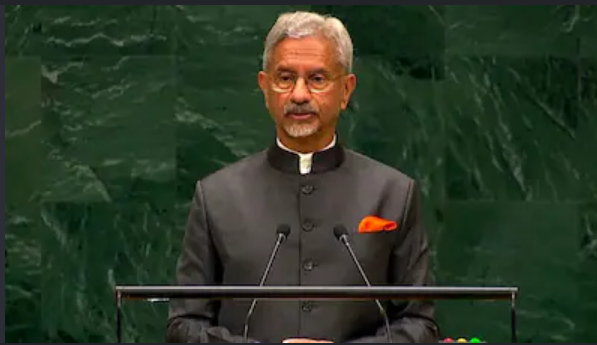
Jaishanakar discusses Middle East crisis with Kuwait and Singapore counterparts, focus on Indian community

Jaishankar holds talks with Kuwait and Singapore counterparts on West Asia tensions, highlights Indian community safety.

Published

on

India’s External Affairs Minister S. Jaishankar held discussions with his counterparts from Kuwait and Singapore amid the ongoing crisis in West Asia, focusing on regional developments and the safety of Indian nationals.

In separate telephonic conversations, Jaishankar exchanged views with Kuwait’s Foreign Minister Sheikh Jarrah Jaber Al-Ahmad Al-Sabah and Singapore’s Foreign Minister Vivian Balakrishnan. The discussions come at a time of heightened tensions in the Middle East region.

According to details shared by the minister, his conversation with the Kuwaiti counterpart primarily revolved around the evolving regional situation and the well-being of the Indian community residing in Kuwait.

He described the interaction as a constructive exchange, highlighting India’s continued attention to the safety and interests of its citizens abroad during the crisis.

In a separate interaction with Singapore’s foreign minister, Jaishankar said the two sides discussed the ongoing conflict in West Asia and its broader implications.

The talks reflect India’s ongoing diplomatic engagement with key global partners as tensions in the Middle East continue to escalate, impacting regional stability and international concerns.

The latest outreach is part of a series of high-level communications by India aimed at closely monitoring developments in the region while safeguarding its strategic and humanitarian interests.

Continue Reading

Trending

© Copyright 2022 APNLIVE.com