English हिन्दी
Connect with us

Latest world news

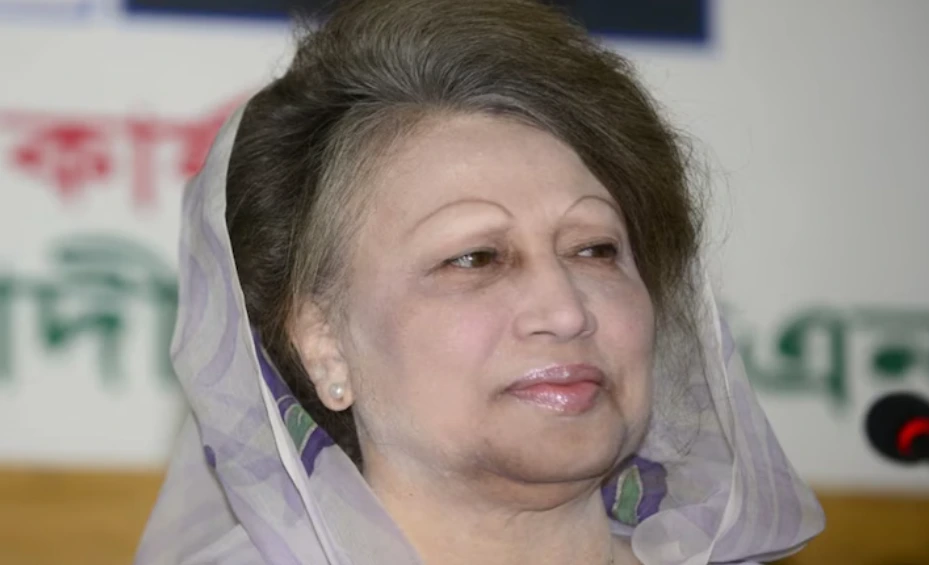
Khaleda Zia, former Bangladesh prime minister and BNP chief, dies at 80

Former Bangladesh prime minister and BNP chief Khaleda Zia died at 80 after a prolonged illness, marking the end of an era in Bangladeshi politics.

Published

on

Khalida zia

Bangladesh’s former Prime Minister and Bangladesh Nationalist Party (BNP) chairperson Begum Khaleda Zia passed away on Tuesday morning at the age of 80 after a prolonged illness. She died at around 6 am while undergoing treatment at a private hospital in Dhaka, the BNP said in an official statement.

Khaleda Zia had been hospitalised for over a month after being admitted with serious infections affecting her heart and lungs. She was also suffering from pneumonia and multiple long-term health complications, including liver cirrhosis, diabetes, arthritis, and chronic ailments related to her kidneys, heart, lungs, and eyesight. A team of specialists from several countries was overseeing her treatment, according to media reports.

The BNP, confirming her death, said prayers were being offered for the forgiveness of her soul and urged supporters and citizens to remember her in their prayers.

Prime Minister Modi expresses grief

Prime Minister Narendra Modi condoled Khaleda Zia’s demise, describing her as a towering political figure and Bangladesh’s first woman prime minister. In a post on X, Modi extended condolences to her family and the people of Bangladesh, noting that her contributions to the country’s development and India-Bangladesh relations would be remembered.

He also recalled a meeting with Khaleda Zia in Dhaka in 2015 and said her vision and legacy would continue to guide bilateral ties between the two nations.

A political journey shaped by upheaval

Khaleda Zia formally entered politics after the assassination of her husband, former President Ziaur Rahman, in 1981. Ziaur Rahman had founded the BNP, and following his death, Khaleda Zia joined the party to hold it together during a period of uncertainty. She went on to become BNP vice-president in 1984 and its chairperson later that year.

Her rise coincided with a broader pro-democracy movement in Bangladesh. Along with Sheikh Hasina of the Awami League, Khaleda Zia played a key role in the popular uprising that ended military rule under Hossain Mohammad Ershad in 1990. Their cooperation later turned into a bitter rivalry that dominated Bangladesh’s political landscape for decades.

Three-time prime minister and key reforms

Khaleda Zia became Bangladesh’s first female prime minister after the BNP emerged victorious in the 1991 parliamentary elections. During her tenure, she introduced the parliamentary system of government, replacing the presidential model, and ensured that executive power rested with the prime minister.

She also played a role in introducing the caretaker government system to oversee free and fair elections, lifted restrictions on foreign investment, and made primary education compulsory and free.

After a brief and contested second term in 1996, Khaleda Zia returned to power in 2001 with a decisive mandate, beginning her third term as prime minister. However, this phase was marked by allegations of corruption, rising militancy, and political violence, including a deadly grenade attack at an opposition rally in 2004.

Legal battles and declining health

Following political instability, an army-backed interim government took charge in 2006, and Khaleda Zia was later jailed on corruption charges. Although she was released ahead of the 2008 elections, she never returned to power.

In subsequent years, she faced multiple convictions, which she and her party described as politically motivated. Due to worsening health, she was shifted to house arrest on humanitarian grounds in 2020 and later freed in 2024 following a change in political circumstances. Earlier this year, Bangladesh’s Supreme Court acquitted her and her son Tarique Rahman in key corruption cases.

Early life and family

Born in 1945 in Jalpaiguri, then part of British India, Khaleda Zia moved to East Bengal with her family after Partition. She completed her schooling in Dinajpur and married Ziaur Rahman in 1960. She is survived by her elder son Tarique Rahman, his wife Zubaida Rahman, and their daughter. Her younger son, Arafat Rahman Koko, passed away earlier.

With her death, Bangladesh has lost one of its most influential and polarising political leaders, whose legacy shaped the country’s politics for over three decades.

Latest world news

US announces new America First visa schedule to boost business ties with India

During his official state visit to New Delhi, US Secretary of State Marco Rubio announced a new America First visa schedule designed to prioritise business professionals and boost bilateral trade efficiency.

Published

on

In a significant development aimed at strengthening bilateral cooperation, the United States has introduced a new “America First” visa schedule. The policy update was announced by US Secretary of State Marco Rubio during his official four-day visit to India. The new schedule is specifically designed to prioritise business professionals who play a key role in fortifying trade and strategic connections between the two nations.

Speaking about the initiative in the national capital, the top US diplomat clarified that the updated framework will not only assist visa applicants but will also significantly enhance operational productivity for the diplomatic mission. “We’re introducing a new America First visa schedule that prioritises business professionals that strengthen these ties,” Rubio stated. He added that the arrangement will enable the system to process applications with greater accuracy, speed, and efficiency.

Focus on Indo-Pacific and regional security

The announcement coincided with high-level discussions between the visiting diplomat and Prime Minister Narendra Modi. The meeting, which lasted for over an hour, covered critical areas of bilateral interest, including trade, energy security, strategic technologies, defence cooperation, and the ongoing West Asia crisis. During the interaction, Rubio extended an official invitation from US President Donald Trump for PM Modi to visit the White House in the near future.

The US Secretary of State described the partnership between New Delhi and Washington as a foundational cornerstone of America’s overarching strategy for the Indo-Pacific region. Highlighting India’s central role, Rubio noted that his very first official engagement upon taking office was a meeting of the Quadrilateral Security Dialogue (Quad), emphasizing that hosting the upcoming foreign ministers’ meeting in India acts as a tangible sign of the deep commitment to this framework.

Clarification on immigration rules

Addressing separate concerns regarding recent shifts in American immigration policies, the top diplomat provided a crucial clarification regarding the new guidelines for permanent residency. Media reports had previously highlighted anxieties surrounding a newly instituted rule that requires many legal immigrants to exit the US and apply for green cards from their home countries.

Rubio explicitly stated to the media that these measures are universal regulatory updates rather than policy shifts targeted at any specific nation. He reassured that the rule is applicable globally to all international applicants and is not directed exclusively at Indian citizens.

The visit marks Rubio’s first official trip to India since assuming office. His comprehensive itinerary began in Kolkata and includes a scheduled bilateral dialogue with External Affairs Minister S Jaishankar, alongside participation in the Quad Foreign Ministers’ meeting alongside international counterparts.

Continue Reading

Latest world news

High stakes for India-US ties as top American diplomat arrives for critical bilateral talks

US Secretary of State Marco Rubio has arrived in India for a vital four-day tour aimed at reinforcing bilateral cooperation amid global energy challenges, tariff disputes, and shifting regional security dynamics.

Published

on

US Secretary of State Marco Rubio has landed in Kolkata to begin an extensive four-day diplomatic tour of India, marking his first official visit to the country since assuming office. The visit arrives at a crucial juncture for bilateral relations, with both nations navigating complex global alignments, ongoing geopolitical conflicts, and shifting economic dynamics.

Upon arriving in Kolkata, the top diplomat broke a 14-year hiatus since a US secretary of state last traveled to the eastern metropolis. Accompanied by his wife, Jeanette D. Rubio, and the US Ambassador to India, Sergio Gor, the delegation commenced the tour by visiting the Missionaries of Charity headquarters, the historical Mother House founded by Mother Teresa.

Strategic energy shifts and regional security on the table

The four-day visit carries elevated strategic significance as the two major global partners look to address critical geopolitical challenges. Headlining the bilateral talks are the economic ripples of the US-Iran war, particularly its immediate fallout on international energy security and commercial trade routes.

The energy partnership remains a key focal point. While India continues to procure substantial volumes of discounted Russian crude oil to stabilize its domestic market, Washington is actively attempting to diversify New Delhi’s energy footprint by expanding American liquefied natural gas (LNG) and crude exports to the South Asian nation. Additionally, the leadership will deliberate on resolving recent trade frictions arising from tariffs imposed by the US on Indian goods.

Strengthening the bilateral roadmap

Prior to starting his engagements, the Secretary of State underlined the strength of the relationship, characterizing India as an invaluable partner and ally with whom Washington shares a robust and extensive collaborative framework. The visit serves as a top-level initiative to stabilize and accelerate the momentum of the bilateral partnership, backed by the personal investment of both US President Donald Trump and Prime Minister Narendra Modi.

The diplomat’s packed itinerary includes a high-profile meeting with Prime Minister Narendra Modi, followed by extensive bilateral discussions with External Affairs Minister S. Jaishankar. Furthermore, the tour will culminate in New Delhi, where the Secretary of State will join regional partners for a meeting of the Quad foreign ministers. Cultural stops in Agra and Jaipur are also scheduled during the four-day visit.

Continue Reading

Latest world news

India and Cyprus elevate bilateral ties to strategic partnership with six new agreements

India and Cyprus have officially upgraded their ties to a Strategic Partnership. Following wide-ranging talks between PM Modi and President Christodoulides, the two nations signed six key pacts spanning defence, cybersecurity, counter-terrorism, and higher education.

Published

on

In a major diplomatic milestone, India and Cyprus have officially upgraded their bilateral relations to a “Strategic Partnership.” Prime Minister Narendra Modi and Cyprus President Nikos Christodoulides held extensive discussions at Hyderabad House, focusing on deepening collaboration across defence, trade, technology, connectivity, and education.

Following the high-level talks, the two nations signed six pivotal agreements and Memorandums of Understanding (MoUs) designed to institutionalize and scale up cooperation across multiple critical sectors.

Driving Security and Defence Synergies

A central highlight of the summit was the focus on national security and regional stability. The two countries announced a comprehensive Defence Cooperation Roadmap spanning 2026–2031, aimed at advancing military exchanges, joint training, and strategic exercises. To address emerging digital threats, a dedicated Cybersecurity Dialogue was established along with an institutional framework for consular discussions.

The security architecture was further strengthened with the formal setup of a Joint Working Group on counter-terrorism. Additionally, a technical arrangement was concluded between the Larnaca Joint Rescue Coordination Center of Cyprus and India’s Ministry of Defence to streamline official coordination for search and rescue operations.

Building Economic and Educational Bridges

On the economic front, Prime Minister Modi highlighted that Cyprus remains one of India’s top ten investors, with inbound investment nearly doubling over the past decade. He noted that the upcoming India-EU Free Trade Agreement opens up massive avenues, setting a bilateral target to double these investments again over the next five years. Furthermore, Cyprus announced its decision to join the Indo-Pacific Oceans Initiative, aligning itself under the pillar dedicated to trade, connectivity, and maritime transport.

In tech and innovation, an MoU was signed between India’s Ministry of Electronics and Information Technology and Cyprus’s Deputy Ministry of Research, Innovation and Digital Policy. The two sides also emphasized human capital by signing a pact for collaboration in higher education and research.

Enhancing Cultural and Diplomatic Bonds

To foster closer diplomatic ties, an agreement was signed between India’s Sushma Swaraj Institute of Foreign Service and the Diplomatic Academy of Cyprus for joint training cooperation. To protect and celebrate heritage, a cultural cooperation agreement was also inked to guide institutional exchange for the period 2026–2030.

Speaking at a joint press conference, PM Modi termed the relationship “future-oriented” and built on a shared commitment to democracy and the rule of law. He highlighted that Cyprus, with its strategic position, serves as a crucial gateway for Indian enterprises looking to expand into the wider European Union market.

Continue Reading

Trending

© Copyright 2022 APNLIVE.com