English हिन्दी
Connect with us

Latest world news

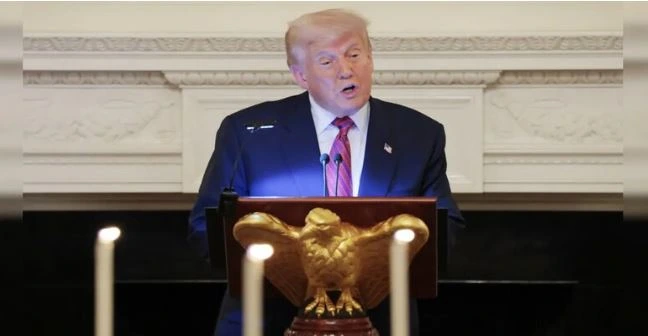
Trump slaps $100,000 fee each on H-1B visas: Huge blow for Indian tech workers

President Trump has imposed a $100,000 fee on H-1B visas, a move that could hit Indian tech professionals the hardest and reshape US immigration policy.

Published

on

In a move set to shake up the global tech sector, US President Donald Trump on Friday signed a proclamation imposing a staggering $100,000 (₹88 lakh+) fee on all new H-1B visa applications. The H-1B program, a lifeline for Indian IT professionals and US-based tech giants, will now become one of the most expensive visa routes in the world.

The White House said the fee hike aims to curb “abuse of the system” and ensure that only the “very highly skilled” enter the US job market. “We need workers, but we need great workers. This ensures companies bring in the best,” Trump remarked while unveiling the measure.

What the Rule Means

The H-1B visa allows US firms to hire foreign professionals with specialized skills, particularly in science, technology, engineering, and mathematics (STEM). It is granted for three years, extendable up to six. Indians dominate the program, making up 71% of beneficiaries last year, while China stood second at 11.7%.

But under the new rule, Indian workers will face a steep financial barrier. Each renewal—already mandatory due to Green Card backlogs—would cost another $100,000, hitting thousands of families waiting in the US immigration queue.

Tech Sector Fallout

Big Tech is expected to be among the hardest hit. Amazon, Microsoft, Meta, and other companies that collectively secure tens of thousands of H-1B visas annually may face skyrocketing costs. Reports suggest Amazon alone received approval for over 12,000 H-1B visas in the first half of 2025.

Industry experts warn this could push US firms to outsource jobs overseas, undermining Trump’s stated goal of protecting American workers.

Citizenship Test Returns

The administration is also bringing back the tougher US citizenship test Trump introduced in 2020—scrapped under Joe Biden—requiring applicants to answer 12 out of 20 questions orally from a bank of 128, focused on history and politics.

Trump’s New ‘Gold Card’ Visa

Alongside the H-1B changes, Trump unveiled a ‘Gold Card’ visa program priced at $1 million for individuals and $2 million for businesses. The scheme will target “extraordinary people at the very top,” who can create jobs and wealth in America, Commerce Secretary Howard Lutnick said.

Critics argue the dual approach—pricing out middle-class skilled immigrants while welcoming millionaires—marks a dramatic shift in US immigration priorities.

Impact on Indians

For Indian professionals, particularly those in IT services, the proclamation could be devastating. With wait times for Green Cards stretching into decades, applicants will be forced to pay renewal fees multiple times, making the US a far less viable career destination.

Immigration lawyers say many may now look to Canada, Australia, or Europe as alternatives, potentially sparking a major talent shift away from the US.

Continue Reading

Latest world news

PM Modi meets Sri Lankan President Dissanayake at AI summit, reviews connectivity agenda

PM Modi and Sri Lankan President Anura Kumara Dissanayake reviewed connectivity, AI cooperation and regional stability during talks at the AI Impact Summit in New Delhi.

Published

on

PM Modi meet sri lanka president

Prime Minister Narendra Modi on Friday held talks with Sri Lankan President Anura Kumara Dissanayake on the sidelines of the AI Impact Summit in New Delhi, reviewing the progress of bilateral initiatives and reaffirming their commitment to deepening connectivity and development cooperation.

President Dissanayake was in India to attend the India-hosted AI Impact Summit. The visit marked his second trip to India since assuming office, following his State Visit in December 2024.

Focus on connectivity and development

According to the Ministry of External Affairs, the two leaders assessed developments stemming from recent high-level engagements, including Prime Minister Modi’s State Visit to Sri Lanka in April 2025. They emphasised fast-tracking cooperation across three key pillars — physical, digital and energy connectivity — which remain central to India-Sri Lanka relations.

Both sides reiterated that improved connectivity would not only enhance economic integration but also contribute to long-term stability and prosperity in the region.

AI collaboration and inclusive growth

Technology-driven development also featured prominently in the discussions. The leaders exchanged views on leveraging artificial intelligence for developmental purposes and improving service delivery.

They agreed that responsible deployment of AI can help advance inclusive growth, particularly in developing countries, and support public service systems.

India’s support during crisis

President Dissanayake expressed appreciation for India’s assistance following Cyclone Ditwah, which caused significant damage in Sri Lanka. India, acting as a First Responder, provided emergency relief supplies and supported search and rescue operations under ‘Operation Sagar Bandhu’.

The leaders also reviewed progress under India’s USD 450 million assistance package aimed at reconstruction and infrastructure restoration in Sri Lanka. The support is intended to aid long-term recovery and strengthen economic resilience.

Cultural ties and regional cooperation

Beyond economic and strategic matters, the meeting underscored the civilisational and cultural bonds between the two countries. The successful conclusion of the Exposition of the Holy Devnimori relics in Sri Lanka was welcomed as a step that further strengthened people-to-people connections.

Both leaders agreed to continue working closely to advance sustainable development, while contributing to peace and stability in the wider Indian Ocean Region.

The meeting highlighted India’s role as both a technology partner and a regional collaborator, as New Delhi and Colombo seek to build a resilient and forward-looking bilateral partnership.

Continue Reading

Latest world news

Trump signs 10% global tariffs after US Supreme Court setback

Donald Trump has signed a new 10% global tariff order after the US Supreme Court struck down much of his earlier sweeping import duties

Published

on

donald-trump

US President Donald Trump has signed a fresh executive order imposing a 10 per cent tariff on imports from countries around the world, just hours after the Supreme Court of the United States struck down much of his earlier sweeping import duties.

The new tariffs, which Trump said will take effect “almost immediately”, are being introduced under a law that limits such measures to 150 days. Describing the move as the beginning of an “adjustment process”, the President signalled that his administration would explore alternative routes to maintain revenue from import duties.

Trump criticises top court ruling

The Supreme Court’s 6-3 decision dealt a significant blow to a key part of Trump’s economic strategy. The ruling invalidated large portions of the administration’s previous tariff framework, prompting a sharp response from the President.

In posts on Truth Social, Trump said certain members of the court “should be ashamed of themselves” and termed the judgment “deeply disappointing”. He argued that the tariff mechanism used by his administration had been “acceptable and proper” and insisted that the new order was legally sound.

Trump also claimed that his use of tariffs over the past year had contributed to economic gains, citing milestones in the stock market. He said the Dow had crossed 50,000 and the S&P had reached 7,000, levels he argued were achieved sooner than expected following his election victory.

Tariffs central to Trump’s policy push

Tariffs have remained a central pillar of Trump’s economic and trade agenda. In April, he had announced “reciprocal” taxes of up to 50 per cent on imports from countries with which the United States runs trade deficits, along with a 10 per cent baseline tariff on most other nations.

He invoked a 1977 law to declare the trade deficit a national emergency, justifying broad import taxes. However, after global backlash, the administration paused the higher reciprocal tariffs for 90 days to allow for negotiations.

According to Trump, several countries agreed to revised trade terms during that period, while others faced steeper duties. He also reiterated claims that tariffs strengthened national security and helped curb fentanyl inflows by 30 per cent when used as penalties against certain countries.

“All of those tariffs remain,” Trump said, adding that other measures would now replace those struck down by the court.

The latest order underscores escalating tensions between the White House and the judiciary, as the administration seeks to preserve a cornerstone of its trade policy while navigating legal constraints.

Continue Reading

Latest world news

India and Switzerland strengthen AI governance, trade ties at Impact Summit

India and Switzerland discussed global AI rules, trade cooperation and future summits as PM Modi met Swiss President Guy Parmelin in New Delhi.

Published

on

AI Impact summit 3455

India and Switzerland placed artificial intelligence, innovation-led growth and expanding economic cooperation at the centre of bilateral discussions as Prime Minister Narendra Modi met Swiss President Guy Parmelin on the sidelines of the AI Impact Summit in New Delhi.

President Parmelin is on a two-day visit to India to participate in the summit, with both sides describing the relationship as friendly and multifaceted. The talks took place at a time when artificial intelligence is increasingly shaping global governance debates, economic competitiveness and social transformation.

AI governance and responsible innovation in focus

Speaking after his engagements at Bharat Mandapam, President Parmelin thanked India for hosting what he described as a landmark gathering. He said artificial intelligence holds transformative potential across sectors such as education, healthcare, work and communication.

He underlined that the benefits of AI are not automatic and depend on timely policy frameworks and safeguards. According to him, governing AI responsibly can help reduce inequality and ensure that technological progress benefits broader sections of society.

The Swiss President said India and Switzerland share similar values in balancing innovation with accountability. He noted that artificial intelligence presents an opportunity to shape a more equitable technological transition than earlier industrial revolutions, provided governments act proactively.

Trade and economic partnership reviewed

Beyond AI, the two leaders reviewed the full spectrum of India-Switzerland ties, including trade and investment, science and technology, innovation, skill development, and people-to-people exchanges.

Economic cooperation featured prominently in the discussions. Both sides welcomed the momentum following the implementation of the India-European Free Trade Association Trade and Economic Partnership Agreement. Switzerland is a member of the European Free Trade Association, and the agreement is expected to boost trade and investment flows between India and EFTA countries.

President Parmelin said economic relations have gained fresh dynamism since the agreement’s rollout. He also indicated that a bilateral investment treaty could further encourage Swiss investment in India while supporting sustainable job creation.

Swiss companies are already present in sectors such as engineering, pharmaceuticals and financial services, with both governments identifying opportunities in advanced manufacturing, clean technologies and research collaboration.

Future AI summits and multilateral cooperation

Artificial intelligence remained the central theme of the engagement. Prime Minister Modi welcomed Switzerland’s decision to host the next global AI Summit in Geneva in 2027. President Parmelin said the event would reinforce Switzerland’s role in digital policy discussions and highlight Geneva’s position as a hub of international diplomacy and law.

He added that the 2027 summit would be followed by the 2028 AI Summit to be hosted by the United Arab Emirates, with Switzerland working in partnership.

Referring to previous AI-focused gatherings held in Bletchley Park, Seoul and Paris, Parmelin described the Delhi summit as part of a continuing global effort to shape common principles for AI governance.

Despite the brevity of his visit, the Swiss President said it was important to participate in discussions that would influence the shared future shaped by artificial intelligence.

The meeting reflected India’s growing role in global technology governance debates, while reinforcing Switzerland’s identity as both an innovation hub and a proponent of multilateral cooperation.

Continue Reading

Trending

© Copyright 2022 APNLIVE.com