
Latest world news
Trump: India Called Us Wanting Trade Deal despite Tough Talks


US President speaks of becoming friend with PM Narendra Modi and Japan’s Shinzo Abe
In a major twist in India-US relations, President Donald Trump has claimed that India wants a trade deal with Washington despite the tough stance taken by his administration on the issue.
According an agency report from Washington, President Trump wants to stop the subsidies that growing economies like India and China have been receiving as he wants the US to grow faster than any other nation. He often accuses India of imposing 100% tariffs on American products.
While addressing his supporters at a fund raising reception in South Dakota, Trump said, “Frankly, I’ll tell you, India called us the other day. They said they would like to start doing a trade deal, first time.” He did not mention who called from New Delhi to whom in Washington.
Trump’s remarks came few days after 2+2 meeting between the two countries. US Secretary of State Mike Pompeo and Defence Secretary James Mattis met Ministry of External Affairs Sushma Swaraj and Defence Minister Nirmala Sitharaman in New Delhi on September 6.
Read More: India, US Sign Key Defense Agreement
Donald Trump used the opportunity to praise his administration saying, “They wouldn’t talk about it with previous administrations. They were very happy with the way it was.” Trump said his trade representatives headed by Bob Lighthizer (the US Trade Representative) are very tough, smart and very good.
The United States and Japan have also started discussions over trade, he said.
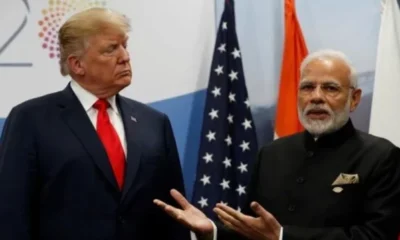
Trump said that he has become friends with foreign leaders including Prime Minister Narendra Modi and the Japanese Prime Minister Shinzo Abe. “Practically, every time a foreign leader comes in to see me, whether it’s Abe of Japan, whether it’s Modi of India, I’ve become friends with all of them,” he said.
 “You know, some of them are tough relationships because they’ve really been taken advantage of our country for many, many decades. But I’m friendly. They respect me. I respect them. They’re respecting our country again,” he said.
Read More: No guarantee to India of US sanctions waiver for Russian missiles, says Pentagon official
Referring to the latest GDP numbers, Trump said, “Think of this. One point in GDP, now when I started, it was down into low ones. President Obama had the lowest recovery since the Great Depression, so lowest, the worst recovery. It was like this. It was just terrible. And I’m not even knocking it. It was terrible.”
“We have such incredible growth. What’s happened has been very much of a miracle, but they haven’t seen the miracle yet. The miracle is going to start because now we’re getting things ready,” Trump said. He asked if countries like India and China can grow at a fast pace, why not the US?
According to the statistics available at ministry of external affairs website, India-US bilateral trade in goods and services increased from $104 billion in 2014 to $114 billion in 2016. The bilateral merchandise trade stood at $66.7 billion. India’s exports of goods to the US were valued at $46 billion and India’s imports of goods from US were valued at $21.7 billion.
Meanwhile, trade in services stood at $47.2 billion. India’s exports of services to the US were valued at $26.8 billion and India’s imports of services from US were valued at $20.3 billion.
Both the countries have committed to for increasing the bilateral trade to $500 billion.







Latest world news
Magnitude 7 earthquake strikes Russia’s Kamchatka Peninsula
A magnitude 7 earthquake struck Russia’s Kamchatka Peninsula region on Friday. The initial report placed the earthquake at a depth of 140 kilometres.


Latest world news
S Jaishankar says India is a natural option for Russia amid Europe tensions
External Affairs Minister S Jaishankar said India remained a natural option for Russia as Moscow increasingly turned towards Asia amid strained relations with Europe. He highlighted the continuity of India-Russia ties and their significance for the balance of power in Asia.

Latest world news
Putin praises PM Modi, says he has very good ideas on Ukraine war
Russian President Vladimir Putin has praised Prime Minister Narendra Modi for repeatedly raising the need to end the Ukraine war, describing his ideas for a settlement as “very good”.

Mallikarjun Kharge’s ‘Your Friends’ jab at Rahul Gandhi over congress exits

Magnitude 7 earthquake strikes Russia’s Kamchatka Peninsula

Delhi deploys 25,000 personnel, installs CCTV cameras ahead of CJP march

Abhijeet Dipke detained ahead of CJP’s national flag march in Delhi

Mallikarjun Kharge seeks all-party meeting with PM Modi on delimitation

Centre sends 3 letters to Punjab government after anti-drug activist’s killing
Mallikarjun Kharge seeks all-party meeting with PM Modi on delimitation
Abhijeet Dipke detained ahead of CJP’s national flag march in Delhi
Magnitude 7 earthquake strikes Russia’s Kamchatka Peninsula
Delhi deploys 25,000 personnel, installs CCTV cameras ahead of CJP march

Afghan Men Try To Hang With The Jet Engine Of The Aircraft in Kabul- Afghanistan News – Kabul News
Trending Top 10 News: 10000 Crore Fine on Flipkart, Apple to Launch Unique Feature, Hdfc Bank Job Ad

Trending Top 10 News: Nokia 6310, Apple sales, Bachpan ka Pyar Video Kid, Dainik Bhaskar IT Raid

Trending Top 10 News: Canada bans Indian flights, Rain in Delhi NCR, AIMIM Twitter hacked, Raj Kundra case

Trending Top 10 News: Shein India, Apple New Service, Pocket Oxygen, Oppo Launched New Phone
-
 India News14 hours ago
Mallikarjun Kharge’s ‘Your Friends’ jab at Rahul Gandhi over congress exits
-
 Latest world news14 hours ago
Magnitude 7 earthquake strikes Russia’s Kamchatka Peninsula
-
 India News14 hours ago
Delhi deploys 25,000 personnel, installs CCTV cameras ahead of CJP march
-
 India News5 hours ago
Abhijeet Dipke detained ahead of CJP’s national flag march in Delhi
-
 India News3 hours ago
Mallikarjun Kharge seeks all-party meeting with PM Modi on delimitation
-
 India News2 hours ago
Centre sends 3 letters to Punjab government after anti-drug activist’s killing
