English हिन्दी
Connect with us

Latest world news

All smoke and mirrors

Published

on

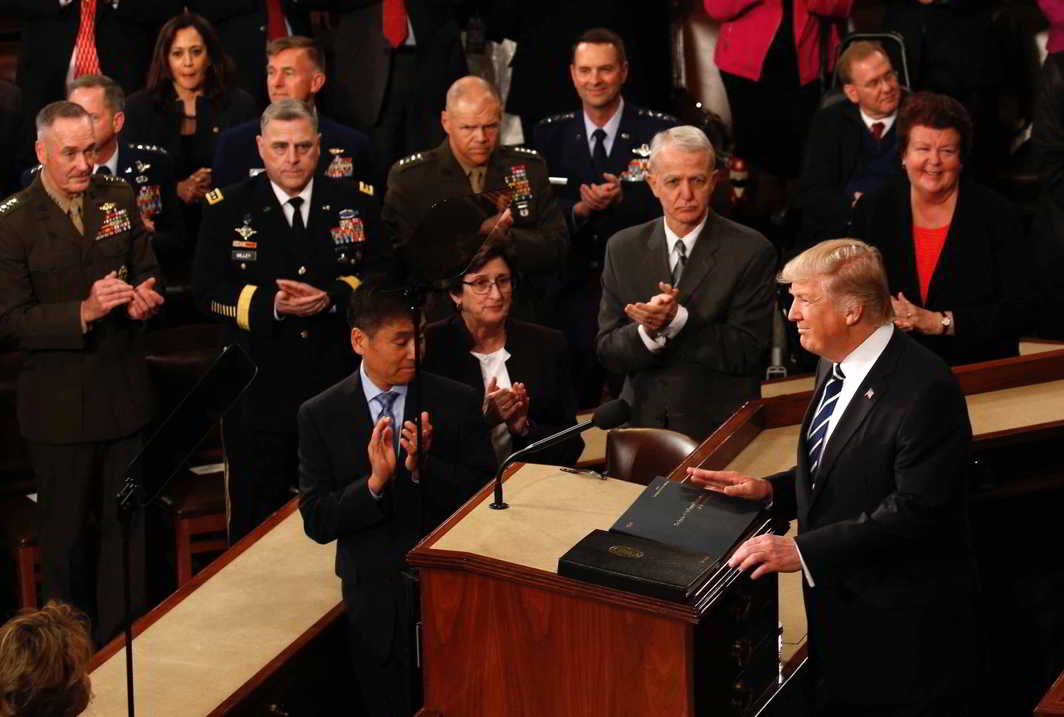
US President Trump addresses the joint session of Congress on February 28, Reuters/UNI

[vc_row][vc_column][vc_column_text]A look at the key points of President Donald Trump’s first speech to the United States Congress and some meditations as to their merit

By Sujit Bhar

US President Donald Trump, in his first address to the Congress on the last day of February, made some specific points. Most still reflected his somewhat strange political beliefs, while some need reflection in a plane mirror. 

Here are our retorts to the highlights of the speech.

– “Recent threats targeting Jewish cemeteries as well as last week’s shooting at Kansas remind us that we are a nation that stands united in condemning hate and evil in all of its very ugly forms.”
Good, but Mr Trump quietly forgot to add that this should include even race-hate related crimes committed by White Supremacists as happened in the Kansas shooting of two Indians (as well as an American). The problem, Mr Trump, is that these hate criminals have risen through their belief in your exhortations. Would you have the courage to tackle the source?

“We’ve defended the borders of other nations, while leaving our own borders wide open, for anyone to cross.”
Agreed. There are too many armies of people walking into the US and attacking locals, taking away their jobs and creating mayhem in the US. But wait a second… anybody and everybody crossing into the US? It used to happen in places like the Republic of Congo and Angola when white armies were marching in. It happens in the US now? And, for the record, exactly which country’s borders does the US defend?

“America must put its own citizens first. Because only then, can we truly MAKE AMERICA GREAT AGAIN.”
Again, agreed that Americans were so great they put the citizens of all other countries first. Remember the delay in joining the war against one Adolf Hitler? And, then, remember how Americans were putting the citizens of Vietnam and Cuba and Guatemala first? They were ignoring poor Americans every time. This is payback time.

“Dying industries will come roaring back to life. Heroic veterans will get the care they so desperately need.”
Let me see if I’m getting this right. American industries—steel mills, and sugar mills and cotton yarn mills and motor car factories and computer hardware factories will all be back, hire only Americans, at American wage rates, sell to Americans only (at those prices nobody else will be able to afford them) and it will be La La Land, all over again. Right?

“Our neglected inner cities will see a rebirth of hope, safety, and opportunity.”
Agreed, again. This town in Kansas, Olathe, means “beautiful” in Shawnee. Neglected? Hear this: In 2008 the US Census Bureau ranked the city as the 24th fastest-growing in all of US. And CNN/Money and Money magazine ranked it No. 11 on its list of the “100 Best Cities to Live in the United States.” None talked about predatory White Supremacist ex-military personnel living there, ready to shoot down “foreigners” especially if they looked like “Iranians”. So what if they are highly educated Indians instead? Has this anything to do with your aversion to H1B visa holders?

“The stock market has gained almost three trillion dollars in value since the election on November 8th, a record.”
This is great. Way to go, Mr Trump. Your new economic and social policies… wait a second. What economic and social policies? You have some? And I thought all the industries that make the tech-heavy indices move have all voted against you. Haven’t they? So which industries have moved? Well, okay, you have appointed Rex Tillerson as your Secretary of State. Yes, that’s the reason. Yeah.

“We have placed a hiring freeze on non-military and non-essential Federal workers.”
Great, weren’t you supposed to generate more employment? Wasn’t that your campaign speech rhetoric? We thought job creation was going at a pretty fast clip in the late Barack Obama administration.

– “We have begun to drain the swamp of government corruption by imposing a 5-year ban on lobbying by executive branch officials.”
Great. There will be no lobbying any more. In India we, too, have no lobbying. It is bad karma. Some say your top appointees were the greatest lobbyists and political influencers in the US. We understand there aren’t any more left. Good for you.

“We have cleared the way for the construction of the Keystone and Dakota Access Pipelines.”
Of course. America needs the oil it deserves, and to hell with the environment. And remember, there are billions of gallons more in Alaska.

“We have withdrawn the United States from the job-killing Trans-Pacific Partnership.”
That’s good. But job-killing? The partnership had not even laid out formal plans, nothing had started, nobody had been hired, and already jobs were being lost? That was bad.

– “To protect our citizens, I have directed the Justice Department to form a Task Force on Reducing Violent Crime.”
That task force is expected to comprise Whites only? Homogeneity is a good thing.

“We will stop the drugs from pouring into our country and poisoning our youth.”
Yes, that’s why you are building that wall. The simple, hardworking, family-minded White youths of America were being poisoned by all those “foreigners”. No wonder Adam Purinton shot down Srinivas Kuchibhotla in Olathe. If you aren’t White, you are either a terrorist or a drug dealer.

– “We will soon begin the construction of a great, great wall along our southern border.”
Finally, the wall. Let’s give you a tip. In India we have this project called MNREGA, where people dig trenches for nothing and get paid for it. Make your people rig the walls, then pay them good salaries and benefits. You will suddenly find a great number of walks to build, a great many years of huge employment.

“We are also taking strong measures to protect our nation from Radical Islamic Terrorism… It is not compassionate, but reckless, to allow uncontrolled entry from places where proper vetting cannot occur… Those given the high honor of admission to the United States should support this country and love its people and its values… We cannot allow our nation to become a sanctuary for extremists.”
Well, you have already tried the Travel Ban. We hear you are dropping Iraq in the new, improved Ban coming up. In India our Honourable Prime Minister Naredra Modi is saying the same things. Within the walls of the country, however, hate crimes are growing. We need to love our country more. We love Hindus in India, you love Whites in the US. So what’s the problem?

“As promised, I directed the Department of Defence to develop a plan to demolish and destroy ISIS.”
Err… Mr Trump, we thought you had said you already HAD a secret plan? Why not share that with the Department of Defence?

“In the last 8 years, the past Administration has put on more new debt than nearly all other Presidents combined.”
Finally, you are right. Even when the government had no funds – it stopped, remember? – Obama had to spend. This is one point you really got right.

“Our trade deficit in goods with the world last year was nearly $800 billion.”
Yes, yes, the Chinese, remember? Dump your inexpensive products in China now. Let them suffer. Oh, sorry, you cannot produce in bulk, inexpensively.

– “Right now, American companies are taxed at one of the highest rates anywhere in the world.”
That’s why they have offices in places like Ireland, where they hardly tax you. The US has been okay with this for a long time.

– “Harley Davidson told me it’s hard to do business with others because other nations tax their motorcycles at 100 per cent. They didn’t ask for a change but I AM!
The world deserves Harleys at cheap prices. I agree. These are necessities. Like you export high-priced cancer drugs.

The rest were repetitions of the same, in different words – as per reality TV lingo, they then become different subjects. But we should stop somewhere.[/vc_column_text][/vc_column][/vc_row]

Latest world news

H-1B visa renewal delays leave hundreds of Indian workers stranded amid US social media checks

Hundreds of Indian H-1B visa holders remain stranded after US consular interviews were delayed due to enhanced social media screening.

Published

on

visa apply

Hundreds of Indian professionals holding H-1B visas are facing unexpected uncertainty after travelling to India for routine visa renewals, only to find their US consular interviews postponed to next year due to a new social media vetting policy introduced by the US administration

Many of these workers had scheduled appointments between December 15 and 26, a window that coincided with the US holiday season. However, interviews planned for mid to late December have now reportedly been pushed to as late as March, leaving employees unable to return to their jobs in the United States.

Appointments postponed without clarity

Immigration law firms say they are dealing with a large number of affected clients. Some attorneys have described the situation as unprecedented, highlighting the lack of clarity around how long the delays may last. Workers who travelled for personal reasons, including family events, now face the risk of prolonged stays in India while their employment continues overseas.

In one reported case, a US-based professional who returned to India this month had two consular appointments scheduled in December, both of which have since expired. Experts have raised concerns over how long US employers may be willing to wait for employees whose return timelines remain uncertain.

US embassy advisory and vetting policy

Earlier this month, the US Embassy in India issued an advisory stating that applicants who arrive at a consulate on a previously scheduled interview date, after being informed of a reschedule, will not be allowed entry. Applicants have been asked to wait for their new appointment dates.

According to official communication, the delays are linked to enhanced social media screening. The policy requires visa applicants to keep their social media profiles public so authorities can assess whether any applicant poses a risk to national security or public safety. While such scrutiny earlier applied to students and exchange visitors, it has now been extended to H-1B and dependent H-4 visa applicants.

Impact on Indian professionals and tech firms

India accounts for nearly three-fourths of all H-1B visa holders, according to data released earlier this year by US immigration authorities. The current delays therefore have a disproportionate impact on Indian professionals working in the US technology and services sectors.

Some US-based technology companies have reportedly cautioned employees against international travel after learning that visa re-entry processing delays at American embassies and consulates could stretch for several months. Legal advisers have warned that overseas travel at this stage could result in extended stays outside the US.

Growing scrutiny of the H-1B programme

The social media vetting requirement is part of a broader tightening of the H-1B programme under the Donald Trump administration. The skilled worker visa pathway has faced increased scrutiny in recent months, including the imposition of a one-time fee on new H-1B visas. The US has also paused certain immigration applications from select countries following security-related concerns.

For now, affected workers and their employers are left waiting, as uncertainty continues over when regular visa processing timelines will resume.

Continue Reading

Latest world news

Hindu man lynched and set on fire in Bangladesh during anti-India protests

A Hindu man was lynched and set on fire in Bangladesh’s Mymensingh district amid rising anti-India protests after the death of a radical student leader.

Published

on

Hindu man set to fire in Bangladesh

A disturbing incident of mob violence against a minority community has been reported from Bangladesh, where a Hindu man was lynched and his body set on fire amid escalating anti-India protests following the death of a radical student leader.

Mob lynching reported from Mymensingh district

A 30-year-old Hindu man, Dipu Chandra Das, was lynched by a mob in Bhaluka Upazila of Mymensingh district after allegations surfaced that he had insulted Islam. According to media reports, the incident took place on Thursday night at an industrial area where Das was employed.

Das was accused of making derogatory remarks about Islam and Prophet Muhammad during an event organised at his workplace to mark World Arabic Language Day. The allegations spread rapidly within the factory premises and nearby areas, leading to heightened tension.

Eyewitness accounts cited in media reports said Das was assaulted by an angry crowd and died on the spot. After his death, the mob allegedly tied his body to a tree, beat it while raising slogans, and later set it on fire.

Body burnt at multiple locations, traffic disrupted

The violence did not stop there. Reports suggest the mob later moved Das’s body to a nearby bus stand area and again set it ablaze. Subsequently, the body was taken to the Dhaka–Mymensingh highway, where it was burned once more, leading to panic among locals and a temporary disruption of traffic on the busy stretch.

Confirming the incident, the local administration said a person was killed following allegations of insulting the Prophet. Officials added that the body has been taken into police custody and the situation is being monitored.

Interim government condemns violence

The lynching took place against the backdrop of widespread protests across Bangladesh following the death of Sharif Osman Hadi, a prominent leader linked to the July Uprising. The Muhammad Yunus-led interim government strongly condemned the killing, stating that there is no place for such violence in the country.

In an official statement, the government appealed to citizens to reject hatred and violence, stressing that those responsible for the crime would not be spared.

Anti-India sentiment intensifies after Hadi’s death

Tensions have been high in Bangladesh since Hadi’s death, with protests, vandalism and arson reported in several cities. Demonstrators targeted prominent media offices and symbolic locations linked to the country’s political history.

Hadi was known for his sharp criticism of India and the former prime minister, whose government was ousted during last year’s uprising. Groups formed after the political upheaval have been actively mobilising street protests and campaigns that fuel anti-India sentiment, particularly after the former premier went into exile in India.

The lynching of Dipu Chandra Das has further raised concerns over the safety of minority communities amid the ongoing unrest in the country.

Continue Reading

Latest world news

Bangladesh rocked by violent protests after student leader Sharif Osman Hadi’s death, anti-India slogans raised

Bangladesh has witnessed widespread violence and protests following the death of student leader Sharif Osman Hadi, with arson, anti-India slogans and a nationwide security clampdown.

Published

on

Bangladesh

Violent protests erupted across Bangladesh after the death of student leader and political figure Sharif Osman Hadi, triggering fresh instability in the country and a sharp rise in anti-India sentiment. The situation turned volatile in Dhaka and several other cities as thousands of demonstrators poured onto the streets demanding swift action against those responsible for his killing.

Hadi, 32, was shot in the head by masked assailants while launching his election campaign in Dhaka last Friday. He was later airlifted to Singapore for treatment, where he succumbed to his injuries. Known for his polarising views and strong anti-India rhetoric, Hadi had emerged as a prominent face during the 2024 student uprising that led to the ouster of former prime minister Sheikh Hasina.

Fires, arson and tense streets in Dhaka

Soon after news of Hadi’s death broke, protests intensified in the Bangladeshi capital. Several buildings, including those housing leading media organisations, were set on fire, with authorities confirming that staff members were trapped inside during the blaze. Fire services later said the situation was brought under control, while security forces were deployed in large numbers to prevent further violence.

Demonstrators were seen chanting slogans invoking Hadi’s name, vowing to continue protests until those behind the attack were arrested. Multiple areas in Dhaka remained tense late into the night as police and paramilitary units attempted to restore order.

Protests spread, Indian mission targeted in Chittagong

Violence was not limited to the capital. In the port city of Chittagong, protesters gathered outside the Indian Assistant High Commission, raising anti-India slogans amid heightened anger on the streets. Similar unrest was reported from other parts of the country, signalling the widening scale of the crisis.

In Rajshahi, demonstrators torched Bangabandhu Sheikh Mujibur Rahman’s residence and an Awami League office, causing extensive damage. Authorities have not yet released a detailed assessment of losses, but security has been tightened across sensitive locations.

Anti-India sentiment deepens diplomatic strain

The latest unrest comes amid deteriorating ties between India and Bangladesh following Sheikh Hasina’s flight to Delhi. Earlier in the week, protesters under the banner of “July Oikya” marched towards the Indian High Commission in Dhaka, demanding Hasina’s return and raising hostile slogans against India.

India has formally conveyed its concerns to Dhaka over threats to its diplomatic missions and inflammatory statements by Bangladeshi political figures. New Delhi has rejected allegations linking India to the attack on Hadi, calling such claims false and misleading.

Yunus calls for calm, state mourning announced

In a televised address, interim chief Muhammad Yunus described Hadi’s death as an “irreparable loss” to Bangladesh’s political and democratic space. He urged citizens to exercise restraint, warning that continued violence could derail the country’s path towards a credible election.

The interim administration has announced a day of state mourning in Hadi’s honour, with national flags to fly at half-mast and special prayers planned nationwide. Bangladesh has been under an interim government led by Yunus since August 2024, with national elections scheduled for February 12.

India issues advisory for its nationals

Amid the unrest, the Indian High Commission in Dhaka issued an advisory asking Indian nationals in Bangladesh to avoid non-essential travel and limit movement outside their residences. Emergency contact details of Indian missions have been shared for assistance.

Manhunt launched for attackers

Bangladesh police have launched a manhunt for those behind Hadi’s killing, releasing photographs of two suspects and announcing a reward of five million taka for information leading to their arrest. Yunus has described the attack as a premeditated attempt by a powerful network to sabotage the electoral process.

Continue Reading

Trending

© Copyright 2022 APNLIVE.com