English हिन्दी
Connect with us

Latest world news

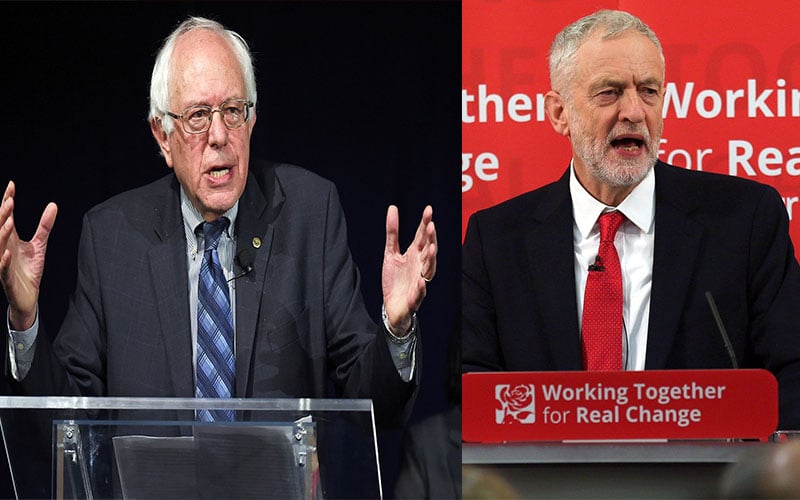
Corbyn And Sanders Most Popular Politicians In Britain And US

Published

on

Bernie Sanders and Jermy Carbyn

[vc_row][vc_column][vc_column_text]By: Saeed Naqvi

The recent rise in the electability of Labour Party leader Jeremy Corbyn as Britain’s next Prime Minister, according to the latest opinion polls, has not made headline news. This is not surprising because Establishments everywhere, of which the media is a part, imagine that an idea can be made to vanish by playing it down.

The findings of the poll have been published even in conservative newspapers like The Telegraph in London. This virtually amounts to a taboo being lifted from the idea of Corbyn. Call it acquiescence, if you like.

Senior Labour leaders, indeed authors of New Labour, like Tony Blair and Lord Peter Mandelson must be close to a nervous breakdown. Or, they must be working very hard, as Mandelson has admitted in interviews, to “undermine Corbyn”.

The difficulty with mean-minded cribbing by Mandelson is that it generates sympathy among Corbyn’s growing tribe of supporters. Take this quote from a Labour member: “The idea that Jeremy Corbyn as Prime Minister implementing policies that actually benefit the people terrifies the Establishment. It is no surprise that Mandelson has found space in his busy schedule for spending time on Oligarch’s Yachts to attempt to undermine Jeremy.”

 This being the tone of the exchange, Corbyn’s path to eventual success will be made ever more difficult by the Establishment of which Mandelson and the Deep State are parts.

There is, however, a tailwind of recent history particular to Britain, which may be helping Corbyn.

 Accelerated globalization after the Soviet collapse, was a shot in the arm for capitalism. This, in its turn, generated arbitrary inequalities which erupted in such movements as “Occupy Wall Street”. The Republican Tea Party was the immediate counter punch.

The popular will adapts to changing climate. Establishments, obstinately resistant to change, begin to strategize: how to channelize or thwart the popular will.

 In almost all western democracies the conflict is on: Establishments vs. the people. A Left wing Syriza brought 43 year old Alexis Tsipras to power as Prime Minister of Greece. Germany and the EU broke the movement’s will. Revert to austerity or we shall not pick up your debts.

In Spain, where the ghost of Franco still hovers over public life, Prime Minister Mariano Rajoy of the Right Wing Peoples Party, supervised over such unspeakable corruption (another gift of globalization), that a new communist-inclined party Podemos, under the leadership of 39 year old Pablo Iglesias, burst upon the scene. The resulting stalemate between the Peoples Party, Socialist and Podemos led to a repeat election which yielded more or less the same configuration. The Establishment worked overtime. On the pain of being decimated, Socialists allowed themselves to be persuaded to abstain in a Parliamentary vote. This enabled the corrupt PP hold onto power. The idea is to weaken and eventually erase Podemos by sheer attrition and election fatigue.

In the process of warding off unfriendly political trends, the establishment learnt another lesson. The sprinkling of leaders breaking out of the two party suffocation were all anti austerity, leftists and in their 30s and 40s. Why could not the “right” respond with similar décor and aspirations?

 That exactly is what has been attempted in Spain by launching Ciudadanos, (Citizens) a centrist party with an unusual rise on an anti corruption platform. I met people in Madrid and Barcelona who described the new party as “Podemos of the right”. In terms of youth, Ciudadanos is an improvement. Its leader, Albert Rivera, 35, is four years younger than Pablo Iglesias.

 “They are stealing Podemos’ aesthetics” laments Madrid’s Communist Mayor who hung a giant placard outside her office: “Refugees Welcome”. She tweets “We are not going to criminalize the Muslim community” Carmena said. “The response to terror must be solidarity.” Her punchline was “co existence = safer cities”.

The aesthetics which define young leaders in Greece, Spain, Canada appear to have been grafted on France’s Emmanuel Macron too. He is their age and talks of influencing the EU to reduce the burden of austerity. The scale of his success has encouraged him to be openly ambidextrous.  He has invited Donald Trump to the National Day parade on July 14. This despite Trump having withdrawn from the Paris accord on climate change.

 In brief, different kinds of gyrations define western democracies today. In this over all confused picture another reality remains largely unnoticed.

A Fox News poll published some months ago (mostly ignored) shows that Bernie Sanders has a +28 rating above all US politicians on both ends of the political spectrum.

The Guardian’s Trevor Timm wrote recently: “One would think with numbers like that, Democratic politicians would be falling all over themselves to be associated with Sanders, especially considering the party as a whole is more unpopular than the Republicans and even Donald Trump right now. Yet instead of embracing his message, the Establishment wing of the party continues to resist him at almost every turn, and they seem insistent that they don’t have to change their ways to gain back the support of huge swaths of the country.”

 The moral of the story is this: a rattled Establishment is in many democracies rushing to thwart or redirect the popular will – and with mixed success.

Against this backdrop, there appears on the horizon a certain British exceptionalism. Jeremy Corbyn’s election as Labour leader despite Tony Blair, Mandelson, and the Parliamentary party, results of the Brexit referendum, the manner in which Theresa May was trounced in June 8 elections – all point to the Establishment in Britain unlike elsewhere, clearly contained by the people.[/vc_column_text][/vc_column][/vc_row]

Latest world news

Suicide bombing at Islamabad imambargah kills 69, over 160 injured

At least 69 people were killed after a suicide bomber detonated explosives at a Shia shrine in Islamabad’s Shehzad Town area, triggering a city-wide emergency.

Published

on

Suicide bombing at Islamabad Shrine

A suicide bombing at a Shia place of worship in Pakistan’s capital Islamabad left at least 69 people dead and more than 160 injured on Friday, according to media reports.

The explosion took place at Tarlai Imambargah, located in the Shehzad Town area, when a suicide bomber detonated explosives near the main gate of the shrine during afternoon hours.

Attacker stopped at entrance, officials say

Security officials were quoted as saying that the attacker was intercepted by guards at the entrance, preventing him from entering the main hall where worshippers had gathered. Despite this, the blast caused extensive damage to the gate and nearby structures.

Visuals from the scene showed shattered windows of surrounding buildings and debris scattered across the road following the explosion.

Emergency declared, injured shifted to hospitals

Following the blast, the Islamabad Inspector General of Police declared a city-wide emergency, as rescue and law enforcement teams rushed to the site amid fears of high casualties.

The injured were shifted to Pakistan Institute of Medical Sciences (PIMS) and Polyclinic Hospital for treatment.

Prime minister condemns attack

Pakistan Prime Minister Shehbaz Sharif expressed deep grief over the attack and strongly condemned the bombing at the Shiite mosque in Islamabad.

In a statement, he said the incident was a tragic act of violence and offered condolences to the families of those killed. Official statements noted that dozens were injured in the attack, with treatment ongoing at city hospitals.

Previous attack referenced

The incident comes less than three months after a suicide blast outside a district and sessions court building in Islamabad on November 11, 2025, in which 12 people were killed and over 30 injured.

Continue Reading

Latest world news

Suicide bombing at Islamabad shrine kills 10, over 20 injured

A suicide bombing at a Shia shrine in Islamabad’s Shehzad Town area killed at least 10 people and injured over 20, prompting a city-wide emergency.

Published

on

Suicide bombing at Islamabad Shrine

At least 10 people were killed and around 20 others sustained injuries after a suicide bomber detonated explosives at a Shia shrine in Pakistan’s capital, Islamabad, on Friday afternoon.

The explosion took place at Tarlai Imambargah, located in the Shehzad Town area, when the attacker set off the device at the main entrance of the place of worship, where devotees had gathered.

Bomber stopped at entrance, say officials

Security officials said alert guards intercepted the attacker at the gate, preventing him from entering the main hall of the shrine. The timely action is believed to have reduced the scale of casualties inside the premises.

However, the blast caused significant damage to the gate structure. Visuals from the site showed shattered windows of nearby buildings and debris scattered across the road following the explosion.

Emergency declared across Islamabad

In the aftermath of the attack, the Islamabad Inspector General of Police declared a city-wide emergency. Rescue teams and law enforcement personnel rushed to the site amid concerns that the casualty count could rise.

The injured were shifted to Pakistan Institute of Medical Sciences (PIMS) and Polyclinic Hospital for treatment.

Recent history of suicide attacks in the capital

The incident comes less than three months after a suicide bombing outside a district and sessions court building in Islamabad on November 11, 2025, which killed 12 people and injured more than 30 others, raising renewed concerns over security in the capital.

Continue Reading

Latest world news

Bangladesh rushes to finalise US trade deal after India secures lower tariffs

Bangladesh is accelerating talks with the US to finalise a trade agreement after India secured lower tariffs, raising concerns over export competitiveness and transparency.

Published

on

Bangladesh is moving quickly to finalise a trade agreement with the United States after India concluded a deal with Washington that lowered tariffs on Indian goods to 18 per cent. The development has triggered concern in Dhaka that Bangladesh could lose market share in the US if it fails to secure comparable or better terms.

The US and Bangladesh are expected to sign the agreement on February 9, just three days before the country’s national election scheduled for February 12. The timing and lack of transparency surrounding the deal have drawn criticism from economists, business leaders and political observers.

Bangladesh’s economy is heavily dependent on ready-made garment exports, which account for nearly 90 per cent of its exports to the US. Any tariff disadvantage compared to India could significantly impact export orders and employment in the sector.

Tariff cuts under negotiation

The proposed agreement follows a series of tariff revisions imposed by Washington. In April 2025, the US imposed a steep 37 per cent tariff on Bangladeshi goods. This was reduced to 35 per cent in July and further lowered to 20 per cent in August.

According to reports, the upcoming deal is expected to bring tariffs down further to around 15 per cent. Officials see this as critical to keeping Bangladeshi exports competitive against Indian products in the US market.

Secrecy around negotiations raises concerns

Concerns have intensified due to the confidential nature of the negotiations. In mid-2025, the interim government led by Muhammad Yunus signed a formal non-disclosure agreement with the US, committing to keep tariff and trade discussions confidential.

No draft of the agreement has been shared with the public, parliament or industry stakeholders. A commerce adviser had earlier stated that the deal would not go against national interests and could be made public with US consent.

Policy experts, however, argue that the lack of disclosure prevents meaningful debate on the agreement’s long-term implications.

Conditions reportedly linked to the deal

Media reports suggest that the agreement may include several conditions. These include reducing imports from China, increasing military procurement from the US, and allowing American goods easier access to the Bangladeshi market.

It is also reported that Bangladesh may be required to accept US standards and certifications without additional scrutiny. Inspections on US vehicle imports and parts could reportedly be eased to facilitate smoother entry into the local market.

A senior policy analyst described the process as opaque, noting that signing the agreement just days before elections could bind the hands of the next elected government.

Garment industry left in the dark

Bangladesh exports garments and textiles worth between $7 billion and $8.4 billion annually to the US, accounting for nearly 96 per cent of its total exports to the American market. In comparison, Bangladesh imports around $2 billion worth of goods from the US.

With India and Bangladesh exporting similar apparel products, lower tariffs for India could shift US buyers towards Indian suppliers. Industry leaders warn that this could put millions of jobs at risk in Bangladesh’s garment sector, which employs 4 to 5 million workers, most of them women.

The sector contributes over 80 per cent of Bangladesh’s export earnings and nearly 20 per cent of its GDP.

A senior garment exporters’ association official said the agreement carries major implications and should ideally have been signed after the election to allow broader political and public discussion.

Political timing draws criticism

Economists and analysts have also questioned why an unelected interim administration is finalising a major trade agreement so close to national elections. They argue that responsibility for implementing the deal will fall on the incoming elected government.

A prominent economist criticised the process as lacking transparency and warned that the country could be pushed into long-term commitments without adequate scrutiny or public consent.

Meanwhile, US diplomats have indicated openness to engaging with various political forces in Bangladesh, including Jamaat-e-Islami, which has been banned multiple times in the country’s history.

Continue Reading

Trending

© Copyright 2022 APNLIVE.com